By Adrian Villellas
Earth.com Staff Writer
RESEARHERS HAVE reported that the human brain may respond to faint electromagnetic rhythms that naturally pulse through the planet’s atmosphere.
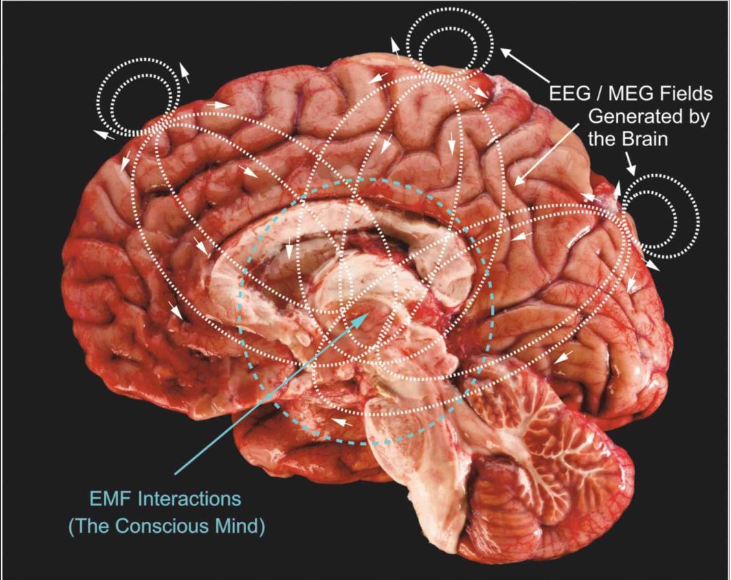
The finding reframes consciousness as a process that may interact with signals extending far beyond the boundaries of the skull.
Where the signal starts
Inside each neuron sits the membrane, a thin boundary where electrical signals meet the material that carries them.
At Politecnico di Torino (PoliTO) anesthesiologist Marco Cavaglià argued that this boundary helps shape stable brain activity.
By treating it as active material, he argued that changes in stiffness, charge, and timing could alter the same input.
If that view holds, mental steadiness may depend partly on materials neuroscience has often pushed to the sidelines.
Earth’s faint rhythm
Lightning keeps exciting Schumann resonances, weak electromagnetic pulses circling between Earth’s surface and the charged upper atmosphere. Their fundamental beat sits near 7.83 Hz, giving the team a concrete external rhythm to test.
That numerical match does not prove a brain response, but it turns a vague idea into a measurable target.
Rather than claim a sweeping link, the model asks whether a real planetary signal nudges a system already built to oscillate.
Water near cells
Water enters the newer framework because it treats vicinal water, an ordered layer beside membranes, as part of the signal itself.
In that view, the layer could help weak electromagnetic energy stay organized long enough to matter inside tissue.
Cerebrospinal fluid joins the same picture, giving signals a possible route beyond one membrane or one cell.
This remains a proposal, not a settled mechanism, but it tries to explain how faint fields might avoid vanishing into noise.
Why membranes matter
Membranes drew the team’s attention because lipids can change thickness, flexibility, and electrical behavior as conditions inside neurons change.
Cavaglià later explained that membranes function less like passive containers and more like the material that shapes how a signal sounds when it passes through an instrument.
That emphasis pulls attention away from neurons alone and toward their wrapping, where chemistry and electricity interact.
Patterns that persist
A paper describes the later energy-mass-information model, a framework linking energy, matter, and information, treating thought as a moving balance among them.
Within that framework, attractors, stable states a system tends to revisit, keep perception and identity from scattering.
Memory, mood, and the sense of self would then reflect patterns that hold together rather than isolated bursts.
This is still a conceptual map, yet it gives the hypothesis a way to describe stability without treating consciousness as magic.
People in step
Shared music, chanting, or coordinated movement can pull breathing, attention, and body timing into the same rough pattern.
Using hyperscanning, simultaneous recording from more than one brain, researchers have repeatedly observed activity lining up across people during social tasks.
That does not mean minds merge, but it shows group experiences can leave measurable alignment in neural activity.
For Cavaglià’s framework, those moments offer a testable setting to ask whether environmental rhythms help separate brains settle into one temporary pattern.
Where doubt bites
Plenty could still go wrong before the idea reaches solid ground in science at all. A matching frequency alone proves almost nothing, because living systems generate their own rhythms and face nonstop electrical noise.
Weak external fields also have to beat heat, anatomy, and ordinary biological clutter before they can change anything meaningful.
That is why the authors kept returning to experiments that could show coupling directly or rule it out cleanly.
Tests that decide
Rather than float as philosophy alone, the papers spelled out concrete ways to test the idea.
They proposed experiments tracking whether membrane composition changes signal stability, anesthesia response, or orderly activity, study outlines.
That matters because any theory about consciousness becomes science only when it risks failure in the lab.
Clear negative results would help here too, because they would narrow an argument that currently stretches across several scales.
Why this matters
If the model earns support, its first impact may land in medicine before it settles philosophy. Earlier work tied how orderly membranes behave to anesthesia, psychiatric states, and neurodegenerative disease, connecting the idea to unstable brain activity.
A better grip on how membranes, fluids, and fields shape stability could change how doctors think about loss of consciousness.
Even a partial win would matter, because it would connect clinical problems to deeper questions about how the brain holds together.
The wider gamble
These papers do not prove the brain listens to Earth, but they join cell biology, brain dynamics, and planetary physics in one story.
Next comes the harder step: experiments asking whether this hidden pulse steadies the mind, or whether the resemblance ends at one number.
The study is published in Frontiers in Neuroscience.