By Jemimah Wellington, JKNewsMedia Correspondent
AN AGREEMENT has been signed to facilitate the deportation of asylum seekers, criminals and visa overstayers, with the presidency confirming it applies strictly to Nigerian nationals between Nigeria and the United Kingdom (UK).
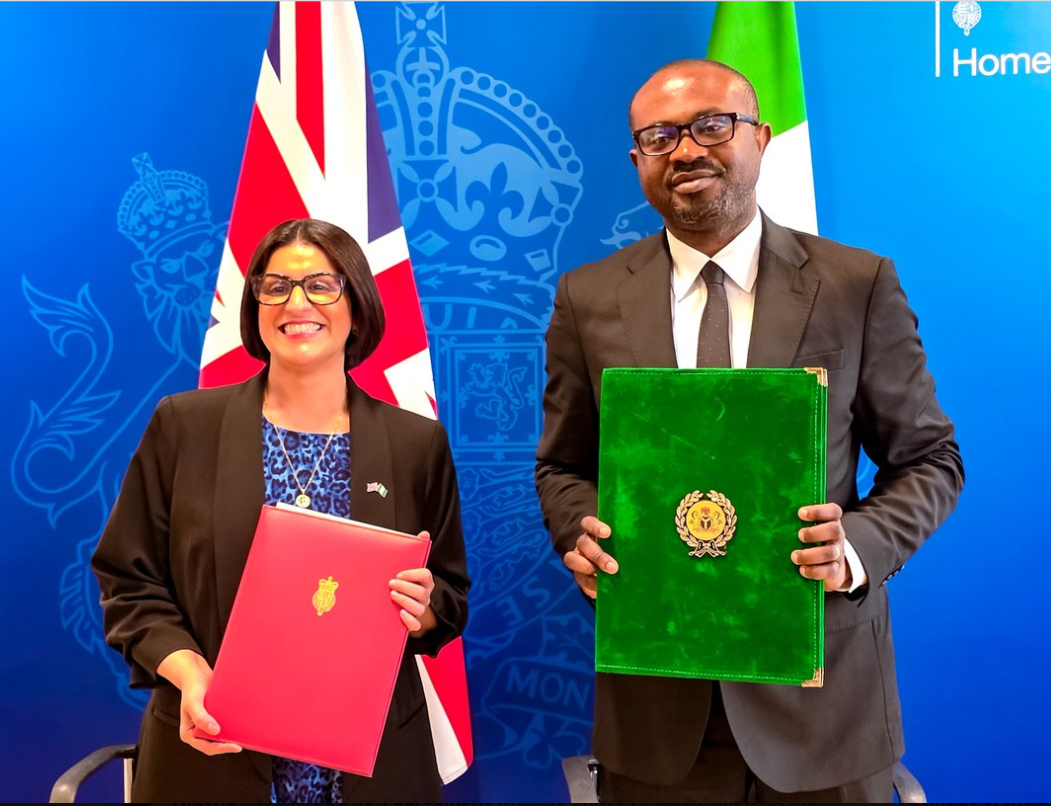
JKNewsMedia.com reports that the agreement was signed during President Bola Tinubu’s state visit to the UK on March 18 and 19 by Olubunmi Tunji Ojo, Minister of Interior, and Shabana Mahmood, Home Secretary.
However, the Home Office initially did not clarify whether deportees would include other nationalities, but the presidency later stated that foreign nationals are excluded.
Bayo Onanuga, presidential spokesman, said in a statement issued on Saturday that the immigration cooperation memorandum would strengthen partnership between both countries.
He stated that the deportees would only be Nigerians who do not or no longer have the right to enter or remain in the UK.
“Nowhere in the 12-page memorandum is Nigeria required to accept foreign nationals other than Nigerians,” Onanuga said.
“A clear condition in the MoU is that the returnees concerned are bona fide nationals of the country and are treated with dignity and respect, with due regard to their human rights and fundamental freedoms,” he added.
Onanuga said individuals slated for repatriation must undergo multiple levels of identification and verification. He added that where errors occur, affected persons would be returned to the requesting country at its cost.
Law enforcement officers in both countries are expected to take necessary action to protect the interests and well-being of citizens and mitigate migration related conflict triggers.
The agreement covers failed asylum seekers, criminals and visa overstayers. It also provides that returnees must travel with their legally acquired personal belongings.
“Every returnee will be given ample opportunity to make adequate arrangements for the transfer or disposal of his property in the territory of the requesting party, under the supervision of the mission of the requested party,” article 12 of the deal states.
Identification checks will be conducted by Nigerian officers in the United Kingdom before deportation and upon arrival in Nigeria. The United Kingdom will coordinate all returns with Nigerian authorities.
Returns may be carried out using scheduled flights or aircraft chartered specifically for deportation. The requesting party is required to provide flight details and particulars of each returnee five working days before the return date.
The agreement allows deportation using a valid passport or through biometric matching to a visa application made in Nigeria. Where biometric matching is possible, an expedited process using a UK letter will be permitted.
Where biometric matching is not possible but there is strong evidence of nationality, including a copy of a passport, passport number or national identity card, the expedited process using a UK letter will also apply.
The arrangement marks the first time Nigeria will accept UK issued letters as an alternative identification document for individuals without valid passports abroad. Nigeria previously relied on emergency travel documents for undocumented travellers.
If Nigerian authorities are not satisfied with a returnee’s identity within five working days of submission of the UK letter, they must provide detailed reasons and evidence of non citizenship to the United Kingdom. In such cases, removal will be deferred at the requesting party’s cost.
Requests for return must be made within 10 working days following deportation and executed within 14 working days after acceptance.
The memorandum states that the UK letter is not the sole identification document, as the Nigeria Immigration Service retains responsibility to issue and manage Nigerian documentation in line with domestic legislation.
“This shall be distinct from the UK Letter process and remains the sole right and responsibility of Nigerian authorities, including the handling of the travel document and any onward transmission required from the issuing office to enable entry,” article 9 subsection 3 states.
The agreement allows individuals to appeal deportation decisions. Claims made under domestic or international human rights legislation will be considered in line with each country’s laws.
Grounds for appeal include long term lawful residence in the United Kingdom and social or cultural integration, as well as significant obstacles to reintegration in Nigeria.
The memorandum provides for reintegration assistance for returnees upon arrival in Nigeria, including airport reception, accommodation, transportation, care packs and small cash support.
“Short term assistance may include airport reception, accommodation, onward transportation, care and provision packs and small cash assistance,” the agreement states.
“Medium term assistance can include support to find and reunite with family; support in obtaining the in country documentation required, signposting to local services, and the potential provision of mental well being and counselling services if required.
“Longer term assistance may allow access to a Returnee Education and Entrepreneurship Fund to enable sustainable reintegration. Support may include accessing the local job market, setting up a business, accessing vocational training or further education, and assistance with legal migration opportunities.”
JKNewsMedia.com also reports that both countries are required to inform each other of any changes in domestic legislation affecting reintegration support or any modification to the assistance package.
The statement said the agreement will run for an initial period of five years and may be renewed for a further five years as agreed by both countries.
Nigeria, UK Migration Deal Excludes Foreign Nationals, Presidency Clarifies
Meanwhile, clarification has been issued on the migration partnership between Nigeria and the United Kingdom (UK), with the presidency stating that the agreement does not require Nigeria to accept foreign nationals.
JKNewsMedia.com reports that another statement issued on the subject said the Memorandum of Understanding (MoU) on immigration cooperation was signed on the sidelines of President Bola Tinubu’s state visit to the UK and aimed to strengthen partnership between both countries.
Nigeria’s Minister of Interior and the Secretary of State for the Home Department of the Government of the UK and Northern Ireland signed the agreement.
The memorandum establishes a framework to facilitate a regulated and safe migration flow between the two countries and to encourage further bilateral cooperation in tackling irregular migration and associated acts by citizens of both countries, in line with their immigration and citizenship laws as well as international treaties, conventions, protocols, agreements and charters.
The presidency stated that the 12-page memorandum does not require Nigeria to accept foreign nationals other than Nigerians, adding that nationals to be repatriated must undergo multiple levels of identification and verification.
It added that where errors occur, affected individuals will be returned to the requesting country at its cost.
Under the agreement, both countries will work together to secure the dignified return of their nationals who do not or no longer have the right to enter or remain in the other country.
“A clear condition in the MoU is that the returnees concerned are bona fide nationals of the country and are treated with dignity and respect, with due regard to their human rights and fundamental freedoms,” the statement said.
Law enforcement officers in both countries are expected to take necessary action to protect the interests and well being of citizens and mitigate migration related conflict triggers.
The memorandum provides that returnees must travel with their legally acquired personal belongings.
“Every returnee will be given ample opportunity to make adequate arrangements for the transfer or disposal of his property in the territory of the requesting party, under the supervision of the mission of the requested party,” article 12 states.
It also allows individuals facing deportation to make claims under relevant domestic or international human rights legislation, which will be considered in line with the respective domestic laws of each country.
Grounds for appeal include lawful long term residence and social or cultural integration in the requesting country, as well as significant obstacles to reintegration in the destination country.
Article 9 outlines return procedures, including identification checks by officers of the requested party before departure and upon arrival, while the requesting party coordinates the process.
“A return may be conducted by means of a scheduled aircraft or an aircraft chartered specifically for this purpose by the authorities of the parties; the requesting party will provide the flight details and particulars of each returnee five working days before the date of return,” the statement said.
It added that returns may be conducted using a valid passport or through biometric matching to a visa application, with an expedited process using a UK Letter permitted in such cases.
Where biometric matching is not possible but there is strong evidence of nationality, including a passport copy, passport number or national identity card, the expedited process using a UK Letter will also apply.
If Nigerian authorities are not satisfied with a returnee’s identity within five working days of submission of the UK Letter, they are required to provide reasons, after which removal will be deferred.
“If subsequent evidence shows that a returnee who has been returned is not a national of the requested party, the requesting party will take the person back to its territory at the requesting party’s cost and by the most efficient means possible,” the statement said.
The memorandum states that the Nigeria Immigration Service retains sole responsibility for issuing and handling Nigerian documentation in line with domestic legislation.
“This shall be distinct from the UK Letter process and remains the sole right and responsibility of Nigerian authorities, including the handling of the travel document and any onward transmission required from the issuing office to enable entry,” article 9 subsection 3 states.
Article 11 provides that returnees will have access to reintegration support upon arrival.
“Short term assistance may include airport reception, accommodation, onward transportation, care and provision packs and small cash assistance. Medium term assistance can include support to find and reunite with family; support in obtaining the in country documentation required, signposting to local services, and the potential provision of mental well being and counselling services if required.
“Longer term assistance may allow access to a Returnee Education and Entrepreneurship Fund to enable sustainable reintegration. Support may include accessing the local job market, setting up a business, accessing vocational training or further education, and assistance with legal migration opportunities.”
The presidency urged media organisations to seek clarification when uncertain about issues to avoid misinforming the public.