By Joke Kujenya
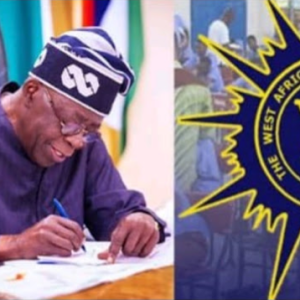
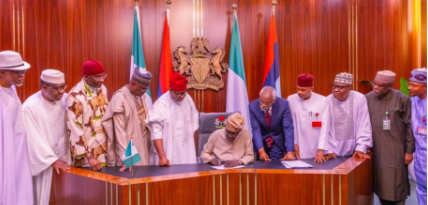
CONTROVERSY OVER result transmission framed the final stretch of deliberations as President Bola Tinubu signed the Electoral Act, 2022 Repeal and Re Enactment Bill 2026 into law.
JKNewsMedia.com reports that the signing followed passage of the bill by the National Assembly (NASS) on Tuesday after months of deliberations.
The legislation generated heated debates in the last week, with lawmakers and prominent Nigerians disagreeing over the method for transmission of results ahead of the 2027 general elections.
The Senate on Tuesday passed the Electoral Act, 2022 Repeal and Re Enactment Bill 2026 after a rowdy session as proceedings resumed with a demand for division over Clause 60 raised by Senator Enyinnaya Abaribe ADC Abia South.
Senate President Godswill Akpabio said he believed the demand had previously been withdrawn, but several opposition senators objected.
Citing Order 52 6, Deputy Senate President Barau Jibrin argued it would be out of order to revisit any provision on which the Senate President had already ruled.
The submission sparked another uproar, during which Senator Sunday Karimi had a brief face off with Abaribe.
Senate Leader Opeyemi Bamidele reminded lawmakers he sponsored the motion for rescission, underscoring that decisions previously taken by the Senate were no longer valid. He maintained that, consistent with his motion, Abaribe’s demand was in line.
Akpabio suggested the call for division was merely an attempt by Abaribe to publicly demonstrate his stance to Nigerians. He sustained the point of order, after which Abaribe rose in protest and was urged to formally move his motion.
Rising under Order 72 1, Abaribe called for a division on Clause 60 3 concerning the provision that if electronic transmission of results fails, Form EC8A should not serve as the sole basis.
He called for removal of the proviso that allows manual transmission of results in the event of network failure.
During the division, Akpabio directed senators who supported the caveat to stand and then asked those opposed to rise. Fifteen opposition senators stood in opposition.
When votes were counted, Akpabio announced that 15 senators were not in support of the proviso, while 55 voted in support.
Proceedings were earlier stalled as lawmakers began clause by clause consideration of the bill following a motion to rescind the earlier amendment.
The motion was formally seconded on Tuesday, paving the way for the Senate to dissolve into the committee of the whole for detailed reconsideration and reenactment.
As deliberations reached Clause 60, Abaribe raised a point of order, drawing immediate attention. Lawmakers spoke in small groups and approached the Senate President’s desk for consultations before the session moved into a closed-door meeting.
At the House of Representatives, lawmakers disagreed over a motion seeking to rescind passage of the Electoral Act Amendment Bill which contained real time electronic transmission of results.
Chairman of the House Committee on Rules and Business Francis Waive moved the motion for the House to rescind its decision on the bill passed on December 23 in line with the Senate’s position.
When Speaker Tajudeen Abbas put the motion to a voice vote, the nays were louder than the ayes, but he still ruled that the ayes had it.
Speaking after signing the bill, Tinubu commended the NASS for the “solid brainstorming discussions” aimed at strengthening national development and safeguarding democratic stability.
“The essence of democracy is to have very solid brainstorming discussions committed to national development and nation building, the stability of the nation,” the President said.
He also said that beyond the historical significance of the legislation, the priority is ensuring that the electoral process is managed in a way that prevents confusion or disenfranchisement.
“What is crucial is the fact that you manage the process to the extent there will be no confusion, no disenfranchisement of Nigerians; and we are all going to see democracy flourish,” he said.
Tinubu said confidence in the system must be rebuilt, adding that no electoral framework can function without human integrity.
“No matter how good a system is, it’s managed by the people, promoted by the people, and result is finalised by the people,” he said.
“For final results, you are not going to be talking to the computer. You are going to be talking to human beings who announce the results.”
Addressing debates around real time electronic transmission, he urged assessment of Nigeria’s broadband capability.
“When you look at the crux of various agreements, maybe Nigeria should question our broadband capability. How technically are we today? How technically will we be tomorrow?” he asked.
He said voting remains manual, with voters appearing at polling units, receiving ballot papers, thumbprinting preferred candidates and casting votes without interference.
Ballots are sorted and counted manually, with arithmetic results entered into official forms.
“Essentially, the transmission of that manual result is what we’re looking at, and we need to avoid glitches,” he said.
Tinubu expressed optimism about the country’s democratic future.
“Nigeria will be there. We will flourish. We will continue to nurture this democracy for the fulfilment of our dream for prosperity and stability of our country,” he said.
The Senate reconvened for an emergency plenary on Tuesday and rescinded its earlier passage of the bill to allow amendments affecting the 2027 election timetable. The ruling triggered protests from lawmakers, prompting an executive session.
JKNewsMedia.com reports that when the House passed the Electoral Act in December 2025, it adopted compulsory real time transmission of election results to IReV. Lawmakers in both chambers approved electronic transmission of results, with manual collation retained as a backup.