By Jemimah Wellington, JKNewsMedia Correspondent
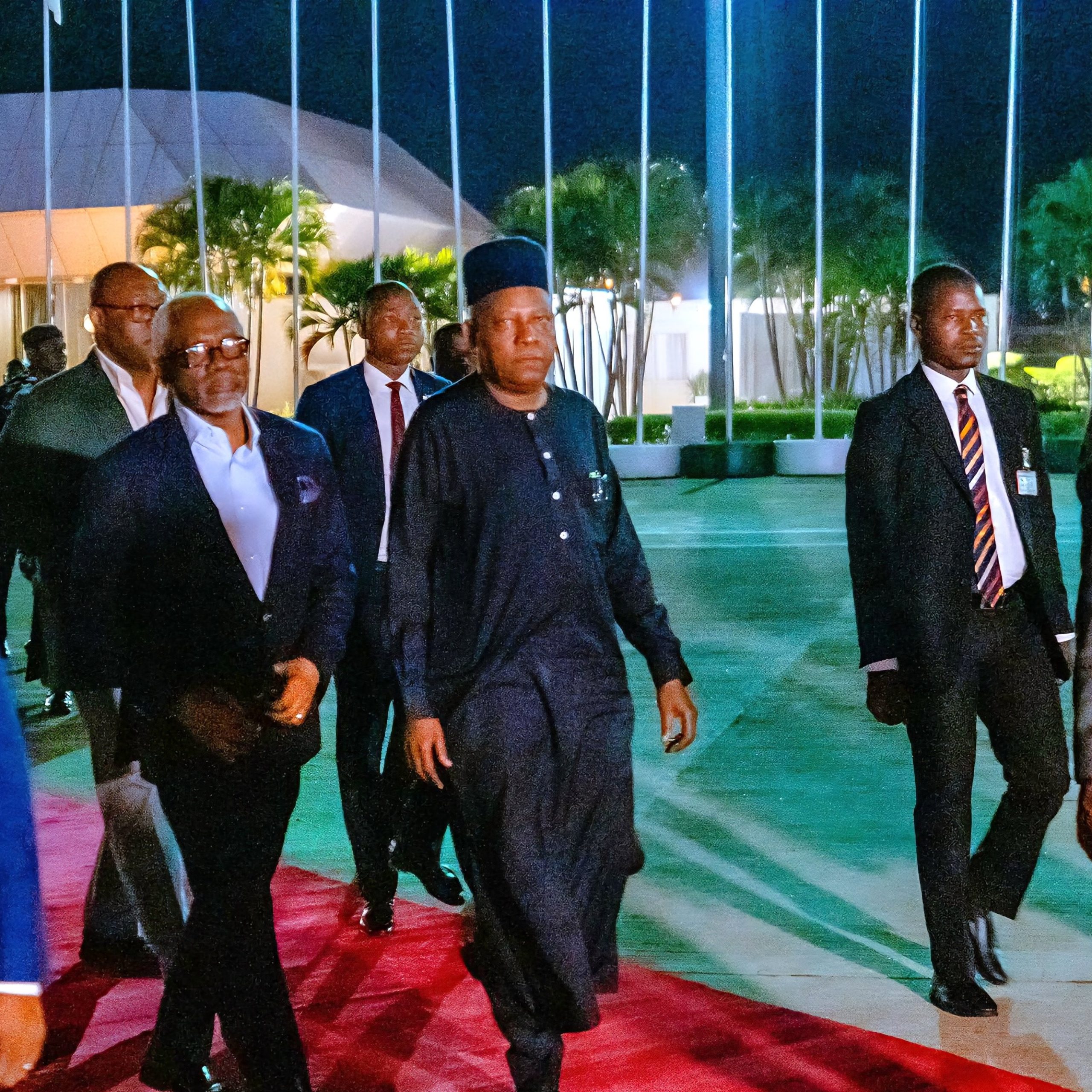
VICE PRESIDENT Kashim Shettima landed in London early Monday to retrieve the remains of former President Muhammadu Buhari, who died on Sunday following a prolonged illness.
President Bola Tinubu had directed Shettima and the Chief of Staff to the President, Femi Gbajabiamila, to lead the Nigerian delegation to the United Kingdom.
The high-level delegation was received on arrival by Minister of Foreign Affairs Yusuf Tuggar and Borno State Governor Babagana Zulum.
Together, they will accompany the late leader’s body back to Nigeria for burial in his hometown of Daura, Katsina State.
Buhari, Nigeria’s 15th president and one of the most influential political figures of the Fourth Republic, passed away in London at approximately 4.30pm on Sunday.
His death brings an end to a chapter spanning nearly five decades of public service, marked by his dual legacy as both military head of state and two-term elected president.
Flags have been ordered to half-staff nationwide as President Tinubu paid tribute, describing Buhari’s passing as a profound national loss. Condolences continue to pour in from across the political spectrum and diplomatic community.
Born in Daura in 1942, Buhari joined the Nigerian Army in 1961 after completing his studies at Katsina Provincial Secondary School. He held key positions, including Federal Commissioner for Petroleum and Natural Resources, Chairman of the Nigerian National Petroleum Corporation (NNPC), and later, Chairman of the Petroleum Trust Fund (PTF). His leadership as military head of state began on December 31, 1983, following a coup, and ended in August 1985.
His military regime launched the War Against Indiscipline, a campaign that enforced civic responsibility and personal ethics. After returning to civilian life, Buhari emerged as a formidable political figure, contesting for the presidency five times. Though unsuccessful in 2003, 2007, and 2011, his breakthrough came in 2015 when he defeated incumbent Goodluck Jonathan under the All Progressives Congress (APC), formed two years earlier from a merger of several opposition parties.
Buhari’s tenure from 2015 to 2023 focused on anti-corruption and national security, but it was also marred by allegations of economic mismanagement, internal displacement crises, and security lapses. Critics often questioned his oversight on appointees, but allies, including his former spokesman Garba Shehu, defended his commitment to governance and integrity.
He was widely known as “Baba Buhari,” a nickname that reflected his cult-like following across northern Nigeria. Despite controversy, his popularity endured. In retirement, Buhari lived quietly but remained a powerful symbol in Nigerian politics.
He was married to Safinatu Yusuf from 1971 until her death in 1988 and later to Aisha Halilu. He is survived by ten children.
The late president will be laid to rest in accordance with Islamic rites in his ancestral home, as his mixed legacy continues to spark debate across the media space.