By Jemimah Wellington, JKNewsMedia Corres
NIGERIA’s BUSINESS community faced a complex mix of progress and pressure in October, as fresh data from the Nigerian Economic Summit Group (NESG) and Stanbic IBTC Bank revealed both improved confidence and persistent hardship across key sectors.
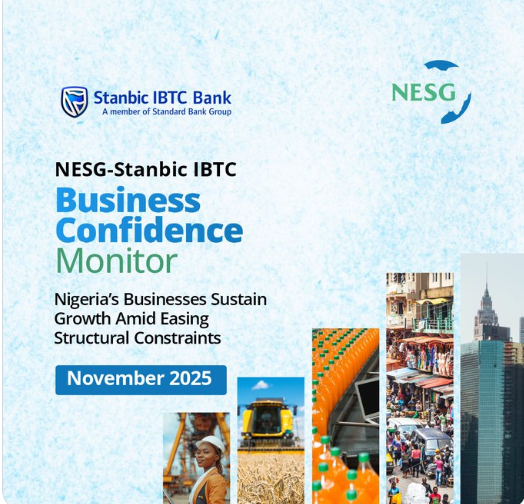
The latest Business Confidence Monitor (BCM) showed that the overall business environment maintained its positive trajectory, with the Current Business Performance Index rising to 111.3 points in October from 107.9 in September, a 3.4-point increase and a significant 34.5-point jump compared to the same period in 2024.
The report stated that the index remained within the expansion zone, reflecting steady activity and cautious optimism among operators despite ongoing structural bottlenecks.
According to NESG, the improved sentiment was largely driven by stronger performances in manufacturing and trade, which both recorded the highest gains of the month.
The manufacturing index rose by 8.8 points to 111.3, while trade increased by 7.8 points to 115.4. Non-manufacturing stood at 115.0, agriculture at 111.4, and services at 111.0. The group explained that this collective expansion underscored sectoral resilience amid challenging conditions.
“The manufacturing and trade sectors recorded the strongest gains, rising by 8.8 and 7.8 points respectively during the month,” the report noted. “All five broad sectors of the economy remained in the expansion zone.”
Sub-indices tracking investment, exports, access to credit, and prices also showed modest improvements over August figures, suggesting gradual progress in capital formation and trade activity.
However, NESG cautioned that deep-rooted structural issues continued to undermine business sustainability.
The report identified key constraints including limited access to finance, high energy and commercial property costs, unclear policy signals, erratic power supply, and rising insecurity across major markets.
These factors, it said, were making it increasingly difficult for firms to access credit, manage production costs, or expand operations.
While inflationary pressures showed early signs of easing, NESG noted that the cost of doing business remained high.
The group reported that many operators were being forced to adjust to persistent input price increases, with some businesses either scaling down or transferring costs to consumers.
“Major constraints to business growth during the month included limited access to finance, high rental costs, policy uncertainty, poor power supply, and insecurity,” the BCM stated.
The Future Business Expectation Index, which measures sentiment for the months ahead, slipped marginally to 132.9 points in October from 134.5 in September.
NESG said the slight decline reflected continued financial strain and ongoing security concerns despite an underlying tone of optimism.
Sectoral expectations varied: trade led with 170.1 points, followed by manufacturing at 146.7, non-manufacturing at 146.4, agriculture at 131.7, and services at 120.1, the weakest among the five, weighed down by weak consumer spending and high operational expenses.
Stanbic IBTC highlighted that policy reforms, a relatively stable exchange rate, and ongoing public investments in infrastructure had helped sustain moderate optimism across the economy. Seasonal spending and improving consumer demand also contributed to October’s gains.
The bank projected that non-oil sector growth would likely remain solid into 2026, supported by potential reductions in interest rates and declining inflation, both expected to stimulate private investment and consumer spending.
Nonetheless, the NESG reiterated that without firm interventions to remove structural bottlenecks in power, infrastructure, and security, Nigeria’s private sector would continue to struggle to convert short-term gains into durable expansion.
The report underscored that for millions of entrepreneurs, these obstacles are daily realities — from unreliable electricity and costly logistics to unsafe transport routes and restricted access to affordable financing.
The BCM concluded that while the economy shows measurable resilience, Nigeria’s true recovery depends on how swiftly government policies can ease operational difficulties for those driving national growth.
NESG stated that sustained reforms in access to credit, energy pricing, and regulatory transparency were essential to stabilising business sentiment and encouraging long-term investments.
Stanbic IBTC noted that the improvement in business confidence during October was encouraging but stressed that monetary and fiscal alignment remained critical to sustaining growth momentum.
The bank called for continuous collaboration between the government, financial institutions, and private enterprises to address funding barriers and improve productivity levels across all sectors.
The report’s data also pointed to gradual rebalancing in regional business activity, with southern commercial centres maintaining stronger optimism compared to northern regions, where insecurity continues to hinder mobility and logistics.
NESG observed that nationwide, the pace of recovery was uneven, underscoring the need for more inclusive policies that address regional disparities in infrastructure, security, and investment opportunities.
According to the BCM, some improvement was recorded in export-related activities due to increased global demand for agricultural commodities and processed goods.
However, the gains remained modest because of logistic bottlenecks and high shipping costs. NESG said sustained attention to export infrastructure, such as ports and storage facilities, would be key to unlocking Nigeria’s trade potential.
The group also urged that current policy measures should prioritise the stability of the exchange rate, targeted incentives for manufacturers, and support for small and medium-sized enterprises (SMEs).
It emphasised that SMEs remain the backbone of Nigeria’s economy and are among the most affected by limited financing and poor infrastructure.
Despite these constraints, NESG and Stanbic IBTC maintained that private sector confidence remained broadly positive, supported by ongoing public infrastructure projects, improved revenue collection reforms, and gradual improvements in consumer sentiment.
The organisations reiterated that stronger coordination among fiscal, monetary, and structural policy authorities would be vital to sustain business optimism through 2025 and beyond.
They called for a pragmatic approach to policy implementation, one that combines short-term relief with long-term measures capable of creating a more predictable and competitive business environment.
NESG concluded that Nigeria’s recovery trajectory depends not only on policy stability but also on how effectively reforms can translate into measurable ease of doing business.
It restated that as the economy shows signs of stabilisation, attention must turn to the lived experiences of business owners facing high costs, limited credit, and insecurity — the real barriers preventing growth from being inclusive and sustainable.