By Jemimah Wellington, JKNewsMedia Reporter
DEEPER INDUSTRIAL ties between Nigeria and China are poised to reshape the nation’s solid minerals sector, with electric vehicle manufacturing taking centre stage as a driver of economic diversification.
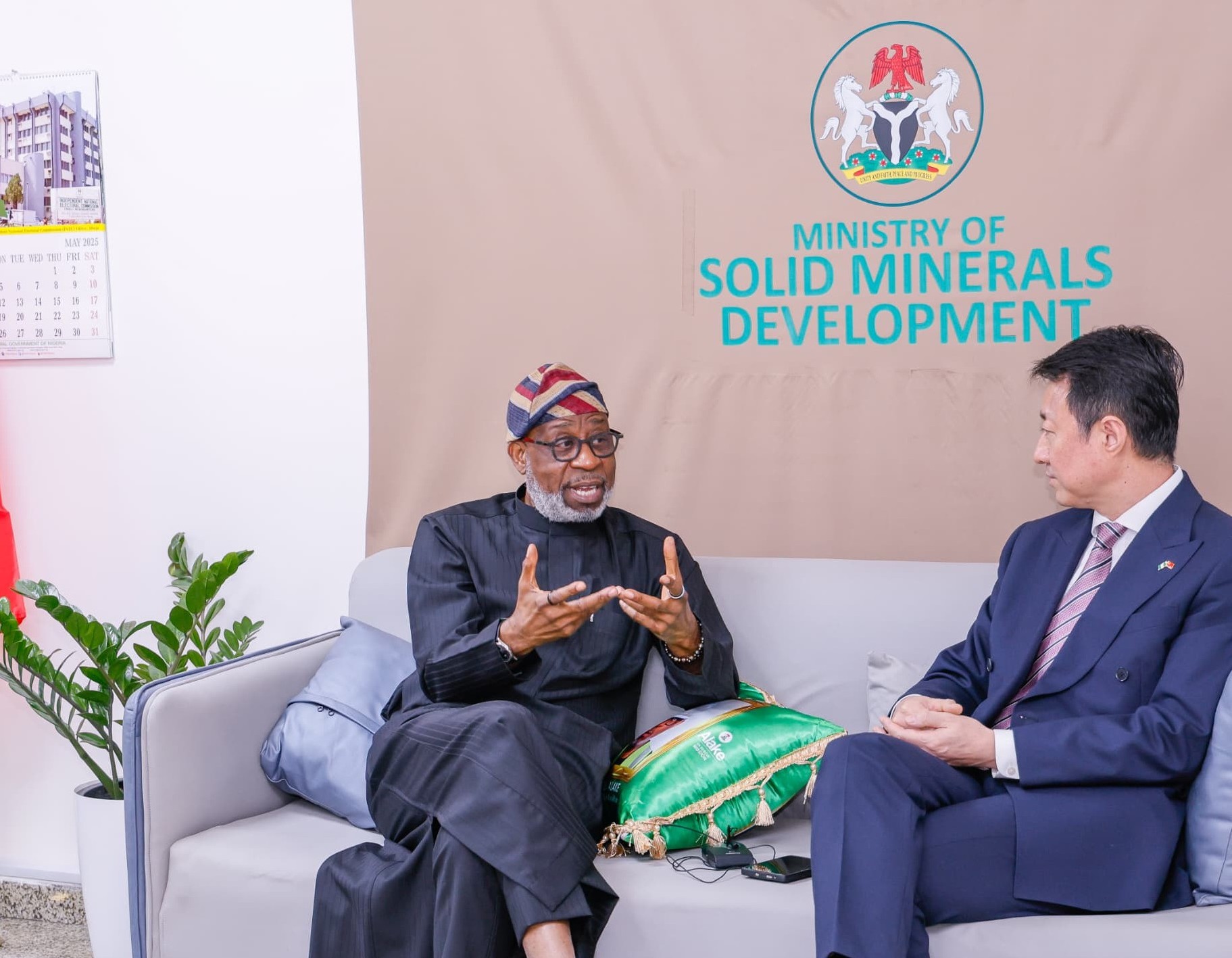
During a courtesy visit to the Minister of Solid Minerals Development, Dr Dele Alake, the Chinese Ambassador to Nigeria,
H.E. Yu Dunhai, emphasised the strategic importance of unlocking Nigeria’s vast mineral wealth through full-cycle industrial investment.
He noted that China regards Nigeria as pivotal in its foreign policy, a position reinforced by the recent high-level engagement between Presidents Bola Tinubu and Xi Jinping.
“Chinese companies are already deeply involved in Nigeria’s mining sector, from exploration to processing. We aim to deepen this collaboration, especially in line with President Tinubu’s eight priority areas, notably economic diversification through solid minerals,” said the Ambassador.
He reaffirmed his government’s commitment to legal and ethical mining operations, noting that Chinese authorities have zero tolerance for illegality.
The embassy, he said, continues to instruct Chinese firms to observe local laws, environmental standards, and corporate social responsibility obligations.
Responding to concerns raised by the Minister regarding illegal activities by a minority of Chinese nationals,
Ambassador Dunhai assured of China’s cooperation in bringing offenders to justice.
Dr Alake cited a recent viral video allegedly showing a Chinese national bribing Nigerian security personnel, stating that such acts damage bilateral relations and the reputation of law-abiding companies.
“We’ve taken action against illegal operators, including some Chinese nationals. While isolated, such incidents undermine the good work of many compliant Chinese firms. We need your cooperation in ensuring that such culprits are brought to justice,” the Minister stated.
Dr Alake praised the impact of Nigeria’s Mining Marshals, a special task force established to combat illegal mining, which he said has sent a strong deterrent message and improved compliance across the sector.
He urged for deeper Chinese investment focused on value addition rather than raw export.
“For years, our minerals have been exported raw to fuel foreign industrialisation. That must change. We now prioritise local processing to drive Nigeria’s development. For instance, with the abundance of lithium, we want to see local manufacturing of electric vehicles and batteries,” he said.
The Minister called on the Ambassador to encourage Chinese firms to establish end-to-end industrial operations in Nigeria, capitalising on the country’s large domestic market and its strategic push to reduce reliance on fossil fuels through clean energy alternatives.
Ambassador Dunhai welcomed the call, aligning Nigeria’s policy with one of President Xi Jinping’s stated goals—supporting African industrialisation.
He revealed that discussions are underway to establish electric vehicle factories and other manufacturing ventures on Nigerian soil, signalling a new phase in Sino-Nigerian industrial relations.