

By Joke Kujenya
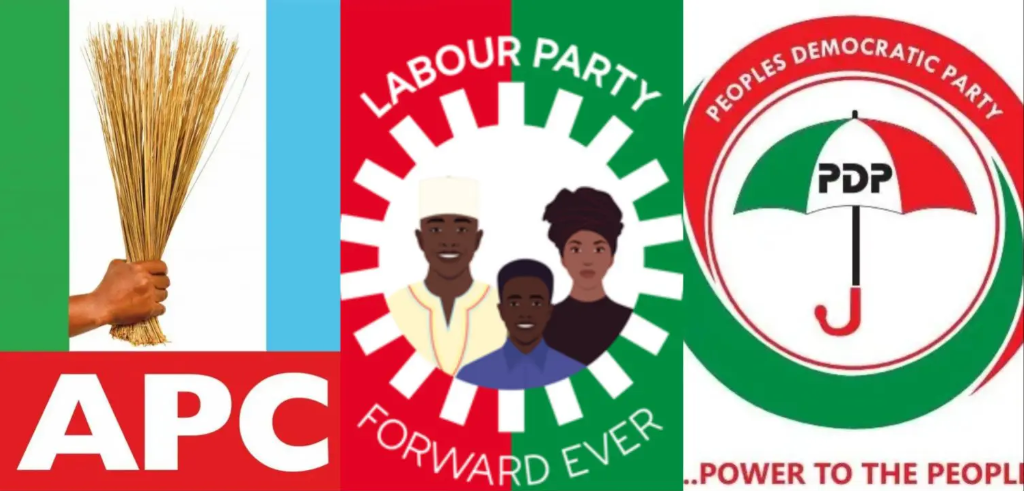
NIGERIA’s POLITICAL environment is already showing familiar signs of early positioning ahead of the 2027 general elections, with major actors across the All Progressives Congress (APC), Peoples Democratic Party (PDP), Labour Party (LP), and the New Nigeria Peoples Party (NNPP) adjusting alliances, messaging, and influence structures.
While no official campaigns have begun, the undertones of strategic alignment are becoming increasingly difficult to ignore.
From Abuja’s corridors of power to state-level political strongholds in the South-East, South-South, and the North-West, the conversation is shifting from governance alone to succession mathematics, party cohesion, and emerging coalition possibilities.
Tinubu’s Reform Agenda and the Burden of Incumbency
President Bola Tinubu, elected in 2023 on the APC platform, remains the central figure shaping Nigeria’s current political direction.
His administration’s early policy decisions, most notably the removal of fuel subsidy and the unification of foreign exchange windows, have continued to define both economic debate and political alignment.
While the presidency has consistently defended these reforms as necessary for long-term fiscal stability, opposition figures including former Vice President Atiku Abubakar of the PDP and Labour Party’s Peter Obi, have repeatedly criticised the immediate economic impact on inflation, transport costs, and household welfare.
The political consequence is clear – Tinubu’s government is not only managing policy implementation but also managing public perception in a high-pressure economic environment that will likely shape voter sentiment into the next electoral cycle.
Within the APC itself, consolidation remains a priority.
Party insiders have continued to emphasise unity following the contested 2023 election outcome, where opposition candidates challenged the result at the Presidential Election Petition Tribunal.
Although the courts upheld Tinubu’s victory, the political divisions from that contest have not fully dissipated.
Atiku Abubakar and PDP’s Search for Repositioning
Former Vice President Atiku Abubakar remains one of the most influential opposition figures in Nigeria’s political landscape.
He has maintained his position within the PDP structure and continues to advocate for what he describes as economic restructuring and institutional reform.
However, the PDP itself continues to wrestle with internal fractures that became more visible during and after the 2023 elections.
The public alignment of some key party figures with the APC-led federal government, most notably Nyesom Wike, current Minister of the Federal Capital Territory (FCT), has altered internal power dynamics significantly.
Wike’s appointment into the Tinubu administration has allegedly remained one of the most politically consequential developments since 2023.
It has placed him at the centre of a cross-party influence structure that continues to fuel debate within PDP ranks, particularly regarding discipline, loyalty, and the party’s long-term cohesion.
Peter Obi and the Enduring Momentum of the Labour Movement
Labour Party (LP)’s Peter Obi remains a defining figure in Nigeria’s post-2023 political reconfiguration.
His 2023 presidential campaign significantly reshaped youth political engagement and introduced a stronger digital mobilisation culture into Nigerian elections.
Although the LP did not secure the presidency, Obi’s political influence has remained strong, particularly among younger voters and urban populations.
His messaging has consistently focused on governance efficiency, productivity, and institutional accountability.
The challenge for the LP moving forward lies in sustaining its 2023 momentum within a structured political system dominated by established party machinery.
Analysts continue to observe whether the movement can evolve from a protest-driven platform into a stable national political structure.
Kwankwaso, NNPP and the North-West Power Equation
Rabiu Musa Kwankwaso of the NNPP continues to hold significant influence in Kano State and parts of the North-West.
His political base remains one of the most organised regional blocs outside the two dominant parties.
Kwankwaso’s role in 2023 demonstrated the importance of regional political structures in determining electoral outcomes, particularly in high-population states.
While the NNPP remains smaller nationally, its regional strength continues to position it as a potential bargaining force in future coalition discussions.
The Emerging Reality – Coalition Politics in Slow Motion
Across party lines, the reality of Nigeria’s political structure is increasingly shaped by coalition thinking rather than single-party dominance.
While no formal alliances for 2027 have been announced, political movements at federal and state levels suggest that conversations around partnerships, mergers, and strategic defections are already underway in informal settings.
What is becoming evident is that Nigeria’s 2027 race will likely not be defined solely by ideology, but by structure, influence networks, and cross-party negotiations.
The APC retains the advantage of incumbency.
The PDP continues to grapple with internal restructuring.
The Labour Party is attempting to institutionalise its grassroots surge.
The NNPP maintains strong regional control in the North-West.
Conclusion: A Political Season That Has Already Begun
Although 2027 remains ahead, Nigeria’s political actors are already positioning themselves for what is shaping up to be a highly competitive and strategically complex electoral cycle.
Governance, opposition strategy, and internal party stability are now deeply intertwined with future electoral calculations.
What emerges from this early phase is not a formal campaign season, but a quiet recalibration of power – one that will likely define the contours of Nigeria’s next political transition.
—
Do you have a news tip for JKNewsMedia.com? Please copy and email us at jkmediapress@gmail.com.



Let’s see what 2027 birth for the citizens. Whoevver takes the lead should make Nigeria a top priority because I see same political game played over the years with repeated patterns and modernized structures.
We’re all watching and hoping for a better Nigeria indeed. Thanks so much.