By Joke Kujenya
A NEW study has shown that sleep may hold deeper clues about brain health than previously understood, as researchers report a sleep derived brain health score that can predict future cognitive performance and long-term neurological health using overnight brain activity patterns.
JKNewsMedia.com reports that the approach, researchers note, is built on overnight sleep electroencephalography data, where brainwave activity is recorded while a person sleeps.
This information is then processed using deep learning models that turn complex patterns into a single brain health score.
The system works by analysing EEG biomarkers and mapping both macro and micro sleep structures into a unified representation.
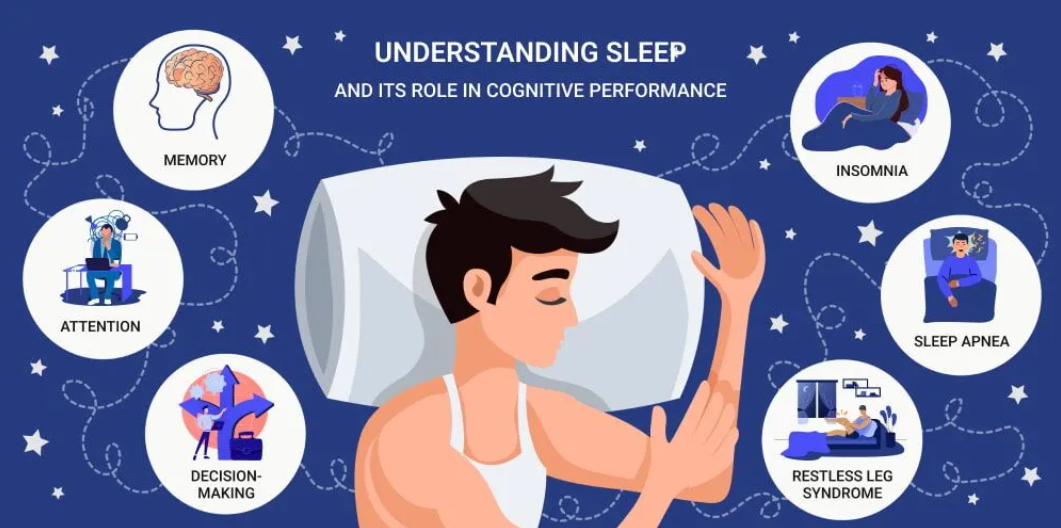
It also considers sleep quality measures such as sleep efficiency, sleep disruption and sleep fragmentation, alongside signals linked to prefrontal sensitivity, an area of the brain closely associated with attention and decision making and known to be vulnerable to sleep loss.
The researchers report that lower sleep derived scores are linked with noticeable changes in everyday thinking skills.
These include weaker task switching ability and higher error rates in executive function, more frequent lapses in attention and reduced focus, and difficulties in memory consolidation where newly learned information is not effectively stored for long term use.
The findings are based on a large analysis of 36000 sleep study recordings drawn from 27000 participants across six cohorts.
The sleep data was processed in different forms, including one-dimensional time series and two-dimensional time frequency spectrograms, allowing the model to learn from multiple views of brain activity during sleep.
A deep learning system was trained without manually defined features, instead learning patterns directly from the data.
It built a 1024-dimensional internal representation of brain health and used this to predict cognitive performance, disease status and sleep metrics.
This complex internal model was then distilled into a single score designed to reflect overall brain health.
When compared with traditional approaches, the sleep derived score performed better than demographic based estimates and conventional EEG measurements such as rapid eye movement fraction and spindle density.
The model also showed stronger links with cognitive outcomes, with correlation values reaching up to 0.40, compared with much lower baseline results.
For disease prediction, performance improved from earlier benchmarks that ranged between 0.50 and 0.55 to a higher range of 0.65 to 0.75 using the deep learning approach.
In statistical survival models adjusted for age, researchers found that a one standard deviation increase in the brain health score was associated with a 31 percent to 35 percent lower risk of mortality, with hazard ratios between 0.65 and 0.69 and strong statistical significance.
The study also found that lower scores are associated with long term brain changes including grey matter reduction and structural brain loss, as well as increased risk of dementia and higher all cause neurological mortality risk.
According to the researchers, the findings suggest that sleep is not only a rest period but also a window into brain health, where measurable patterns in overnight activity may offer early warning signals long before clinical symptoms appear as contained in the report funded by the National Institutes of Health (NIH) and other supporting organisations.
—
Do you have a news tip for JKNewsMedia.com? Please copy and email us at jkmediapress@gmail.com.