By Olukorede Yishau
THERE ARE places we live in, and there are places that live in us. Houston, one of America’s many cities, is where I have called home since the first quarter of 2022. Lagos is a city in which I have spent substantial parts of my life. I have lived in different parts of Lagos, experienced its madness and magic, watched it expand, swallowed its dust, complained about its traffic and enjoyed its day and nightlife.
Yet, if someone asks me where, anywhere in the world, I feel happiest, my answer won’t be Houston, where I have spent years building another chapter of my life.
It would not be Agege, Maryland, Ilupeju or any of the other places in Lagos where I have lived. It will not even be Somolu, where I was born and gleefully showcase on every passport I have owned. My answer will be Epe. Yes, my Epe, where a few days ago a tanker loaded with 45,000 litres of Premium Motor Spirit overturned, spilling its contents onto the roadway. I am so happy no casualties were recorded.
Epe is that place that lives in me while Houston, Ilupeju, Maryland and others are where I have lived.
That qualification matters because Epe is not simply a geographical location to me. It is memory with streets. It is childhood with landmarks. It is family history wearing the clothes of a town. It is the endless lagoon, the abundant fish, the Aiyetoro market, the voices, the familiar faces, the roads that seem to know where I am going even when I do not. It is the place where I do not have to explain myself before I feel at home. I simply just feel at home.
Hometowns are different from other places. You can acquire a house somewhere else, obtain documents that establish residence somewhere else, pay taxes somewhere else, raise children somewhere else and even become so accustomed to another country’s roads that you stop looking at maps. But there remains something stubborn about the place where your earliest memories were deposited. It does not compete with your new home. It simply waits. My Epe waits and whenever I return, something in me settles. I have not returned for years, but it waits.
I lived in metropolitan Lagos, but Epe has always been different. Lagos can be exhilarating, but Lagos can also be exhausting. It is a city that rarely allows you to forget that millions of other people are trying to get somewhere at the same time. Epe has changed too, but it has not entirely surrendered the things that made it mine.
The irony is that the new Epe is not exactly the Epe of my teens. The town has grown. Roads that once carried a different kind of traffic now carry vehicles connected to a Lagos that has pushed steadily eastward. The Lekki-Epe corridor has transformed dramatically over the decades. What was once a relatively rural road has become a major artery connecting Epe with the expanding metropolitan Lagos. The original road dates back to the early 1980s, and its later rehabilitation and expansion have fundamentally altered the landscape.
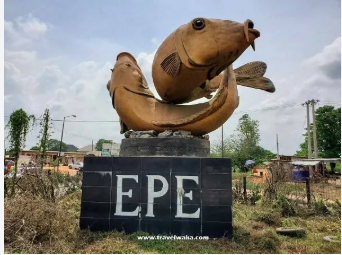
Today, the approach to Epe can feel like watching two versions of Lagos meet. There is the Lagos of concrete, development, traffic and ambition. Then there is the Epe of water, fishing, trading, old houses, traditional institutions and memories. The town sits beside the lagoon, and fishing, agriculture and trading remain central to its economic identity. The Epe Local Government itself describes the town as the “fish basket” of Lagos and highlights its mangroves, trails, hills and historic monuments.
The transformation is not merely physical. Epe has acquired a new vocabulary of development. New roads, newer buildings, educational institutions, markets and hospitality facilities have appeared. The Lagos State University campus in Epe, for instance, has become an important institutional presence, housing programmes including engineering, agriculture and environmental sciences.
The old Epe, meanwhile, remains visible beneath the new one at the waterfront, in market, in the sound of people bargaining, in the boats and the lagoon, in the palace and in the old stories, and in the names of people whose families have been connected to the town for generations.
And you find it in the smell. Anyone who knows Epe understands that smell. The smell of fish is not merely the smell of fish. It is an announcement. It is the town saying, “You are here.” Oluwo Modern Fish Market (Epe Fish Market) remains one of the town’s most recognisable economic and cultural landmarks, sitting by the lagoon where aquatic commerce continues to shape daily life. The market is not simply a place where fish are bought and sold. It is part of the visual memory of Epe.
This is why development presents a complicated emotion for people like me.
Of course, I want Epe to develop, I want good roads, I want reliable electricity, I want better schools, hospitals and businesses, I want young people from Epe to be able to build successful lives without believing that success requires abandoning the town, and I want investment to come without destroying the character that made the town worth investing in.
But there is a difference between development and replacement. A town should be allowed to grow without becoming unrecognisable to the people whose lives gave it meaning.
This is one of the things I sometimes think about when I am in America. America has given me a different relationship with place. Here, everything can feel organised around function. Roads take you somewhere, buildings house people, businesses provide services and neighbourhoods have identities, but those identities can change quickly.
Epe feels different to me. In Epe, a place can carry the memory of people who are no longer alive. A road can remind you of somebody. A house can transport you to another decade. A market can bring back a voice. A lagoon can make you remember a version of yourself that disappeared somewhere between adulthood and responsibility. That is the bond. It is not easy to explain to someone who has never had it.
It is the reason a person can travel thousands of miles and still be emotionally summoned by something as ordinary as a local expression, the sound of Yoruba spoken in a particular way, the sight of a particular tree or the memory of an old family compound.
Epe’s history itself is unusually layered. Accounts of the town trace its origins to early hunter settlements and later describe its importance in the nineteenth century, including the period when King Kosoko and his followers found refuge there after leaving Lagos. His presence contributed to important changes in the town’s religious and social history.
So when I say Epe makes me happiest, I am not simply talking about nostalgia. I am talking about belonging. There is a peculiar freedom in being somewhere you do not need to impress. In America, like everyone else, I have responsibilities. There are bills, appointments, deadlines, work, driving, paperwork and the endless machinery of adult life. Even after five years, there are moments when one is reminded that one has crossed an ocean and entered another system.
In Epe, I am not thinking about any of that. I can simply be.
Perhaps that is why the changes in Epe do not frighten me as much as they fascinate me. I can see the new roads and still remember the old ones. I can see new buildings and remember what stood there before. I can watch the town stretch towards the future while carrying my own private version of its past.
The irony is that Epe itself is changing partly because of the same Lagos that once seemed so far away. The expansion of the Lekki corridor has brought greater connectivity, development and investment. Current infrastructure plans continue to position Epe within an even larger regional transport network, including the proposed 7th Axial Road linking the Lekki Deep Sea Port corridor to Epe and onward towards the Epe-Ijebu Road.
The lagoon, too, is not frozen in time. Research examining Lagos’s lagoon systems over four decades, from 1984 to 2024, found significant changes associated with urbanisation, land reclamation, sedimentation and climate-related factors.
So even the water remembers that time is moving.
But perhaps this is what I love about Epe. It does not have to remain exactly as it was for me to remain attached to it.
I do not need my hometown to become a museum. I want it alive. I want its children to have reasons to stay and reasons to return. I want its fishermen to prosper. I want its traders to flourish. I want its schools to produce people who can compete anywhere in the world. I want the lagoon protected. I want development that respects history. I want Epe to become more prosperous without losing the unhurried intimacy that makes it feel different from the rest of Lagos.
Most of all, I want to remain capable of returning there and feeling that mysterious thing I cannot quite manufacture anywhere else. Happiness.
Not the loud happiness of a party. Not the temporary happiness of money spent on a holiday. Not the excitement of arriving in a new city. Something quieter. The happiness of recognition.
The happiness of seeing a place and knowing that, long before you became an adult with responsibilities scattered across countries, this place knew you simply as one of its own.
America is home. Lagos has been home. I have lived in other parts of Lagos and built memories there. But Epe occupies another room in me. Perhaps hometowns are like that. You can leave them. You can live thousands of miles away. You can become accustomed to another country, another weather, another road system and another rhythm of life.
But, sometimes, when the plane lands in Lagos and the journey towards Epe begins, something changes. The closer I get, the less I feel like a man who has travelled. I feel like someone returning.
My final take: When I finally see Epe, with all its changes, imperfections, memories and possibilities, I am reminded of something the world outside my hometown can never quite teach me: There are places we choose to live and there are places that chose us long before we understood what belonging meant.
Quote:
There are places we choose to live and there are places that chose us long before we understood what belonging meant.
—

Share Your Story with us!
Advertise with us!
Publicity for a product, service, or event!
Contact: WhatsApp Only: +2348039560647
Email: jkmediapress@gmail.com
Advertise with us!
Publicity for a product, service, or event!
Contact: WhatsApp Only: +2348039560647
Email: jkmediapress@gmail.com