By JKNewsMedia
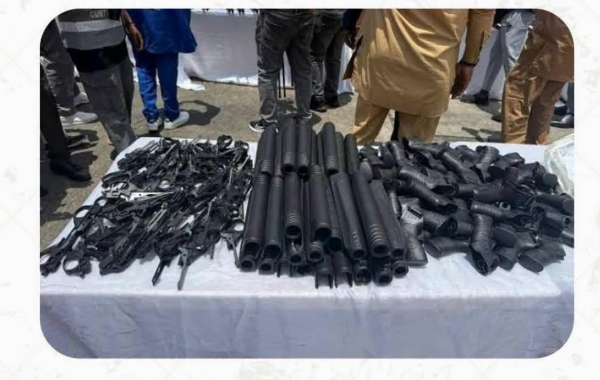
INTERCEPTION OF 204 pump-action rifles and firearm components at Tin Can Island Port has intensified concerns over international arms trafficking through Nigeria’s ports ahead of the 2027 general elections.
JKNewsMedia.com reports that the weapons were concealed in a 20-foot container, TEMU 184536/9, which arrived from Turkey aboard MV Algeciras Express on August 16, 2026, as the Nigeria Customs Service (NCS) said credible intelligence prompted the container to be flagged for examination.
A 100 per cent physical examination uncovered by NCS the firearm components hidden among declared household goods, including furniture, refrigerators, solar panels and detergents.
The seizure came weeks after another operation at the same port resulted in the recovery of 399 fully assembled pump-action rifles and 535 assorted firearm components after Customs officers assembled previously intercepted knocked down components.
Also, the repeated interceptions have raised concerns among security stakeholders over the scale of the trafficking network and the number of consignments that may be reaching Nigeria undetected.
Additionally, the Sea Empowerment and Research Centre (SEREC) urged the FG to move beyond intercepting individual shipments and focus on disrupting the supply chain behind the illegal firearms trade.
Dr Eugene Nweke of SEREC said the recurring pattern of firearms allegedly originating from Turkey had become a national security intelligence concern requiring coordinated investigations involving Nigerian and Turkish authorities.
Nweke called for a comprehensive investigation into the manufacturers, suppliers, exporters, financiers, freight forwarders, shipping routes, Nigerian consignees, clearing agents and intended recipients connected to the consignments.
“The safest firearm is the one that never leaves the source country,” stakeholders stressed, calling for stronger intelligence gathering before weapons are shipped and while they are in transit.
SEREC also urged the government to revisit what it described as the “Turkey question”, while stressing that repeated identification of Turkey as the source of the consignments should not be interpreted as an allegation against the Turkish government.
Nweke recalled that four shipments involving 2,671 pump-action rifles from Turkey in 2017 had prompted the then Comptroller-General of Customs, Col. Hameed Ali (rtd.), to engage the Turkish ambassador over the issue.
He questioned what became of the source-country investigation promised at the time, the intelligence exchanged and the safeguards subsequently established.
With the 2027 elections approaching, SEREC warned that the proliferation of illicit firearms could have grave implications for public safety and electoral security.
JKNewsMedia.com reports that the organisation also called for a Turkey-Nigeria arms-trafficking prevention mechanism involving Customs, the National Centre for the Control of Small Arms and Light Weapons, the Office of the National Security Adviser, police, intelligence agencies, maritime authorities, financial intelligence institutions and Turkish law-enforcement agencies.
Meanwhile, Customs Comptroller-General Bashir Adewale Adeniyi vowed that the service would not allow Nigeria’s ports and borders to become channels for weapons capable of threatening national security.
Adeniyi said the NCS would intensify intelligence-led enforcement, risk management and collaboration with other security agencies to disrupt firearms smuggling.
The Director-General of the NCCSALW, DIG Johnson Babatunde Kokumo (rtd.), described the handover of the seized weapons as evidence of stronger inter-agency cooperation.
For stakeholders, however, the challenge extends beyond the seizures made at the ports, with the critical test being whether Nigeria can identify, expose and dismantle the networks behind the firearms before they reach the country, he said.
—