By Ajibola Olaide, JKNewsMedia Reporter
THE FEDERAL Inland Revenue Service (FIRS) has reaffirmed that Nigerians will not be required to obtain a separate Tax Identification Number (TIN) before they can open or operate bank accounts under the new framework set to take effect in January 2026.
In a statement issued on Saturday, Arabinrin Aderonke Atoyebi, Technical Assistant on Broadcast Media to the Executive Chairman of the FIRS, Zacch Adedeji, stated that the tax system is already integrated with national registries.
According to her, individuals are automatically covered through their National Identification Number (NIN), while businesses are captured via their Corporate Affairs Commission (CAN) registration details.
She explained that the TIN is not a fresh requirement, but an embedded identifier designed to ensure that every taxpayer can be uniquely verified.
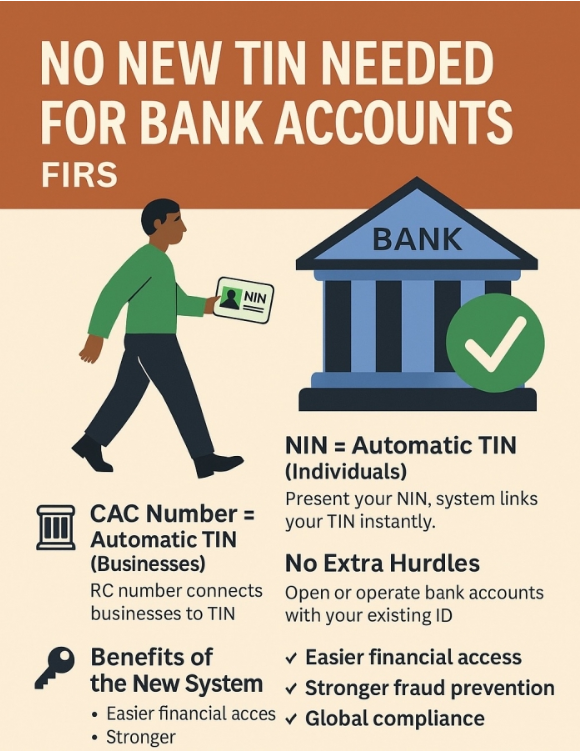
For individuals, the provision of a National Identification Number during bank account opening or Know Your Customer (KYC) checks automatically retrieves their tax identifier, while businesses achieve the same through their RC numbers.
“The TIN is a 13-digit unique identifier for all taxable persons and entities in Nigeria.
“It encodes details such as issuance year, registry source, state of registration, and a cryptographic fragment for security, ending with a check digit.
“It is not a standalone requirement imposed on citizens. Instead, it is a statutory tool that ensures every taxpayer, whether an individual, a registered business, or an association, can be uniquely verified within the national tax system,” Atoyebi explained.
She stressed that the system eliminates duplication, reduces fraud, and streamlines financial reporting. “A Nigerian walking into a bank with their NIN is already tax compliant.
The bank simply retrieves their Tax Identification Number as part of the onboarding process,” she said.
The clarification followed public concern generated by media reports suggesting that Nigerians would be compelled to secure a separate tax identifier before accessing banking services from January 2026.
Reacting to the claims, Atoyebi noted through her official X handle that such reports were misleading.
She emphasised that Nigeria’s tax system has evolved to integrate seamlessly with existing national registries, ensuring that every eligible individual or entity is automatically identifiable for tax purposes.
She pointed to the implementation of the National Taxpayer Directory (NTD) under the Nigeria Tax Administration Act (NTAA) 2025 as the backbone of the integration, noting that the system provides a single, consent-driven source of truth for onboarding, reporting, and compliance within the financial system.
On the link with national identity systems, she said: “For individuals, the TIN is automatically linked to their NIN issued by the National Identity Management Commission (NIMC). When an individual provides their NIN, such as during bank account opening or KYC processes, the system cross-checks the identity in the national database.
“As part of this verification, the tax identifier is automatically retrieved and attached to the person’s records. This means citizens do not need to manually apply for or present a tax identifier before opening a bank account. The system handles the integration in real time.”
She added that businesses are equally covered through their CAC registration numbers. “For businesses, the TIN is tied directly to the RC Number issued by the CAC. Likewise, for cooperatives, partnerships, professional bodies, and other legal entities, the tax identifier is connected to their respective recognised registries.
“This linkage ensures that corporate entities can be transparently identified for both tax and compliance purposes. Just as with individuals, banks and regulators do not require extra documentation beyond the foundational registry numbers to confirm tax status,” she explained.
Highlighting the broader benefits of the framework, Atoyebi stated that it promotes inclusivity, financial access, and fraud prevention.
She said the integration allows individuals and businesses to open and operate bank accounts using their National Identification Number or RC number, with the tax identifier automatically integrated in the background.
She added that the system eliminates duplicate or false identities by ensuring every taxpayer is tied to a verifiable registry.
She also noted that the framework ensures regulatory compliance, as banks and financial institutions can rely on a single source of data for onboarding, reporting, and Know Your Customer checks.
According to her, the reforms extend beyond companies to cover associations, professional bodies, and trustees, while also enhancing compatibility with international systems for trade finance and compliance.
The FIRS urged citizens to disregard speculation about banking restrictions, emphasising that the reforms are designed to improve financial access, strengthen transparency, and align with global best practices rather than create new barriers.
Atoyebi concluded that the framework is not a hurdle but a gateway to financial inclusion, regulatory transparency, and global interoperability in Nigeria’s evolving digital economy.