By Joke Kujenya
THE ROOM didn’t feel like a typical media event. No stiff introductions but a light-hearted ‘getting-to-know-you’ better session.
As JKNewsMedia.com observed, there was no polite applause just for the sake of it.
Rather, what filled the space instead was something heavier. It was a quiet, shared understanding that journalism in Nigeria is no longer what many once dreamed it would be.
Young reporters sat amidst veterans who had seen it all sharing their newsroom glory days, the slow erosion of pay, the rise of digital pressure, and the constant question: is this career still worth it?
This was Media Career Fix, a new initiative by the Media Career Development Network (MCDN) funded by the Nigeria Liquified Natural Gas (NLNG) Limited and from the very first session, it was clear this was not going to be another talk shop.
It turned out to be more than a session; it became a much-needed jolt for careers that had been running on empty.

A Profession at a Crossroads
When the Executive Director, MCDN, Lekan Otufodunrin stepped forward, he didn’t pretend things were fine.
He spoke plainly about a profession where many journalists lack direction, mentorship, and even the most basic tools to grow.
Otufodunrin hinted that a recent survey conducted on the launch of the project painted a troubling picture: “reporters navigating their careers without guidance, battling poor pay, limited access to data, and growing safety concerns.”
But perhaps what struck the room most was not the data; it was the decision that followed.
Originally, only 30 journalists were meant to benefit from the initial process. But that number was quietly tripled.
“We had to make more selection for the respondents that now added up to 150 journalists attending both in persons and virtually. With every applicant now included,” he stated.
“That tells you how deep the problem is,” someone whispered audibly.
Also, Otufodunrin described what participants would receive as personalised career assessments, mentorship, training, and practical strategies to build sustainable careers.
But beyond the structure, his message carried urgency. For each young professional to maximise the opportunity, “journalists,” he said, “must stop drifting. Careers cannot be left to chance anymore. This is the Hard Truth No One Escaped!
If the opening set the tone, the keynote shattered any remaining comfort: Here’s the truth – your career is not stuck…you are, her bullet hit.
When Omotola Adebanjo, the Guest Speaker, a News Editor, Career Mentor at British Broadcasting Corporation (BBC), Journalism Teacher, Poet and Author, began expanding on her prepared text, the room leaned in.
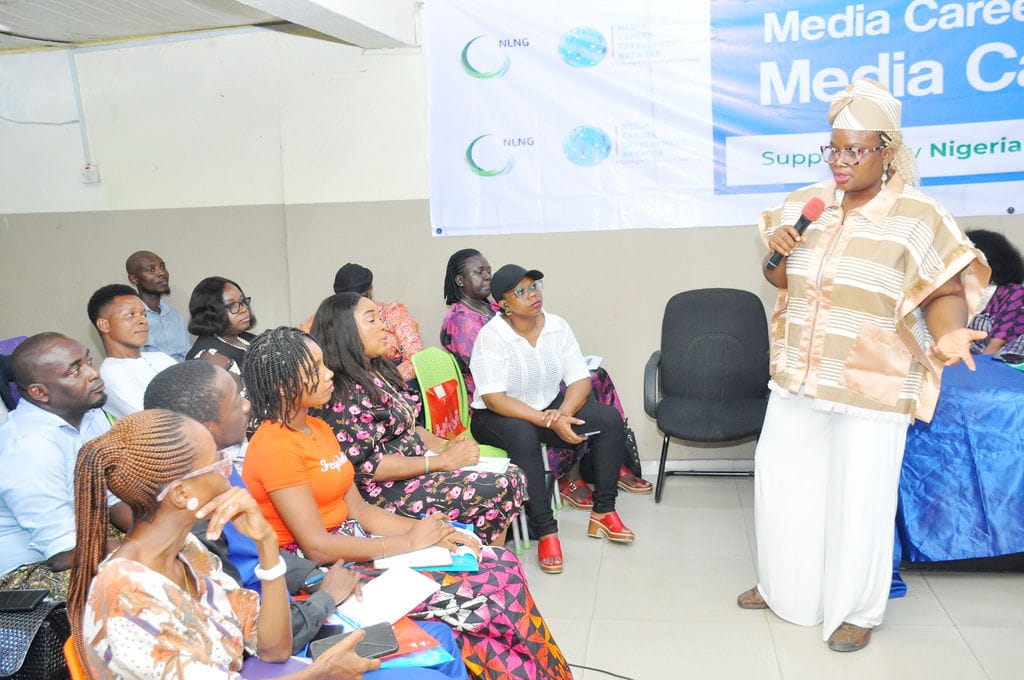
Her text was captioned “Fixing You First: The Hard Truth About Building a Journalism Career in Nigeria.”
She didn’t soften her words, and that, we all loved.
“You don’t grow because of the newsroom,” she said. “You grow because you decide to, then, the newsroom will catch up with you.”
For many younger journalists in the hall, that line landed hard.
In a profession where people often blame struggling organisations, shrinking opportunities, or poor leadership, Adebanjo turned the spotlight inward.
She spoke about skills ownership – not just having abilities – but mastering them.
She stressed visibility, because being good is no longer enough if no one can see your work.
She pointed to adaptability in a media landscape that shifts faster than most can keep up with.
And then she addressed something many avoid, financial responsibility.
The room grew quieter as this has been a major nag for both the ancient and modern journalists.
Some nodded. Others stared at their notebooks; the rest fixed their gaze on Adebanjo expecting her to come up with some magic wands.
She too, after pausing for a while and with nothing said at that point, continued. . .
Because beneath all the talk about passion and storytelling, there was a shared reality everyone understood… passion does not pay bills, the guest speaker hit harder.
Not Just the Journalists
Still, Adebanjo was careful not to place the burden entirely on individuals.
She turned her attention to media organisations, and here too, there was no sugar-coating.
▪️Newsrooms, she said, must stop treating journalists as disposable.
▪️Training should not be an afterthought.
▪️Mentorship should not be accidental.
▪️Innovation should be rewarded, not ignored.
▪️And editorial independence must be protected if journalism is to survive with integrity.
It was a call-out and perhaps, a call to action, by Adebanjo.
A Gathering That Felt Different
Around the room were familiar names and faces media trainers, editors, founders, mentors.
Among them, Joke Kujenya, Senior Investigative Journalist/Mentor/Media Trainer and Publisher, JKNewsMedia.com, Shekinat Lawal, former Chairperson of Nigeria Association of Women Journalists (NAWOJ) Lagos State Chapter; Olufunke Treasure, broadcast journalist, leadership coach, and ardent gender advocate and Adebisi Adetunji, Career Clarity Coach/Media and Dev. Communications/ Author.
But what made the gathering stand out wasn’t who attended, it was how people listened.
There was less networking chatter, more note-taking. Less posturing, more reflection.
At one point, a young journalist sighed quietly and said, “So it’s really on us. Not in defeat but in realisation.”
More Than a Programme
By the end of the session, Media Career Fix felt less like a programme and more like a mirror.
It compelled journalists to look at the profession as it is – unstable, demanding, often underpaid – but also full of possibility for those willing to adapt and take control.
Both in-persons and virtually, more than 150 journalists have now been sensitised through the process of reassessment, training, and mentorship.
Whether it changes their trajectories remains to be seen.
But one thing was clear as people filed out of the room, conversations had shifted.
From “the industry is broken” to “what can I fix about myself within it?”
And in today’s Nigerian media landscape, that shift might be where real change begins. So, “Don’t just clap for this. Act on it,” Adebanjo rounded up.
This time, the claps couldn’t stop.
—
Do you have a news tip for JKNewsMedia.com? Please email us at jkmediapress@gmail.com.