By Helen Okechukwu, JKNewsMedia Reporter
NIGERIA’s ECONOMIC growth outlook has improved slightly for 2026, but rising food and energy prices threaten to deepen poverty and food insecurity, the International Monetary Fund (IMF) has warned.
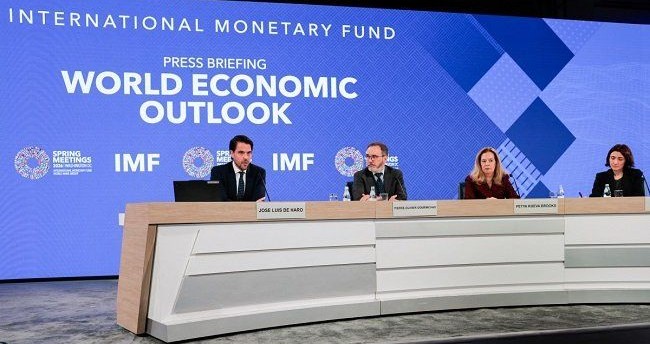
JKNewsMedia.com reports that the Fund raised its growth forecast for Nigeria to 4.2 per cent from 4.1 per cent in its October 2026 World Economic Outlook (WEO), titled “Resilience Under Strain, Urgent Choices”, released on Tuesday during the IMF and World Bank (WB) meetings in Bangkok, Thailand.
It projected growth of 4.3 per cent for Nigeria in 2027.
The IMF attributed the improved outlook to greater macroeconomic stability and favourable terms-of-trade effects. However, it cautioned that escalating costs of essential goods could put additional pressure on households already struggling with the cost of living.
“Nigeria is supported by improved macroeconomic stability and favourable terms-of-trade effects, though higher prices for essentials are expected to further aggravate poverty and food insecurity,” the Fund said.
The warning comes as the Nigerian government pursues reforms aimed at addressing structural weaknesses in the economy, while households continue to face the effects of rising living costs.
At a press briefing on the report, Deniz Igan, chief of the IMF research department’s world economic studies division, said policymakers must balance immediate support for vulnerable households with the need to preserve fiscal stability over the medium term.
“What we are advocating for is for policymakers to balance the near-term needs of the population, and that involves food security, that involves energy security,” Igan said.
She noted that food and energy costs were rising disproportionately in Nigeria, making it increasingly difficult for vulnerable households to cope with the cost of living.
Although Nigeria’s position as an energy exporter has helped sustain economic growth, Igan warned that the risk of poverty remained high.
“While the growth held up in Nigeria, given energy exporter, poverty risks are still very high,” she said.
The IMF advocated targeted, temporary financial assistance to help households most exposed to rising prices.
“What we’re advocating for is cash transfers, income support, targeted temporary income support for the most vulnerable households in Nigeria,” Igan said.
She stressed that such measures should remain consistent with the government’s medium-term fiscal framework.
Beyond Nigeria, the IMF expects economic growth across sub-Saharan Africa to remain at 4.5 per cent in 2026. However, it warned that the regional projection conceals significant differences in economic performance among countries.
The Fund said national growth prospects would depend on fiscal capacity, the implementation of reforms, exposure to commodity price movements, climate shocks and access to external financing.
It also noted that oil-importing and non-resource-intensive economies faced greater exposure to rising food and energy costs, while some larger economies continued to benefit from earlier stabilisation and reform efforts.
These gains, however, come alongside challenges, including limited participation in the global technology upswing driven by artificial intelligence and pressure from declining official development assistance.
The IMF projected growth in the rest of the region to slow from 5.6 per cent in 2025 to 5.5 per cent in 2026 and 5.3 per cent in 2027.
South Africa’s growth outlook, meanwhile, is expected to remain stable in the near term before improving gradually over the medium term, supported by stronger policy frameworks and ongoing structural reforms.
The report also warned of renewed pressure on the global economy from rising inflation. The IMF projected global inflation to increase to 4.7 per cent in 2026 from 4.1 per cent in 2025, largely driven by higher energy and food prices, before easing to 4.1 per cent in 2027.
It said a war-related supply shock had interrupted the steady decline in inflation, with the effects varying across countries depending on exchange-rate movements, labour-market conditions and the credibility of monetary policy.
Igan said central banks should continue to prioritise price stability while tailoring their responses to the nature of economic shocks and conditions in their respective countries.
She said monetary policy decisions should reflect factors including labour-market tightness, prevailing inflation levels and exposure to artificial intelligence and commodity price movements.
Silvana Tenreyro, director of the IMF research department, urged governments to look beyond immediate crisis management and strengthen their capacity to withstand future disruptions.
“Move from just coping to rebuilding. We need to restore fiscal space. We need to rebuild supply-side resilience,” Tenreyro said.
She called for governments to identify vulnerabilities in critical inputs, including energy, and strengthen their ability to withstand further supply disruptions.
JKNewsMedia.com also reports that the IMF also projected global trade volume growth to slow from 5 per cent in 2025 to 4.6 per cent in 2026 before recovering to 4.7 per cent in 2027.
The report attributed the slowdown to tariffs, adjustments in trade relationships and changes in global production chains, although technology-related trade flows are expected to provide some support.
It also says that for Nigeria, the revised growth projection offers a more favourable economic outlook, but the IMF’s warning underscores the pressure that rising essential costs could continue to place on vulnerable households.
—

Share Your Story with us!
Advertise with us!
Publicity for a product, service, or event!
Contact: WhatsApp Only: +2348039560647
Email: jkmediapress@gmail.com