By Jemimah Wellington, JKNewsMedia correspondent
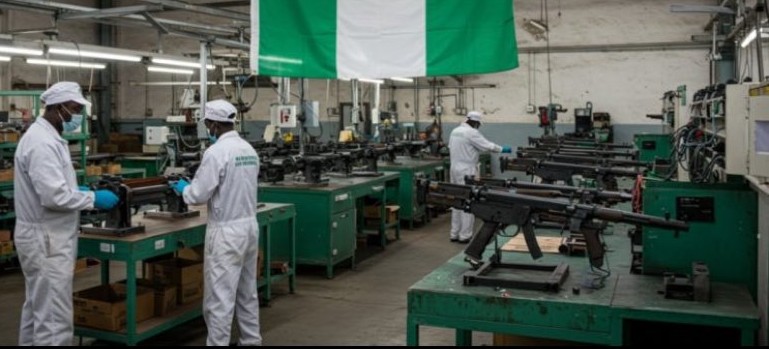
EFFORTS TO strengthen Nigeria’s defence manufacturing sector have intensified as the Independent Media and Policy Initiative (IMPI) urged the Federal Government to prioritise domestic arms production, with the Defence Industries Corporation of Nigeria (DICN) taking a central role.
The call was made in a policy statement signed by the think tank’s Chairman, Dr Omoniyi Akinsiju, who asked the administration of President Bola Tinubu to ensure adequate funding for DICON and pursue partnerships with countries such as Turkey and Israel to close technical expertise gaps.
The group said DICON, established in 1964, was designed to be the backbone of Nigeria’s self-reliance in defence production but has been hampered by underfunding and bureaucracy.
It described the corporation as crucial to national security ambitions that remain unrealised.
“The DICN, established in 1964, should be the backbone of self-reliance. Instead, it is held back by underfunding and bureaucracy,” the statement said.
IMPI cited the OBJ 006 rifle as an example of DICON’s potential yet ongoing reliance on imports.
“It’s OBJ 006 rifle, meant to symbolise self-sufficiency, still relies on imported parts,” the statement added.
The think-tank compared DICON with defence manufacturers abroad, highlighting South Africa’s Paramount Group, which produces armoured vehicles for global markets, and Turkey’s expanding drone industry.
“Contrast this with South Africa’s Paramount Group, which produces armoured vehicles for global markets, or Turkey’s booming drone industry,” it said.
IMPI argued that Nigeria has the technical capacity for local defence production but lacks political commitment.
The group noted that local companies, including Proforce, already produce mine-resistant vehicles, while the military continues to rely on imported and sometimes overpriced equipment.
“Nigeria has the capacity; what is missing is the political will. Local firms like Proforce already manufacture mine-resistant vehicles, yet the military still imports overpriced, refurbished equipment from questionable middlemen,” the statement said.
The think tank highlighted the $500 million contract for outdated Puma helicopters in 2014 as an illustration of systemic flaws, noting corruption concerns.
“The $500 million contract for outdated Puma helicopters in 2014, a deal stained by corruption, shows how broken the system could be,” it said.
IMPI urged a strategic shift to local production supported by funding and international collaboration.
“Nigeria must prioritise local arms production. DICON needs funding and partnerships with tech-savvy nations such as Turkey or Israel to bridge expertise gaps,” the statement said.
The group also emphasised the role of the Air Force Institute of Technology (AFIT), which it said has skilled engineers and researchers already involved in designing and developing indigenous drones for military, civilian, and scientific applications.