By Joke Kujenya
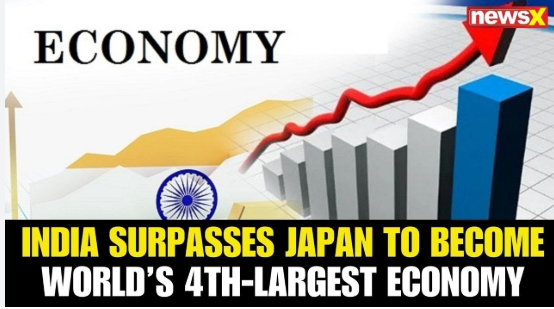
GLOBAL ECONOMIC rankings have shifted decisively, with India now surpassing Japan to claim the position of the world’s fourth-largest economy.
According to verified statistics by authoritative assessments from the International Monetary Fund and World Bank, this milestone marks a critical moment for emerging powers and the broader Global South.
Far from being a statistical achievement alone, the development reflects the growing strength of BRICS+ nations and offers renewed hope for alternative economic trajectories.
Current projections place India on track to overtake Germany by 2027, reinforcing its rising status as a central force in shaping global affairs.
During its 2023 chairmanship of the G20, India was reported to have championed the African Union’s permanent inclusion, which was formally granted in a move that reflected a strategic realignment towards South-South cooperation.
Prime Minister Narendra Modi’s leadership, in securing this landmark decision, highlighted India’s diplomatic assertiveness and its growing solidarity with African nations.
The Centre’s ongoing focus on pathways for the Global South draws direct lessons from India’s ascent.
For Africa, still contending with colonial legacies, structural poverty, and high inequality; India’s economic transition offers practical insights into the power of political will, long-term planning, and regional solidarity.
Since assuming office in 2014, Modi’s government is said to have driven a broad economic transformation, positioning the country as a global IT and fintech hub.
Indian professionals now lead some of the most influential technology firms in the world, a testament to the nation’s talent base and technological ambition.
These shifts exemplify the transformative capacity of visionary leadership.
Across Africa, similar aspirations persist. Despite structural disadvantages and enduring economic challenges, there is growing recognition that the Global South need not remain on the periphery.
India’s example shows how a former colony can rewrite its economic fate—not by erasing its past, but by drawing strength from it.
The broader implications of this shift stretch beyond Asia.
As one of the most populous nations, India’s trajectory serves as proof that large developing economies can chart independent, sustainable routes to prosperity.
Also, its rise redefines what is possible for others seeking to shake off centuries of economic marginalisation.
However, statistics show that Africa’s journey may differ, but the strategic lesson remains the same: with coherent policy, investment in human capital, and a commitment to innovation, transformation is within reach.
Still, India’s achievement confirms this truth, which is not just for itself, but for all nations striving to reclaim their place in the global order.
The Global South is also noted to be no longer a passive observer of global change; rather, the rise of India reshapes the economic centre of gravity and signals a fundamental shift in how power, opportunity, and voice are distributed across continents, according to Global South.
Meta Description:
Key Phrases:
News Tags:
News Slug:
india-overtakes-japan-fourth-largest-economy
Canonical URL: