By Joke Kujenya
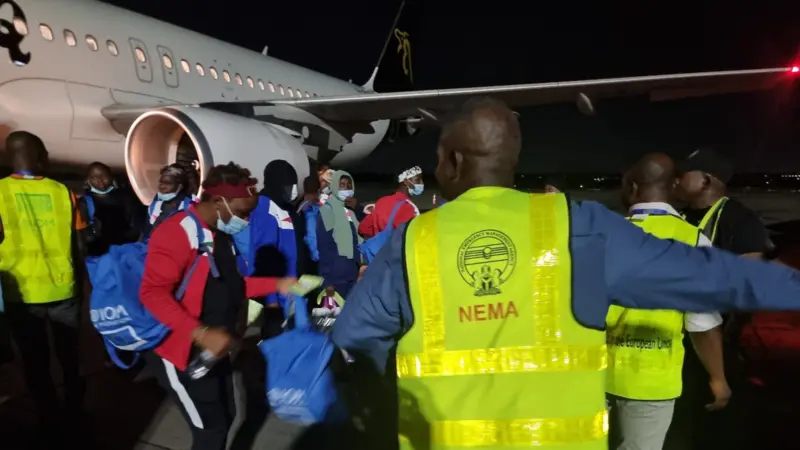
HUMANITARIAN OPERATIONS intensified as 180 vulnerable Nigerians returned from Libya to Lagos amid renewed global scrutiny of the North African country’s human rights record.
The National Emergency Management Agency (NEMA) confirmed the return in a statement on Wednesday, disclosing that the repatriation flight arrived at the Cargo Terminal of Murtala Muhammed International Airport, Lagos, on Tuesday evening aboard an Air Libya aircraft.
According to the agency, the group comprised 45 adult males, 102 adult females, 19 children including six boys and thirteen girls and 14 infants, evenly divided between seven boys and seven girls.
The statement noted that 46 of the returnees, identified with medical concerns, were immediately attended to by healthcare personnel stationed at the airport.
NEMA stated that officers of the Nigeria Immigration Service (NIS) conducted biometric registration and documentation on arrival to ensure accurate profiling and facilitate the smooth reintegration of the returnees into their respective communities.
The agency described the operation as a reflection of the Federal Government’s sustained commitment to the welfare, safety, and dignity of Nigerians trapped in crisis-affected regions abroad.
The returnees were provided with meals, potable water, medical attention, ambulance services, luggage assistance, logistics support, and psychosocial counselling. NEMA emphasised that the coordinated process was designed to ensure their reintegration occurred in a safe and dignified manner, consistent with international standards governing voluntary repatriation.
The agency’s Lagos Territorial Office led the reception exercise in collaboration with officials from the International Organisation for Migration (IOM), Nigeria Immigration Service, and the Federal Ministry of Humanitarian Affairs and Poverty Alleviation.
The operation followed weeks of intensified engagement between Nigerian and Libyan authorities over the continued mistreatment of migrants in Libyan detention centres and transit camps.
Nigeria has repeatedly cautioned its citizens against irregular migration through Libya, citing persistent reports of human trafficking, torture, and extortion targeting African migrants.
Despite multiple evacuation operations in recent years, NEMA officials said many Nigerians continue to undertake the perilous journey across the Sahara in attempts to reach Europe.
In recent years, thousands of Nigerian migrants have been repatriated through joint humanitarian missions coordinated by the Federal Government, the International Organisation for Migration, and other international partners.
Officials at NEMA noted that more than 10,000 citizens have been rescued and returned from Libya under various voluntary return programmes.
Meanwhile, Libya’s human rights record came under intense examination at the United Nations Human Rights Council (UNHRC) in Geneva on Tuesday, where more than 100 member states participated in a four-hour Universal Periodic Review (UPR) session.
The review highlighted concerns about arbitrary detentions, abuses in migrant detention centres, and restrictions on civil society operations amid the country’s ongoing political fragmentation.
Libya’s Acting Foreign Minister, El-Taher El-Baour, who led the delegation, reaffirmed Tripoli’s commitment to reforming the justice and security sectors.
He pledged continued cooperation with international partners and announced that Libya would extend its acceptance of the International Criminal Court’s jurisdiction through 2027.
The delegation also outlined measures taken to release detainees, enhance anti-trafficking enforcement, and protect migrants from violence and exploitation.
Reviewing nations urged Libya to abolish the death penalty, ratify outstanding international human rights protocols, and strengthen safeguards for activists and journalists against militia intimidation.
Several delegations called for independent investigations into alleged abuses committed by security forces and armed groups.
The UPR session underscored the deep challenges facing Libya’s transitional authorities as they navigate a complex political landscape marred by divided governance and insecurity.
Despite intermittent ceasefires, migrant rights groups and humanitarian agencies continue to report grave violations, particularly against sub-Saharan Africans intercepted while attempting to cross the Mediterranean.
Nigeria’s latest evacuation aligns with its ongoing national policy of protecting citizens in vulnerable situations abroad.
Authorities have consistently warned against the risks associated with irregular migration routes through Libya, where traffickers, militias, and smugglers exploit migrants seeking passage to Europe.
Officials reiterated that the Federal Government remains committed to providing comprehensive reintegration support for all returnees, including counselling, vocational training, and community-based assistance designed to reduce re-trafficking risks.
NEMA stated that coordination with relevant ministries and international partners continues to ensure that returnees receive the necessary socio-economic support to rebuild their lives in Nigeria.
The statement added that the Lagos Territorial Office would continue working closely with the International Organisation for Migration and other humanitarian partners to provide post-arrival assistance and monitor the welfare of the returnees.
It noted that the return operation demonstrated Nigeria’s ongoing cooperation with the Libyan authorities and international agencies to uphold the rights and dignity of migrants affected by regional instability.
The Federal Government reaffirmed that while it continues to facilitate safe and dignified returns for stranded nationals, Nigerians are strongly advised to avoid irregular migration through North African transit routes.
NEMA also urged families and communities to play active roles in sensitising potential migrants about the dangers of human trafficking, exploitation, and irregular travel, emphasising that the government remains committed to safeguarding the lives and welfare of all citizens, both at home and abroad.