By Jemimah Wellington, JKNewsMedia Correspondent
A NATIONWIDE mechanisation rollout took centre stage on Monday as 2,000 tractors were officially commissioned under Nigeria’s Renewed Hope Agricultural Mechanisation Programme.
Held at the National Agricultural Seeds Council, Sheda, along the Abuja–Lokoja Expressway, the launch signalled the federal government’s intensified commitment to transforming agriculture through modern technology and farmer empowerment.
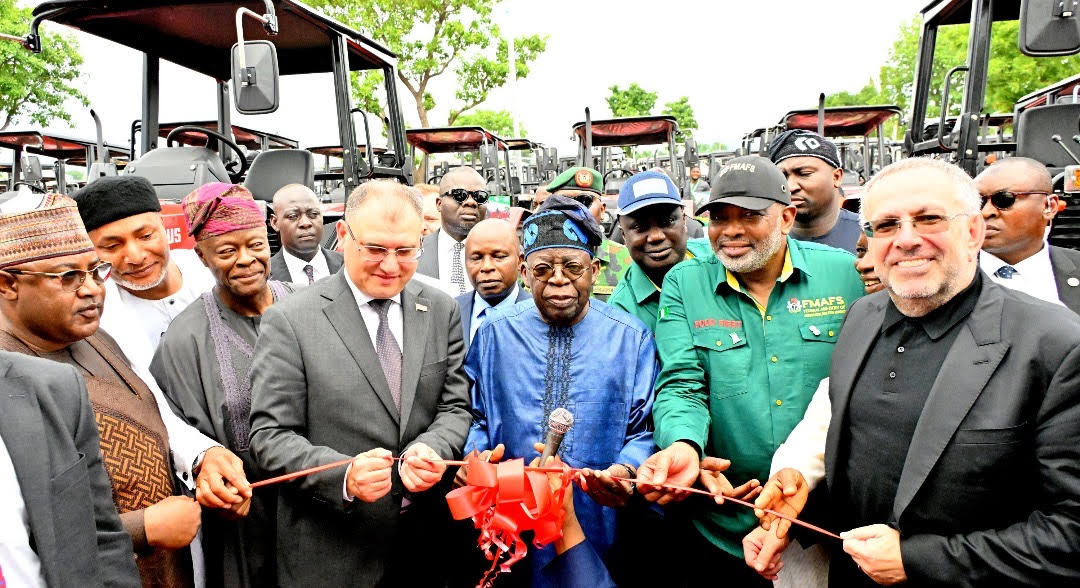
President Bola Tinubu, who led the commissioning, described the event as a pivotal milestone in addressing Nigeria’s food security challenge while reaffirming his administration’s resolve to support rural development and sustainable agricultural productivity.
According to the President, the programme represents a strategic response to earlier warnings on the country’s food crisis.
He said the newly launched initiative was not merely about equipment distribution, but about altering the trajectory of Nigeria’s agricultural potential, elevating the country into a global food supplier while reducing dependence on manual farming.
The tractors and other implements will be distributed nationwide using a service-provider model designed to benefit smallholder farmers, reduce labour intensity, and improve yields.
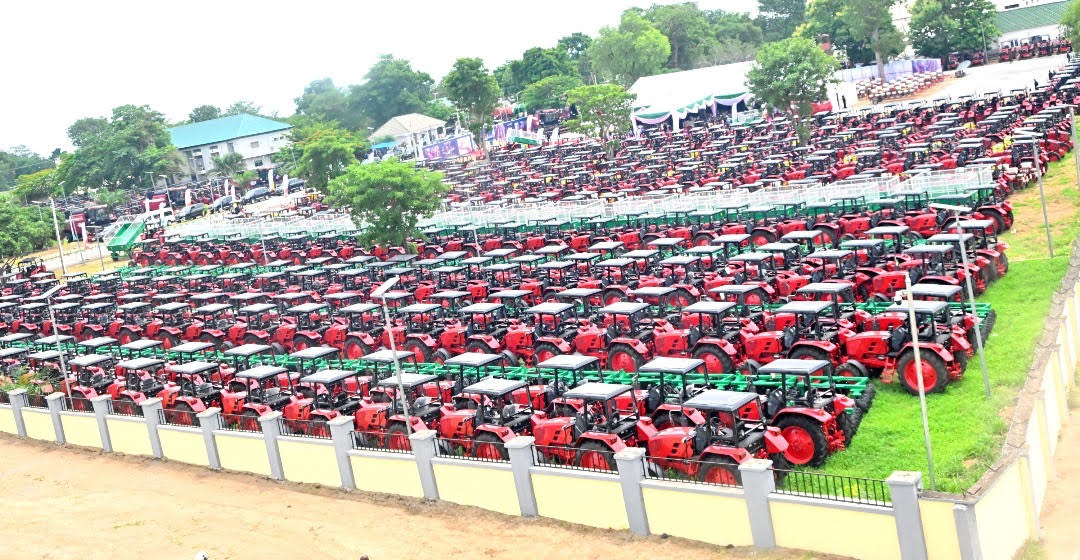
Backed by international partnership, notably with the Republic of Belarus, the equipment package includes not only 2,000 tractors, but also combine harvesters, mobile workshops, spare parts kits, and tools to support deployment.
President Tinubu credited Belarus for its commitment to youth empowerment through technology and skills transfer, citing the instrumental role of Belarusian businessman and long-time associate, Alex Sigman, in facilitating the collaboration.
The commissioning also served to acknowledge the larger bilateral agenda between Nigeria and Belarus.
Belarusian Deputy Prime Minister Viktor Karankevich, speaking on behalf of President Alexander Lukashenko, described the project as the first phase of a broader strategy to strengthen Nigeria–Belarus cooperation.
Future phases will include the establishment of service centres, local assembly plants, and training hubs for advanced agricultural machinery operation and maintenance.
Minister of Agriculture and Food Security Abubakar Kyari highlighted the scale and ambition of the mechanisation programme, describing it as the largest of its kind in Nigeria’s history.
The initiative is projected to cultivate over 550,000 hectares of farmland, generate more than two million metric tons of food, and create over 16,000 jobs while supporting over half a million farming households.
Key components of the initiative include mandatory operator training, GPS tracking for equipment monitoring, pro bono support to research and training institutions, and a structured repayment system for equipment usage.
The programme also intends to engage Nigerian youth in equipment handling, logistics, maintenance, and agri-tech development.
As the tractors begin their journey to Nigeria’s farms, the federal government has emphasised transparency and accountability in deployment.
President Tinubu called on stakeholders to ensure efficient utilisation of the equipment and pledged close oversight.
Representatives from the National Assembly, farmers’ associations, development partners, and senior government officials attended the event, underlining its national importance.
President Tinubu was also handed a personal invitation from the Belarusian president to visit Minsk, further consolidating ties between both countries.