By Jemimah Wellington, JKNewsMedia Correspondent
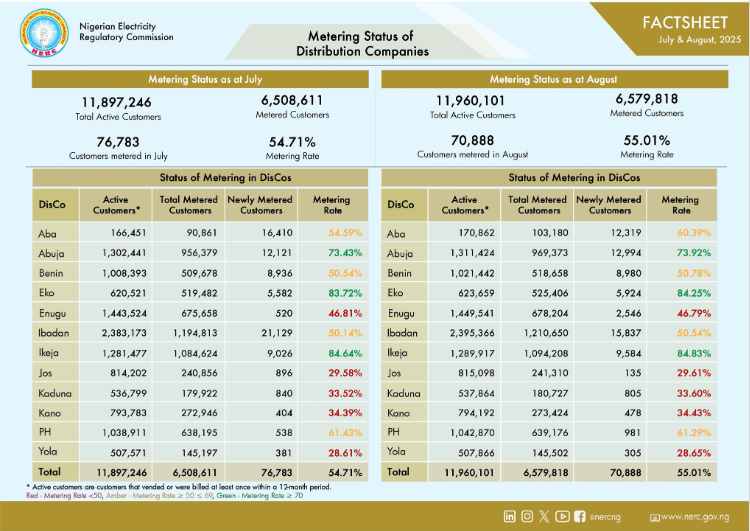
THE NUMBER of active electricity customers in Nigeria climbed to 11.96 million in August 2025, up from 11.89 million recorded in July, according to the Nigerian Electricity Regulatory Commission (NERC).
The update, published through the Commission’s verified X (formerly Twitter) and Instagram handles on Monday, came as part of NERC’s official Metering Factsheet for July and August 2025, detailing customer and metering data across the 11 electricity distribution companies (DisCos) nationwide.
According to the Commission, “Out of these, 6.58 million customers were metered, resulting in a metering rate of 55.01%, up slightly from 54.71% in July. A total of 70,888 customers were newly metered in August, compared to 76,783 in July, reflecting ongoing metering efforts across the Nigerian Electricity Supply Industry (NESI).”
NERC stated that the marginal increase in metering coverage reflected sustained reforms and investments by electricity distribution companies in customer management systems.
The Commission explained that these initiatives were aimed at improving billing transparency, reducing estimated billing disputes, and enhancing overall consumer confidence within the sector.
Eko Electricity Distribution Company (EKEDC), Ikeja Electric (IKEDC), and Abuja Electricity Distribution Company (AEDC) were ranked among the top-performing DisCos in metering coverage nationwide.
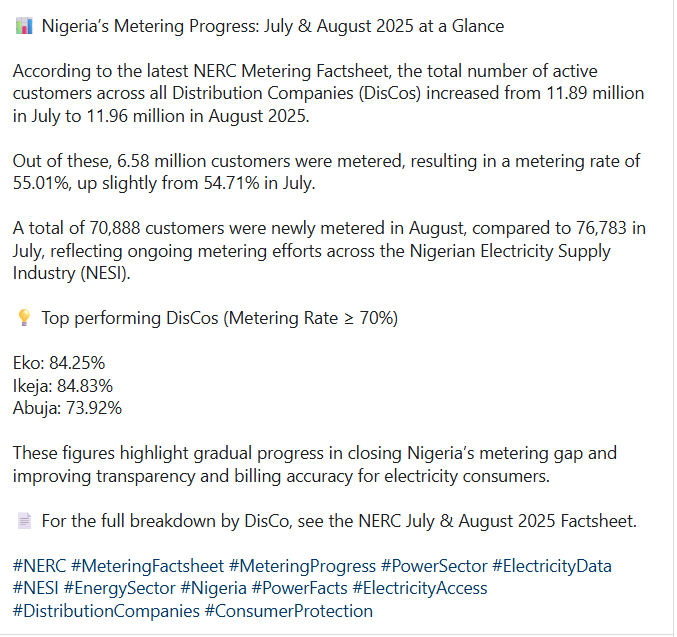
NERC’s report showed that Eko DisCo recorded a metering rate of 84.25%, Ikeja DisCo achieved 84.83%, while Abuja DisCo maintained 73.92%, representing the highest regional performances across the country’s electricity market.
The latest figures came amid NERC’s enforcement drive to ensure strict compliance with energy billing regulations, particularly for unmetered customers.
In April, the Commission imposed monetary penalties on eight distribution companies for breaching monthly energy caps on estimated billing.
The affected companies included Abuja Electricity Distribution Company (AEDC), Ikeja Electric (IKEDC), Eko Electricity Distribution Company (EKEDC), Enugu Electricity Distribution Company (EEDC), Jos Electricity Distribution Company (JEDC), Kaduna Electric, Kano Electricity Distribution Company (KEDCO), and Yola Electricity Distribution Company (YEDC).
NERC confirmed that the eight companies faced a combined fine exceeding ₦628 million for their non-compliance.
The regulator further directed each DisCo to provide credit adjustments to all affected customers, as part of remedial actions designed to protect consumer rights and ensure fair billing practices.
The Commission emphasised that enforcement of the capping order was crucial to maintaining accountability within the Nigerian Electricity Supply Industry, warning that further breaches would attract stiffer sanctions.
The regulatory body has continued to publish quarterly performance assessments of the DisCos, evaluating their compliance levels, metering progress, and customer engagement activities.
In its second quarter 2025 report, NERC disclosed that DisCos installed a total of 225,631 meters between April and June 2025, representing a 20.55% increase compared to the 187,161 meters installed in the first quarter of the year.
Of the total meters installed in Q2 2025, 147,823 units – representing 65.52% – were deployed under the Meter Asset Provider (MAP) framework.
The Commission also reported that 65,315 meters were installed through the Meter Acquisition Fund (MAF) scheme, 12,259 units under the Vendor Financed framework, while 234 meters were installed through the DisCo Financed scheme.
Also, the Meter Asset Provider scheme, introduced to accelerate the closing of Nigeria’s metering gap, allows private sector vendors licensed by NERC to supply and install meters to customers, thereby reducing reliance on estimated billing.
The Meter Acquisition Fund, on the other hand, was designed to support DisCos in financing mass metering programmes using funds pooled from the Market Settlement System.
NERC explained that the increasing pace of meter installation underscored collaborative efforts between the regulator, electricity distribution companies, and meter vendors in addressing Nigeria’s long-standing metering deficit.
The Commission reaffirmed its commitment to achieving nationwide metering coverage in line with its Strategic Goals for 2025, which include consumer protection, improved service delivery, and sectoral transparency.
The Commission further reiterated that regular publication of metering and customer data would enhance public awareness of ongoing reforms in the power sector and encourage consumer participation in regulatory monitoring.
Across several regions, electricity consumers have continued to demand accelerated meter deployment to curb overbilling and promote equitable energy charges.
NERC noted that improving metering access remained a top priority within its regulatory oversight functions, adding that customer satisfaction and accurate billing remained central to Nigeria’s power sector recovery agenda.