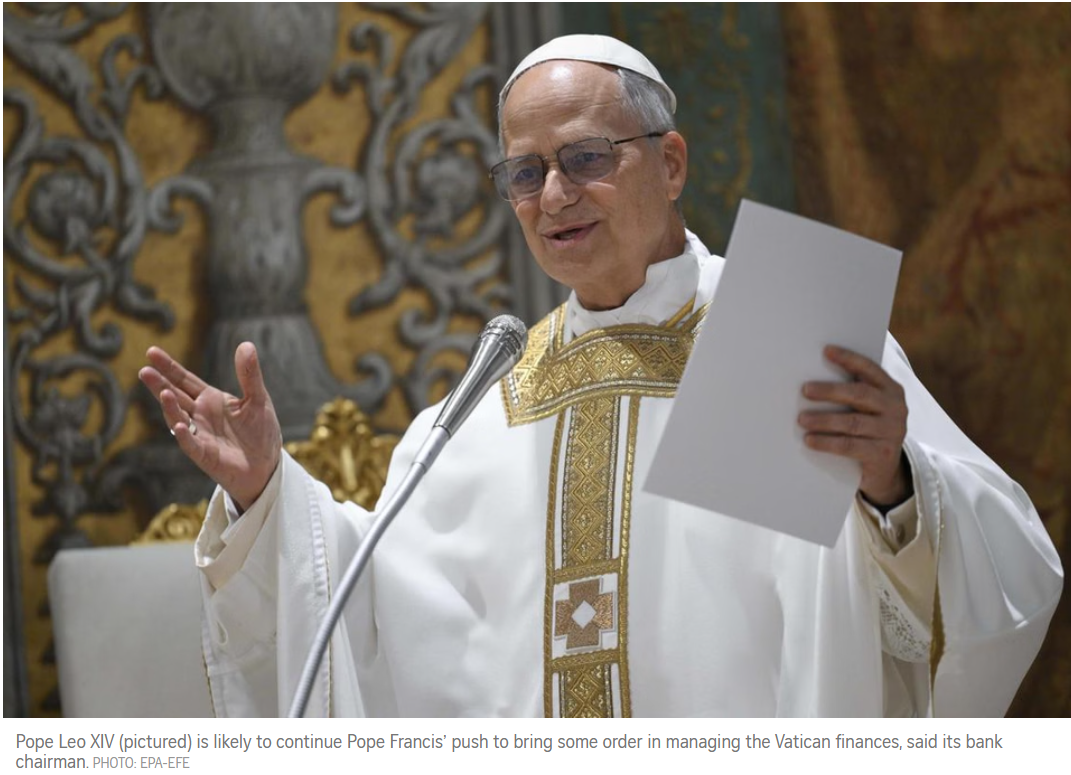
NEWLY SELECTED Pope Leo XIV assumes office amid a turbulent legacy of financial scandals, opaque accounting, and stalled reforms at the heart of the Catholic Church.
The American-born pontiff is reported to inherit not only spiritual leadership over 1.4 billion Catholics but also responsibility for stabilising the Vatican’s precarious financial system—one Pope Francis spent a decade attempting to fix.
Cardinal electors weighed the Holy See’s dire balance sheet during closed-door discussions before the conclave, reflecting the urgency of the crisis.
The Vatican reported a consolidated loss of nearly €70 million on revenues of €1.2 billion in 2023, continuing a pattern of deficits fuelled by declining donations, spiraling operational costs, and a fragile pension scheme.
The crisis has deep roots, with a long history of scandal clouding the Church’s finances.
At the centre of the reform effort stands the Institute for Works of Religion (IOR), known as the Vatican bank.
Its chairman, Jean-Baptiste de Franssu, appointed by Pope Francis in 2014 as part of a sweeping economic overhaul, believes the new pope will carry the torch forward.
“Francis has started the process, I’m sure Leo XIV will continue,” de Franssu told AFP.
The IOR and wider Vatican financial structure have suffered multiple blows over the decades.
The 1982 collapse of Banco Ambrosiano, in which the Vatican held a majority stake, became a symbol of entrenched corruption. Its chairman, Roberto Calvi, was found hanged under London’s Blackfriars Bridge in a suspected mafia-linked murder.
By 2013, when the recently late Pope Francis assumed office, conditions remained dire. Italy’s central bank had halted all card payments in the Vatican over its failure to comply with anti-money laundering laws, and the US listed the microstate among countries of concern for illicit finance.
Francis responded by launching the Secretariat for the Economy, enforcing stricter oversight, and clearing out nearly 5,000 dubious accounts from the IOR.
These efforts earned the Vatican entry into the Single Euro Payments Area and rare praise from the Council of Europe for its anti-money laundering measures.
Still, resistance to reform ran deep. “There was no strong governance, the rules were not respected, we did not have the right competence,” de Franssu admitted of his early days at IOR.
High-profile trials followed. In 2023, Cardinal Angelo Becciu—once among the Vatican’s most powerful figures—was convicted of embezzlement and sentenced to five years and six months in prison.
The trial exposed a complex web of financial crimes involving former Vatican staff, lawyers, and financiers.
At its heart was a disastrous property investment in London’s Chelsea district, partly funded by Peter’s Pence—the global collection for the pope’s charitable works.
Becciu’s removal from office and exclusion from the conclave that elected Leo XIV marked a dramatic fall from grace. He has since lodged an appeal.
Beyond past scandals, Pope Leo XIV now faces the pressing realities of diminished contributions from the faithful, rising salaries, and a retirement fund the Vatican admits is unsustainable.
Pope Francis himself warned last year the Church “cannot guarantee in the medium term the fulfilment of the pension obligation for future generations.”