By Jemimah Wellington, JKNewsMedia Reporter
VIBRANT PROCESSIONS, tight security, and resounding calls for a living wage defined this year’s International Labour Day gathering in Abuja, where Nigerian workers rallied in solidarity amid biting economic challenges.
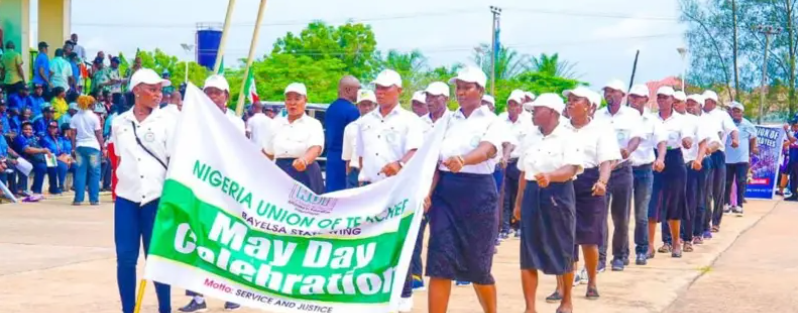
Workers across Nigeria converged on Eagle Square in the heart of Abuja on Thursday to mark the 2025 May Day celebration, joining millions worldwide in commemorating the struggles and triumphs of the labour force.
The square came alive with colour as employees from diverse sectors arrived in coordinated uniforms symbolising their vocations—from construction and civil service to teaching and health care.
The rally, organised by the Nigeria Labour Congress (NLC) and the Trade Union Congress (TUC), drew thousands in a show of unity and resilience, underscoring the enduring spirit of Nigerian workers despite soaring inflation, fuel shortages, and economic stagnation.
Security operatives from the Nigeria Police Force, the Department of State Services (DSS), and the Nigeria Security and Civil Defence Corps (NSDC) manned checkpoints across the venue, ensuring a controlled atmosphere for the event.
Attendees were thoroughly screened at all entry points, with plain-clothed officers stationed inside the square.
This year’s Labour Day theme, “Reclaiming the Civic Space in the Midst of Economic Hardship”, reflected the current national mood.
Union leaders were expected to use the platform to highlight pressing issues affecting workers nationwide, from the long-delayed implementation of the newly approved ₦70,000 minimum wage to calls for improved welfare and social protection.
There was glaring uncertainty over the attendance of President Bola Tinubu or Vice President Kashim Shettima at the event—the second May Day celebration under the Tinubu administration.
Many workers spoke candidly about their frustrations under the current administration. Oloruntoba Aduragbemi, a civil servant in Lagos, described how rising transport costs have forced her to walk halfway to work.
“The President promised us a better Nigeria before taking office, but what I’m seeing is far from it,” she said.
Another worker criticised the removal of the fuel subsidy, stating that while the policy might have curbed corruption, the absence of effective mitigation measures has left ordinary Nigerians reeling.
“Even though Tinubu approved the ₦70,000 minimum wage, some state governments are yet to begin payments,” she added. “The job I do isn’t meant for a woman, but I have no choice. My husband’s salary can’t sustain our family of six.”
Amid the grim economic backdrop, political leaders extended messages of solidarity. Senate President Godswill Akpabio praised Nigerian workers for their resilience, calling them the “backbone of the economy.”
He noted the Senate’s recognition of their contributions, stating, “Despite obvious challenges, you remain the backbone of our economy. Your unwavering commitment drives our nation forward.”
First Lady Oluremi Tinubu hailed workers in both formal and informal sectors, acknowledging their central role in national development. Former Vice President Atiku Abubakar also paid tribute, urging the government to see workers as partners, not just instruments of economic growth.
“In the face of hardship and poor remuneration, Nigerian workers continue to shoulder our economic ambitions with quiet heroism,” his statement read.
From Bayelsa, Governor Duoye Diri invoked personal history in his message, recalling his roots as the son of a classroom teacher. “I stand in profound solidarity with every worker,” he said, affirming that his administration values their sacrifice and cooperation.