By Joke Kujenya
PAINFUL BUT necessary adjustments in Nigeria’s tax system are beginning to yield measurable results as the Presidential Fiscal Policy and Tax Reforms Committee (PFPTRC) Chairman, Taiwo Oyedele, said the government advances a sweeping national tax overhaul designed to simplify levies, cut corporate rates, and promote fairness.
At an interactive session with media practitioners, the committee chaired by Oyedele, he outlined how government actions since May 2023 have stabilised the macroeconomy, reduced inefficiencies, and laid a foundation for sustainable growth.
According to the presentation, reforms have transformed the fiscal landscape from a period of deficit, inflation, and revenue strain to a stage of cautious recovery anchored on policy coordination and financial discipline.
Present at the media meet were other members of PFPTRC, Oyedele said the committee noted that before the reforms, Nigeria’s fiscal environment faced multiple exchange rate windows, unsustainable subsidies, and a tax-to-GDP ratio below 10 per cent.
These weaknesses left the economy vulnerable, with debt service consuming nearly all revenue.
However, current data presented by the committee indicate significant progress, including unified exchange rates, higher reserves exceeding $23 billion, improved FAAC inflows, and a rising tax-to-GDP ratio now at 13.5 per cent.
The report stressed that the reform framework is people-centred, growth-focused, and efficiency-driven. “We are reforming to make Nigeria’s tax system more conducive for growth,” the presentation stated.
The measures include harmonising taxes, eliminating double taxation, reducing compliance costs, and ensuring a progressive system where the poor are exempted, the middle class pays less, and the wealthy contribute more.
The reforms are being implemented in phases—foundation, capacity, and implementation—aimed at creating a unified, transparent, and digitalised tax administration.

At the core of the institutional changes is the establishment of the Nigeria Revenue Service (NRS), which replaces the Federal Inland Revenue Service (FIRS) as a unified collection body for federally collectible taxes and levies.
In the foundation phase, the government is gazetting and publishing all new tax Acts and developing transitional guidelines and subsidiary regulations.
The capacity phase includes nationwide training for tax officials, judges, and professionals, alongside technology upgrades to integrate a unified taxpayer database linked to the National Identification Number (NIN) and the Corporate Affairs Commission (CAC).
The implementation and monitoring phase involves public awareness campaigns across all geopolitical zones, tax clinics targeting small businesses and the informal sector, and a Tax Reform Results and Accountability Tracker (TRRAT) to measure performance indicators such as revenue growth and compliance rates.
Under the new fiscal regime, small businesses are key beneficiaries.
The reform increases the exemption threshold for small enterprises, eliminates taxes on investment and capital, and reduces the corporate income tax rate from 30 percent to 25 percent.
The minimum tax on companies’ turnover and capital has been scrapped to ease entry barriers for startups and improve operating cash flow.
Oyedele said the policy also harmonises levies previously administered by multiple agencies, such as the Tertiary Education Tax, NITDA levy, and NASENI levy, into a simplified structure.
The number of statutory taxes and levies is being reduced from over sixty to fewer than ten. According to the committee, this streamlining will remove duplication and create certainty for investors.
On personal income tax, a progressive structure has been introduced, ensuring low-income earners pay no tax, middle-income earners pay less, and high-income earners contribute more.
Comparative data from the presentation show Nigeria now has the lowest major tax rates among peer African economies. While South Africa’s top personal tax rate stands at 45 percent, Kenya and Ghana maintain 35 percent, compared with Nigeria’s 25 percent.
The committee clarified that no new taxes have been introduced on the masses since the current administration assumed office.
Instead, several taxes have been repealed or suspended, including the 5 percent excise duty on airtime and data, cybersecurity levy on money transfers, carbon tax on single-use plastics, and import duties on essential goods such as food, pharmaceuticals, and agricultural items.
The committee further outlined changes in capital gains tax, replacing the flat 10 per cent rate with a progressive structure aligned with global best practices in the United States (US), United Kingdom (UK), South Africa, Ghana, and Brazil. Gains are now taxed on a net basis, allowing for the deduction of capital losses.
Small companies and individuals with gains below N10 million are exempt, while re-investment reliefs and exemptions for reorganisations remain in force.
To support market growth, the reform provides input VAT credit on assets, tax reliefs for investments, and a low withholding tax regime to enhance liquidity.

It also caps the total number of taxes in the Constitution to prevent future proliferation of levies.
The policy emphasises a balance between fiscal federalism and national coherence. Efforts are ongoing to harmonise subnational taxes and levies through collaboration with states.
A presumptive tax regime will be introduced for hard-to-tax informal sector operators, promoting inclusivity and voluntary compliance.
The reform also introduces a five per cent fuel surcharge on fossil fuels such as petrol and diesel, to be activated by ministerial order.
The levy is designed as an environmental charge to promote cleaner energy transition.
According to the committee, Nigeria’s transformation from a fragmented and archaic tax structure to a modern, harmonised system will enhance competitiveness, attract investment, and improve living standards.
“The reforms will facilitate economic growth and shared prosperity,” the statement noted.
The government projects that with sustained implementation, Nigeria will achieve a healthier fiscal balance, lower budget deficits, and improved credit ratings, while reducing the tax burden on businesses and households.
The committee, led by Oyedele, concluded its briefing with a call-to-action urging citizens, businesses, and stakeholders to engage actively, understand the provisions of the new laws, and identify areas of benefit.
They also had a one-hour media tete-a-tete during which diverse questions from journalists were answered.
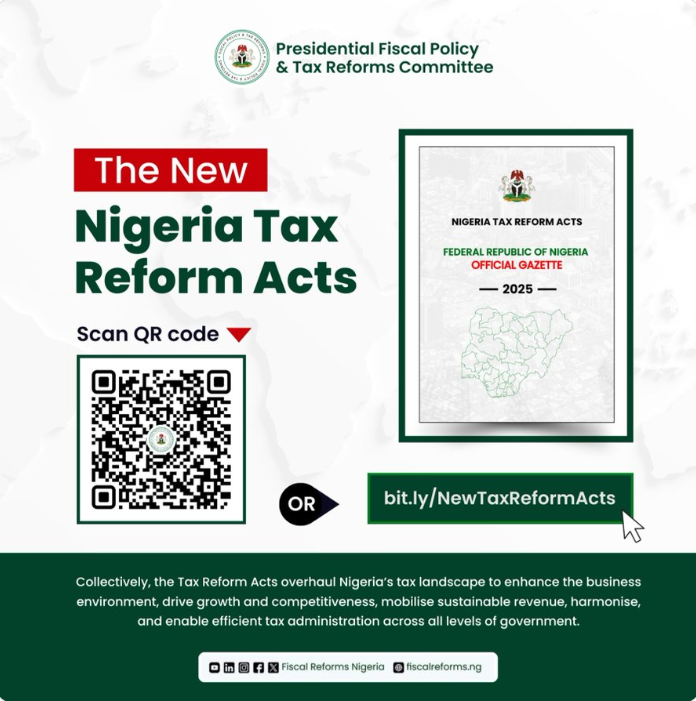
Citizens were encouraged to visit the official platform, fiscalreforms.ng, for accurate information and updates.
As the reforms progress, the Presidential Fiscal Policy and Tax Reforms Committee affirmed its commitment to transparency, stakeholder collaboration, and the long-term goal of building an efficient, equitable, and growth-oriented tax system.