By Joke Kujenya
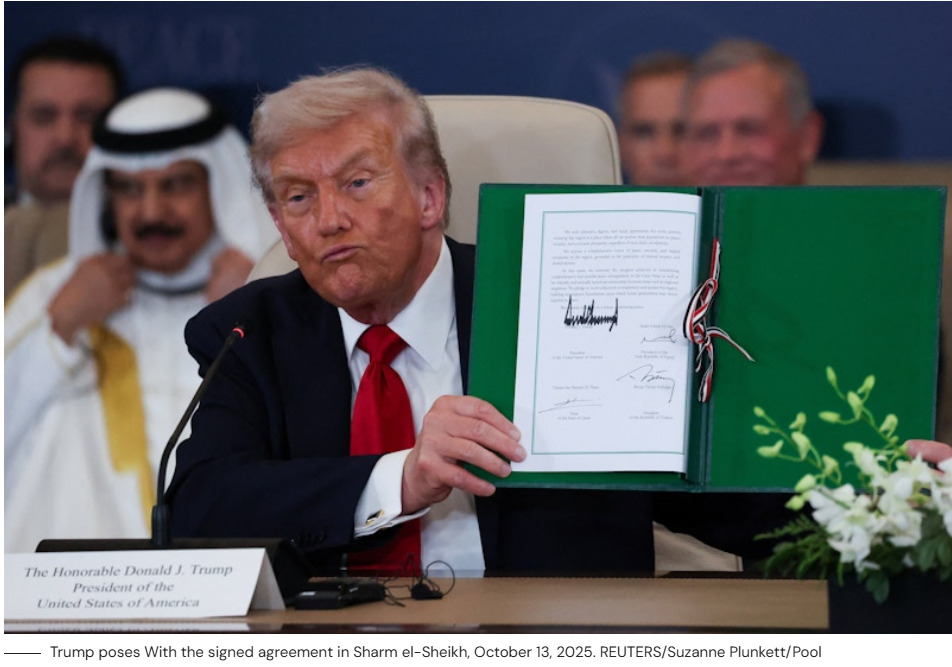
DIPLOMATIC MOMENTUM gathered in Sharm El-Sheikh on Monday as United States President Donald Trump joined Arab leaders to finalise what officials described as the most comprehensive Israel-Gaza peace accord in nearly two decades.
The agreement, signed in the Red Sea resort city, signals a coordinated regional effort to end the long-running Israel–Hamas conflict and rebuild Gaza after years of destruction.
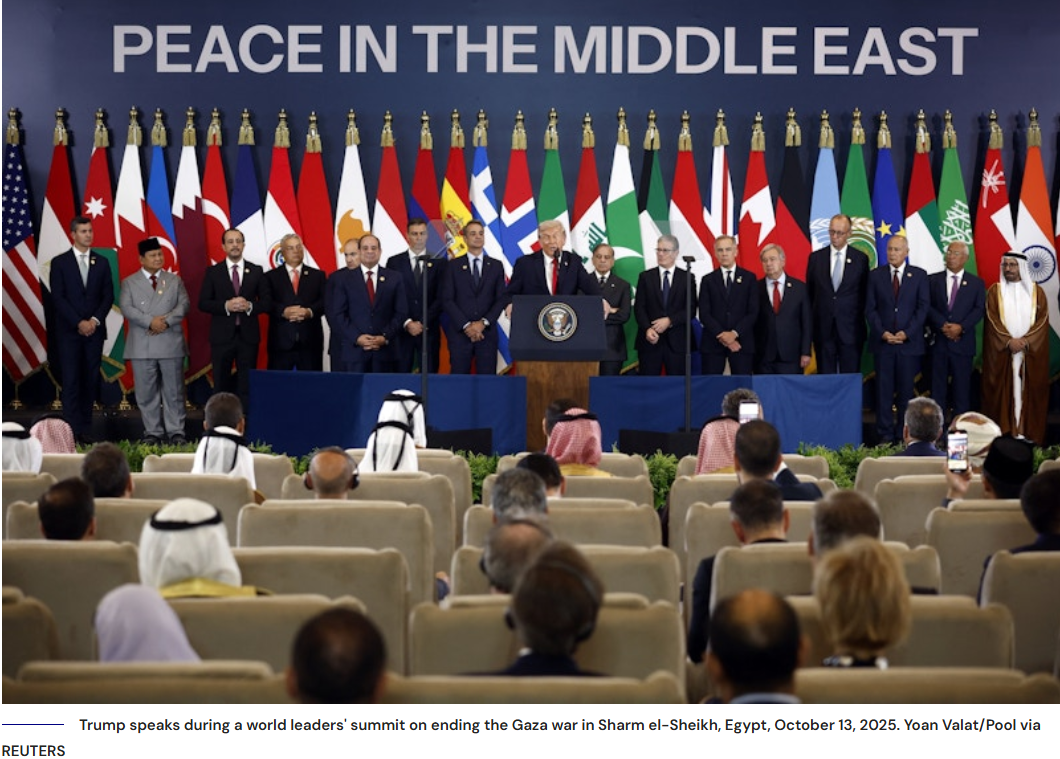
Standing alongside Egyptian President Abdel Fattah al-Sisi, Qatar’s Emir Sheikh Tamim bin Hamad Al Thani, and Turkish President Recep Tayyip Erdoğan, Trump hailed the deal as a “turning point for peace in our time.”
Addressing delegates, he said, “The rebuilding begins.
“It may be easier than the war itself. The world has watched long enough. Today, we take a step that few believed possible — peace, security, and dignity for both Israelis and Palestinians,” Trump noted.
The accord, mediated by Egypt, Qatar, and Turkey, establishes a permanent ceasefire, a prisoner and hostage exchange, and a multi-billion-dollar reconstruction plan for Gaza.
According to the joint communiqué, the deal includes a total ceasefire and withdrawal of Israeli forces from central Gaza within 30 days, a comprehensive hostage exchange involving 20 living Israeli captives for thousands of Palestinian detainees, and the creation of a transitional governing council in Gaza.
The arrangement will be backed by a multinational stabilisation force and a $53 billion reconstruction fund led by Gulf donors and international partners.
A senior Egyptian diplomat said the accord “marks the first time both Israel and Hamas have signed a binding written framework since the start of the 2023 war,” describing it as an “imperfect but historic” step toward ending recurrent hostilities.
President al-Sisi called the agreement a “last chance for stability in the region,” asserting that Egypt “rejects any plan that displaces Palestinians or denies their right to their homeland.”
He stressed that the accord’s goal was to rebuild Gaza rather than “resettle it elsewhere.”
Qatar’s Emir Sheikh Tamim described the initiative as “a step toward ending the endless cycle of bloodshed,” while pledging Doha’s full commitment to humanitarian recovery.
Turkey’s President Erdoğan welcomed the outcome as “a necessary reset in regional cooperation,” urging all parties to “move beyond revenge and toward reconstruction.”
The deal, informally termed The Cairo Compact, revives aspects of Trump’s earlier Abraham Accords, expanding them to include Gaza’s post-war transition.
Aides said the U.S. President had engaged in months of quiet back-channel diplomacy with Arab capitals and Israeli officials before the announcement.
Earlier at the Knesset in Jerusalem, Trump told lawmakers, “We have achieved what they said could never be done — an agreement that ends war and begins renewal.”
Analysts observed that the development could bolster Trump’s global statesmanship credentials ahead of the 2026 U.S. elections, though they cautioned that sustaining the truce would depend on cooperation from all sides.
Israeli Prime Minister Benjamin Netanyahu confirmed that the first phase of the ceasefire had commenced and expressed appreciation to international mediators.
“This deal secures our hostages, strengthens Israel’s security, and opens a path to lasting calm,” he stated. The Israeli Defence Forces began a partial withdrawal from northern Gaza over the weekend, with United Nations (UN) monitors scheduled to verify compliance.
Reactions across the Arab world were mixed. Jordan’s Foreign Minister Ayman Safadi welcomed the development but called for “clear guarantees” for Palestinian self-determination, saying that “without a genuine path toward a two-state solution, this peace will remain temporary.”
Saudi Arabia’s Foreign Ministry also praised the humanitarian provisions of the accord but reaffirmed that “true peace depends on ending occupation and recognising Palestinian sovereignty.”
Protests were reported in parts of the West Bank and Beirut, where demonstrators accused Arab governments of conceding too much influence to Washington.
Implementation challenges remain considerable. Hamas’s role in Gaza’s transitional administration is yet to be fully defined, Israel insists on maintaining limited security oversight along the borders, and the timely release of reconstruction funds will determine the pace of recovery.
Middle East analyst Tareq al-Husseini told Reuters that the deal “could reshape the region — or unravel within months,” adding that “everything depends on political will and sustained international oversight.”
UN Secretary-General António Guterres described the agreement as “an overdue step toward restoring humanity,” urging that it “must be the start of a just peace, not merely the end of a violent chapter.”
European Union foreign policy chief Josep Borrell welcomed the initiative and announced that Brussels would contribute €2 billion toward reconstruction efforts.