By Joke Kujenya
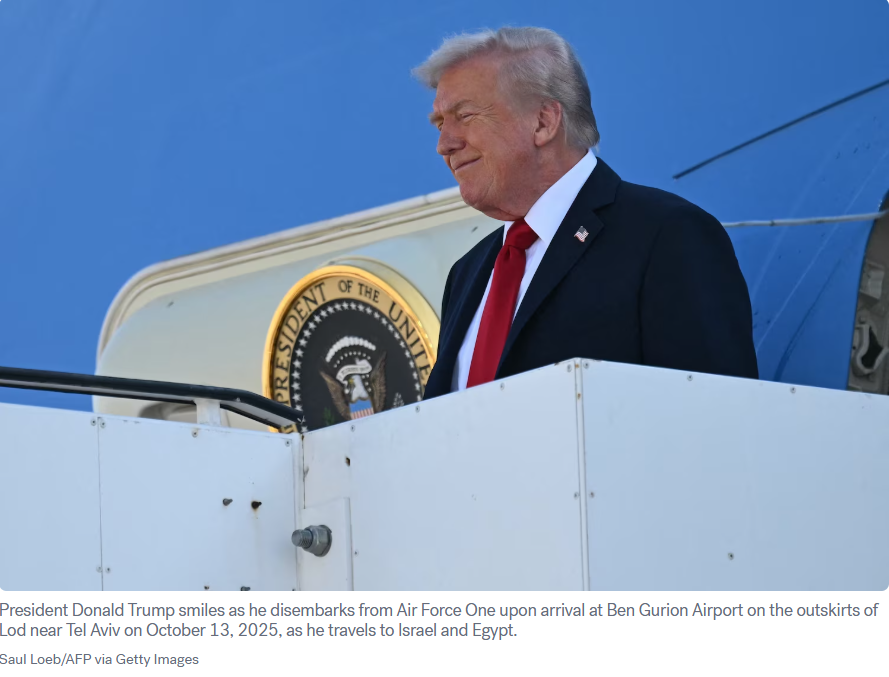
TENSION BEGAN to ease across the Middle East on Monday as President Donald Trump arrived in Israel to address the Knesset, marking a pivotal moment in the United States-brokered ceasefire between Israel and Hamas.
His visit came as the last 20 living Israeli hostages held by Hamas were returned home under the terms of a prisoner exchange agreement that has brought cautious relief after more than two years of devastating conflict.
According to Israeli officials, the freed hostages crossed back into Israeli territory earlier in the day and were immediately taken for medical evaluations before reuniting with their families.
The Israel Defense Forces (IDF) confirmed that several of the returnees, including Omri Miran, Guy Gilboa-Dalal, and Alon Ohel, were airlifted by helicopter to hospitals for further care and family reunions.
The released group also included twin brothers Ziv and Gali Berman. Officials said the remains of 28 deceased hostages have yet to be returned.
In exchange for the hostages, Israel has released 250 Palestinian prisoners and more than 1,700 detainees, the first groups of whom have now left Israeli prisons.
The move forms part of the wider agreement negotiated through international mediation to end the war in Gaza, which began after the October 7, 2023, attacks.
Addressing the Israeli parliament, President Trump declared that “Israel has won all that can be won by force of arms,” adding that “it is time to translate these victories against terrorists on the battlefield into the ultimate prize of peace and prosperity for the entire Middle East.”
He said the next phase of the region’s recovery must be “focused on restoring stability, safety, dignity, and economic development so the people of Gaza can finally have the better life their children deserve.”
A spokesperson for Hamas said in a statement that the group welcomed the U.S. President’s remarks in Jerusalem, calling on “all mediators and international parties” to ensure that Israel’s military operations in the Gaza Strip do not resume.
The spokesperson reaffirmed the group’s commitment to the ceasefire terms while urging the international community to monitor the situation closely.
In Gaza, residents who had fled the violence have begun returning to what remains of their homes, starting to reckon with the scale of destruction after two years of continuous bombardment.
While relief is visible in some quarters, the process of rebuilding remains uncertain amid a fragile truce and deep humanitarian scars.
Israeli Prime Minister Benjamin Netanyahu and President Isaac Herzog welcomed President Trump at Ben Gurion Airport before accompanying him to the Knesset.
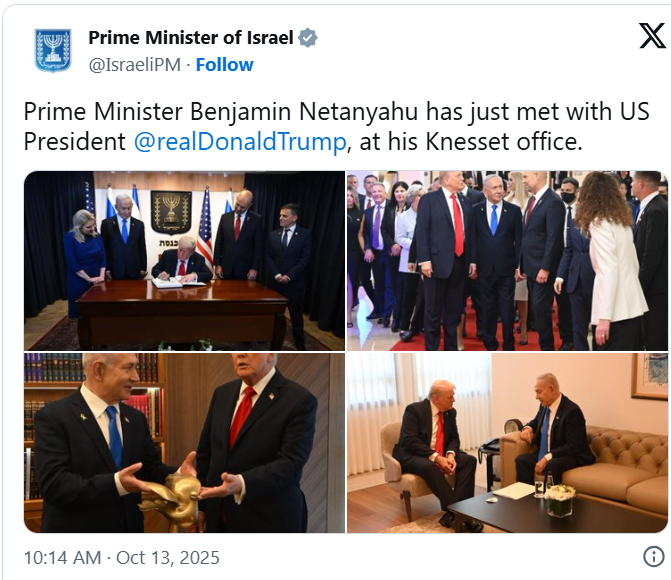
The Israeli Prime Minister’s Office released photographs showing the leaders meeting ahead of the address. The atmosphere was described as cautiously hopeful as discussions turned to consolidating the ceasefire and preparing for the next stage of the peace process.
The U.S. delegation attending the session included Secretary of State Marco Rubio, Secretary of War Pete Hegseth, U.S. Ambassador to Israel Mike Huckabee, and the Chairman of the Joint Chiefs of Staff.
The group is expected to join President Trump later in Egypt for an international peace summit co-chaired by Egyptian President Abdel Fattah El-Sisi.
According to a statement from the Egyptian presidency, the Sharm El-Sheikh summit will gather leaders from more than 20 countries, including Palestinian Authority President Mahmoud Abbas and Prime Minister Netanyahu.
The summit aims “to end the war in the Gaza Strip, enhance efforts to achieve peace and stability in the Middle East, and usher in a new era of regional security and stability.”
Egypt, as one of the key mediators in the ceasefire negotiations, has worked closely with the United States and regional partners to maintain dialogue between Israel and Hamas.
Officials said discussions in Sharm El-Sheikh will focus on rebuilding Gaza, securing humanitarian access, and establishing long-term frameworks for political reconciliation across the region.

The World Bank and United Nations have also been engaged in assessing the scale of reconstruction needs in Gaza, where years of conflict have destroyed infrastructure and displaced hundreds of thousands of residents.
Regional governments are expected to pledge support for post-war recovery during the summit.
Families on both sides of the conflict marked the day with mixed emotions—relief at the return of loved ones, grief for those lost, and apprehension about what comes next.
In Khan Younis, Palestinian father Muhammad Hasan Saeed Dawood described collecting his son, who had been detained by Israeli forces at a checkpoint, as “a very beautiful feeling and happy, a day of joy.” He called it “a national holiday,” reflecting the sense of cautious optimism among many families in Gaza.
Meanwhile, President Trump is expected to continue bilateral meetings in Jerusalem before travelling to Egypt for Tuesday’s peace summit.
His administration has described the current ceasefire as “the foundation of a new chapter for the Middle East,” though officials acknowledge that lasting peace will depend on sustained dialogue and mutual adherence to the terms of the truce.