By Joke Kujenya
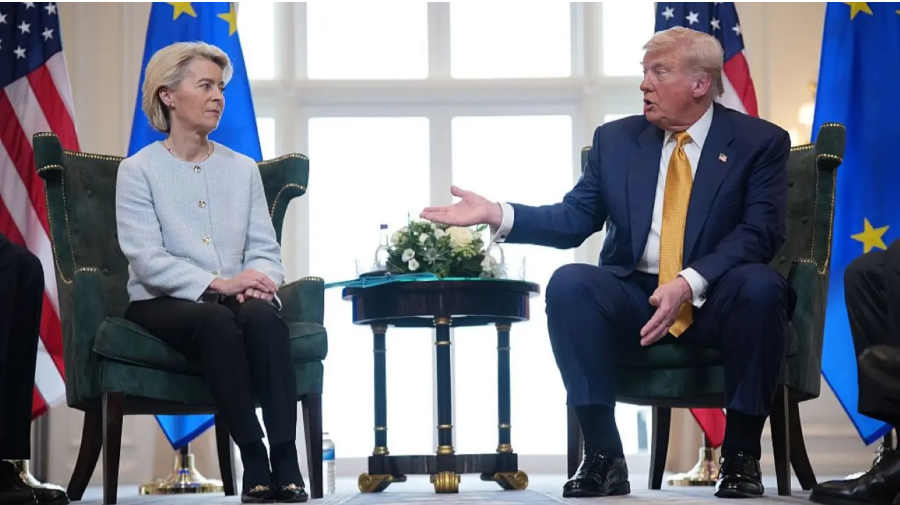
UNITED STATES (US) President Donald Trump and European Commission President Ursula von der Leyen on Sunday announced a transatlantic tariff agreement to avoid a full-scale trade war, hours before a White House-imposed deadline that threatened sweeping new levies on EU exports.
The deal, reached during a one-hour bilateral meeting at Trump’s Turnberry golf resort in Scotland, imposes a flat 15 percent tariff on European Union exports to the United States, including automobiles, steel, and aluminium, down from the previously threatened 30 percent levy.
“We have reached a deal. It’s a good deal for everybody,” Trump said.
He confirmed the agreement includes a commitment from the EU to purchase $750 billion worth of American energy and invest an additional $600 billion in the US economy.
Von der Leyen, negotiating on behalf of the EU’s 27 member states, said the agreement would provide “stability” and “predictability” to businesses on both sides of the Atlantic.
“It’s a good deal. It will bring stability. It will bring predictability. That’s very important for our businesses,” she told reporters while seated next to Trump.
EU Avoids Immediate US Tariff Hike
The deal comes just ahead of the 1 August deadline set by Washington for the EU to strike a deal or face a blanket 30 percent tariff on all exports to the US.
The EU had been facing multiple layers of tariffs since Trump’s return to office: 25 percent on cars, 50 percent on steel and aluminium, and an across-the-board 10 percent levy.
Had the deal collapsed, EU member states had already greenlit retaliatory tariffs targeting $109 billion worth of American goods, including aircraft and vehicles, to begin on 7 August.
Brussels was also preparing further restrictions on US services and public contracts.
Von der Leyen had lobbied for exemptions for key sectors such as pharmaceuticals, aircraft, and spirits, but Trump ruled out concessions.
He confirmed pharmaceuticals would be excluded from any preferential treatment, stating that all drugs must be “built, made in the United States.” Earlier this month, Trump threatened a 200 percent tariff on imported medications.
Trump also rejected an EU proposal for a steel quota system, insisting that tariffs on European steel “stay the way they are.”
The agreement requires final approval from EU member governments. EU ambassadors, who were in Greenland for an official engagement at the time of the talks, were briefed by the European Commission on Sunday and are scheduled to reconvene to deliberate.
With an annual $1.9 trillion in goods and services exchanged between both economies, the EU had sought to preserve a fragile trading relationship and avoid economic shocks that could ripple through major sectors, especially in Germany and France.
The agreement sets the same tariff baseline as the US-Japan trade deal signed earlier in the year. While the 15 percent rate remains significantly higher than the pre-Trump average of 4.8 percent, it averts further escalation.
US Commerce Secretary Howard Lutnick reaffirmed that the 1 August deadline was non-negotiable.
“There will be no extensions, no more grace periods,” Lutnick said Sunday.
Trump has made tariff reform a cornerstone of his second term trade agenda, warning dozens of countries to strike bilateral pacts or face punitive measures by the deadline.