By Ajibola Olaide, JKNewsMedia Reporter
GLOBAL MARKETS slumped on Wednesday as US President Donald Trump imposed sweeping tariffs on Nigerian imports, adding to concerns over escalating trade tensions.
The move, part of Trump’s broader protectionist trade policy, triggered uncertainty in financial markets, with Wall Street, European indices, and Asian markets all seeing turbulence.
Trump’s decision to impose new tariffs on Nigeria follows months of trade tensions, with the US President arguing that the country has benefited unfairly from US trade policies.
The specific levies, which took effect immediately, include duties on key Nigerian exports such as agricultural products and manufactured goods.
The White House confirmed that Trump would formally outline the measures at 4.00pm Washington time (2000 GMT), after the close of US markets, in what he promised would usher in a “golden age” of American industry.
However, officials admitted on Tuesday evening that final details were still being ironed out.
Meanwhile, the dollar weakened slightly, oil prices dipped, and gold—considered a safe haven—flirted with an all-time high as traders sought shelter from market volatility.
While Tokyo’s Nikkei index closed marginally higher and Chinese indices stabilised, European markets turned lower, led by a sharp decline in Frankfurt.
The losses extended to Wall Street after the opening bell, with the Dow Jones Industrial Average, the S&P 500, and the Nasdaq Composite all trading lower.
“For traders and investors, Wednesday represents a day of huge uncertainty as we weigh up the potential for retaliatory tariffs and a tit-for-tat trade war,” said Joshua Mahony, an analyst at Scope Markets.
Also, Tesla shares tumbled five percent in early trading following lacklustre first-quarter sales figures, with the electric vehicle maker citing reduced production and consumer hesitation stemming from CEO Elon Musk’s association with the Trump administration.
Oil prices also edged lower, with West Texas Intermediate slipping to $71.11 per barrel and Brent crude falling to $74.31 per barrel. The US dollar lost ground against both the euro and the pound, reflecting investor anxiety over potential inflationary pressures from the tariffs.
Trump’s Hardline Trade Stance Ignites Global Trade War Fears
Trump’s escalating tariff war has drawn swift rebukes from major global economies.
The European Union and China vowed to retaliate, while Australian Prime Minister Anthony Albanese called the tariffs “not the act of a friend.”
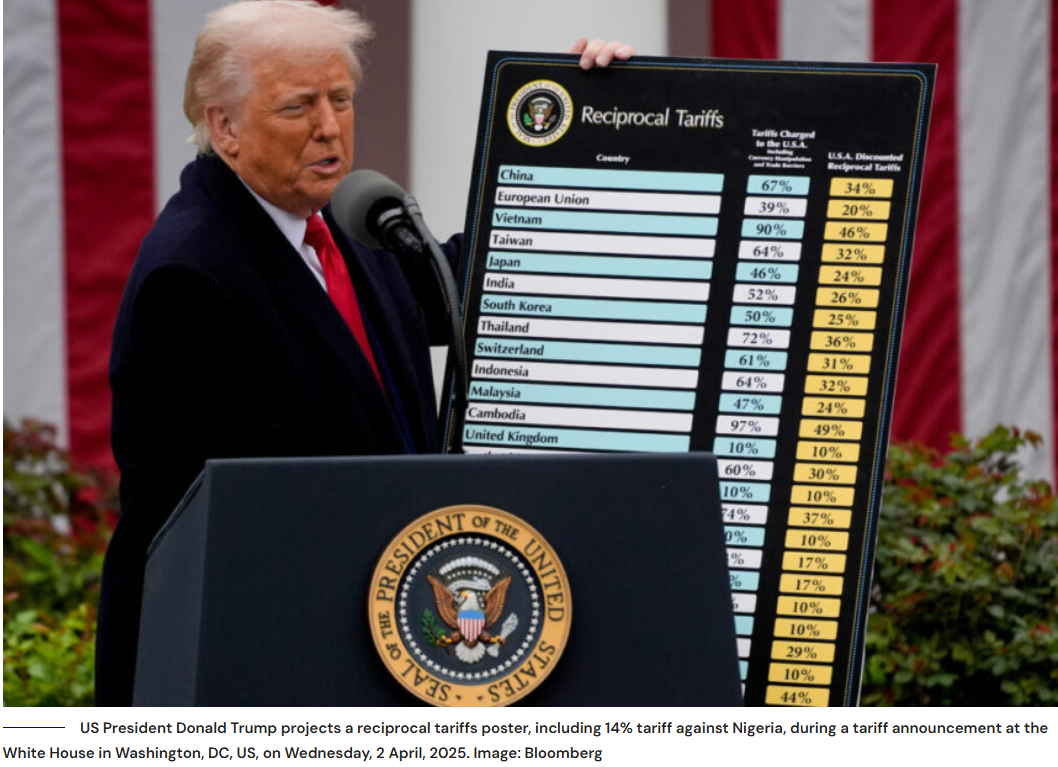
Holding up a chart of the sweeping measures in the White House Rose Garden, Trump hailed the tariffs as “our declaration of economic independence,” arguing they would correct decades of unfair trade practices.
“For decades, our country has been looted, pillaged, raped, and plundered by nations near and far, both friend and foe alike,” Trump declared.
The new tariffs include an additional 34 percent levy on Chinese goods, bringing the total added rate to 54 percent. The EU faces a 20 percent tariff, while Japan will see 24 percent.
Countries deemed to have “treated us badly”—including Vietnam (46 percent), Cambodia (49 percent), and Myanmar (44 percent)—were among the hardest hit. A “baseline” tariff of 10 percent will apply to all other nations, including the UK.
The tariffs rattled global stock markets, with Tokyo’s Nikkei index plummeting more than four percent and Vietnam’s main index tumbling five percent. US stock futures also pointed to sharp losses, while gold surged to a record high as investors scrambled for safe assets.
While Trump insisted the tariffs would restore the US economy to a lost “Golden Age,” many experts warned of severe consequences.
The levies could slow global economic growth, rekindle inflation, and force central banks to reconsider interest rate cuts.
US Treasury Secretary Scott Bessent warned that any retaliation would lead to escalation, reinforcing fears of prolonged trade hostilities.
Despite the backlash, Trump remained defiant, championing the tariffs as a way to “Make America Wealthy Again.” Surrounded by cheering workers from industries such as steel and oil, he doubled down on his belief that tariffs were the key to fixing America’s trade imbalances.
The initial 10 percent tariffs take effect on Saturday, with the harsher rates for designated “worst offenders” scheduled to begin on April 9.
Official figures show that several African nations are now subject to the reciprocal tariff framework;
14% on Nigeria (which currently imposes 27% on U.S. imports)
30% on South Africa (matching its 60% tariff on U.S. goods)
40% on Mauritius (which imposes a staggering 80% on U.S. goods)
10% on Ghana (matching its 17% tariff on U.S. goods)
10% on Ethiopia (matching its 10% tariff on U.S. goods)
30% on Algeria (in response to Algeria’s 59% tariff on U.S. goods)
21% on Namibia (which currently imposes 42% on U.S. imports)
50% on Lesotho (matching its 99% tariff burden on U.S. goods)
10% on Kenya (matching its existing 10% tariff)
Mauritius, Lesotho, and Algeria face the highest tariffs, while South Africa and Nigeria are among the largest economies impacted by these changes.