By Joke Kujenya
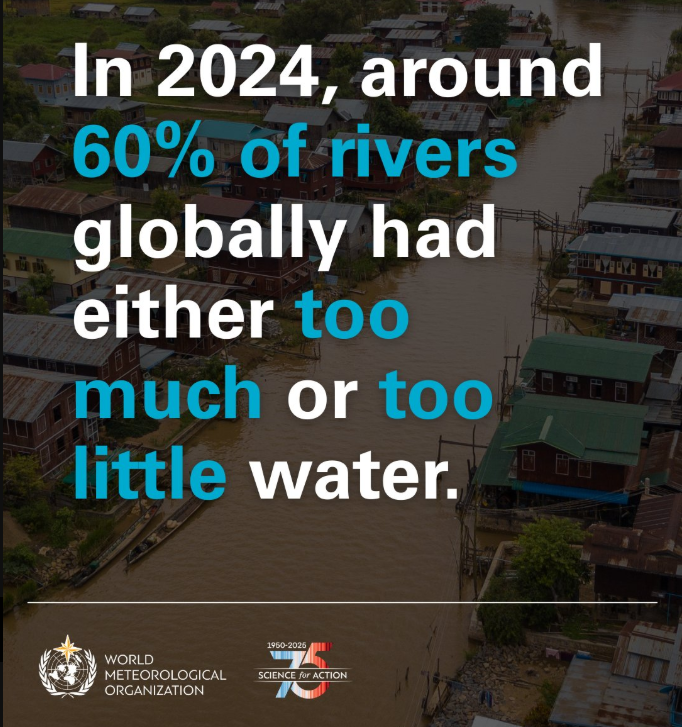
ESCALATING CLIMATE extremes are driving the world into a deepening water crisis, with catastrophic floods, prolonged droughts, violent storms, and accelerating glacial loss striking at rates described as abnormal and increasingly severe.
This warning comes from the State of Global Water Resources 2024 report issued by the World Meteorological Organisation (WMO), which underlined the mounting pressure facing nations as global temperatures rise and the water cycle becomes more volatile.
The UN agency said water-related disasters are occurring more frequently across regions, with Europe, South Asia, Africa, and South America all experiencing extreme events that illustrate the destabilisation of global hydrological systems.
“This year has been marked by relentless water-related hazards,” WMO Secretary-General Celeste Saulo stated. “We’ve seen catastrophic flooding in Pakistan, South Sudan, and Indonesia – and the trend shows no signs of slowing.”
According to the report, the year 2024 was confirmed as the hottest in 175 years of recorded observation.
Average global surface temperatures were measured at 1.55°C above pre-industrial levels, creating conditions that accelerated ice melt, destabilised river systems, and disrupted rainfall patterns.
The WMO calculated that 450 gigatonnes of glacial ice were lost within the year, a volume sufficient to raise global sea levels by 1.2 millimetres.
The report emphasised that such changes pose a grave threat to coastal populations, ecosystems, and low-lying island nations.
In central and eastern Europe, the destructive force of Storm Boris triggered flash floods that displaced tens of thousands of residents.
Rivers in the Czech Republic rose to levels usually expected only once in a century, underscoring how rare events are becoming regular occurrences.
“The water cycle is no longer predictable,” said Stefan Uhlenbrook, WMO Director of Hydrology. “What used to be rare is becoming routine.”
The report documented striking regional contrasts. Wetter-than-average conditions dominated central-western Africa, Lake Chad, Kazakhstan, southern Russia, and parts of Asia.
By contrast, large areas of South America and southern Africa experienced prolonged droughts that undermined food security, weakened hydropower supply, and placed additional strain on water-dependent communities.
The WMO stressed that such extremes illustrate the interconnected nature of the water cycle.
Disruptions in one part of the world can generate ripple effects across borders, destabilising agriculture, trade, and livelihoods in regions far from the source of the initial disruption.
Alongside the observed disasters, the agency highlighted a serious gap in global water data.
Monitoring of key hydrological indicators such as streamflow, groundwater levels, soil moisture, and evaporation remains incomplete or inconsistent.
This, the report stated, undermines the capacity of governments, agencies, and communities to manage water resources and prepare for emergencies.
“Without reliable data, we’re flying blind,” Saulo warned. “We must invest in monitoring systems and international cooperation to safeguard water security.”
The WMO urged a comprehensive and coordinated response to the crisis.
Among the measures outlined were the expansion of real-time monitoring networks, improvements in the collection of data on groundwater and river flows, and the deployment of advanced satellite-based hydrological models to enhance forecasting and early warning systems.
The report further called for investment in open data platforms to ensure that information is accessible to governments, researchers, and emergency responders.
The agency noted that better forecasting and early warnings can save lives and reduce economic losses in the face of floods, droughts, and other hydrological hazards.
Attention was also drawn to infrastructure resilience.
The WMO recommended upgrading flood defences, irrigation systems, and urban drainage networks to withstand increasingly frequent extreme events.
It urged authorities to integrate climate adaptation into water infrastructure planning to protect vulnerable populations.
Training and capacity building were also identified as essential priorities.
Local governments and communities were urged to strengthen disaster preparedness, adopt water conservation practices, and adapt livelihoods to shifting climate realities.
The report emphasised that access to safe and sufficient water must be ensured equitably, particularly for populations in drought-prone and flood-risk regions.
In addition, the WMO stressed the need for integrated water governance.
It recommended closer coordination between sectors such as agriculture, health, energy, and urban planning to prevent competition over resources and to strengthen the resilience of societies to climate shocks.
Reducing greenhouse gas emissions was also highlighted as a decisive factor.
The report stated that limiting further global warming is fundamental to preventing worsening disruption of the water cycle and safeguarding hydrological stability in the long term.
Saulo said the evidence contained in the State of Global Water Resources 2024 demonstrates the scale of the challenge: “With glaciers vanishing, river basins destabilising, and rainfall patterns shifting, no nation can afford to ignore the urgency of coordinated action.
Water is the foundation of life, economies, and ecosystems. Protecting it must be at the core of global climate strategies.”
The report concluded with a clear call for unified international commitment.
It emphasised that lives, ecosystems, and economies will remain at risk unless governments, organisations, and communities act decisively to confront the deepening crisis.
The WMO said the need for data, investment, and cooperation is urgent, stressing that only coordinated strategies will prevent escalating loss and damage linked to climate-driven water disasters.