By Joke Kujenya
THERE IS a quieter form of political courage in Nigeria that rarely receives sustained attention.
It is not the courage of those who hold office or command party structures.
It is the courage of individuals who attempt to enter those spaces, fully aware of how tightly controlled they are.
That is the lens through which the political journey of Bisayo Busari, a 2027 Democratic Leadership Alliance (DLA) presidential aspirant, becomes instructive.
Busari publicly declared her intention to contest for Nigeria’s presidency under the DLA platform, a move that placed her within one of the most competitive and high-barrier political contests in the country.
Her ambition alone challenged long-standing assumptions about who can realistically aspire to lead Nigeria.
But her candidacy did not progress to the ballot stage.
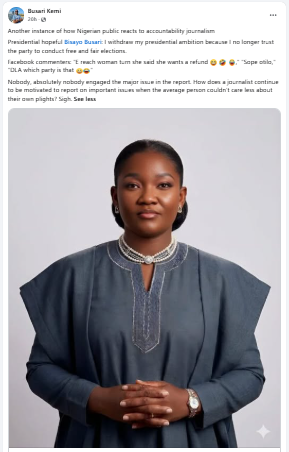
According to her public statement shared on social media, she withdrew from the race after expressing a lack of confidence in her party’s ability to conduct a free and fair internal electoral process.
That concern, whether widely accepted or disputed, sits at the centre of a much larger democratic question: the credibility of internal party democracy in Nigeria.
Internal Democracy As The Weak Link
Nigeria’s democratic system often draws scrutiny at the level of general elections, but the foundations are laid much earlier within political parties.
If aspirants begin to question fairness at the primary level, then the legitimacy of outcomes at the general election stage is already under strain.
Busari’s withdrawal, therefore, is not just a personal political decision.
It reflects a broader anxiety that has long been raised by political actors across party lines: that internal party processes are frequently influenced by power blocs, informal arrangements, and entrenched interests.
Whether her specific claim is universally accepted is less important than what it signals.
It points to a recurring credibility gap within party structures that continues to shape political participation in Nigeria.
The Public Reaction Gap
Equally significant is what followed her announcement or rather, what did not follow.
The story did not generate sustained national debate. It did not evolve into a broader interrogation of internal party democracy or candidate trust in electoral processes.
Instead, it moved quickly through the public space, overtaken by competing political narratives and online attention cycles.
This pattern is not unique to Busari’s case.
It reflects a wider issue in how political information is consumed: issues that speak to institutional design and democratic integrity often receive less sustained attention than more sensational or personality-driven content.
The result is a shrinking space for reflective political engagement, even when the subject matter directly concerns the health of the democratic system.
A journalist’s dilemma, and a public one
For journalists, this creates a familiar tension.
Stories that require time, context, and sustained attention often struggle to compete in an information environment driven by speed and novelty.
Reporting that seeks to connect institutional questions to everyday democratic outcomes can be quickly overshadowed by more immediate or emotionally charged narratives.
Yet the persistence of such reporting remains essential.
Democratic systems are not shaped only by elections and official announcements; they are also shaped by the extent to which citizens engage with questions about fairness, process, and legitimacy.
The challenge is not only on the side of journalists. It also lies in how audiences assign value to different kinds of political information.
Beyond One Candidacy
Busari’s political ambition and subsequent withdrawal should not be read in isolation.
It sits within a broader context of contested trust in political institutions and processes.
Her decision raises questions that extend beyond a single party or individual:
▪️How many potential candidates self-exclude due to perceived or real barriers within party systems?
▪️What does it mean for democratic renewal when internal party confidence is weakened?
▪️And how does this affect the diversity of political participation?
These are not questions with immediate answers; but they are central to understanding how political systems either open up or close down over time.
The Quieter Cost Of Distrust
Democracies are often assessed by visible outcomes: elections held, winners declared, governments formed. Less visible, but equally important, is the confidence individuals have in the fairness of the journey leading there.
When that confidence weakens at the level of party primaries and internal selection processes, it narrows the field of participation long before voters ever cast a ballot.
That is the quieter implication of Busari’s withdrawal.
Not simply that a candidate exited a race, but that her exit reflects a perception of structural limitation within the very spaces meant to produce democratic leadership.
What should not be missed
The significance of this episode is not whether Busari would have won, or whether her assessment of her party was universally shared.
It is that her experience has reopened a familiar but often under-examined question in Nigerian politics: how credible are the internal mechanisms that produce candidates in the first place?
If that question is left unexamined, then public attention will continue to move on quickly, while the underlying issues remain unchanged.
And that is where the real democratic cost emerges not always in dramatic breakdowns, but in the slow normalisation of distrust.
That alone should have sparked a national conversation. Instead, many people barely looked beyond the headline.
What should have captured our collective attention was not merely her withdrawal from the race. It was her reason for stepping aside.
Busari stated that she no longer trusted her party to conduct free and fair elections.
Let’s think about that for a moment.
A presidential aspirant was raising concerns about internal democracy, the very foundation upon which larger democratic processes are supposed to stand.
If party members lose confidence in the fairness of their own political structures, what does that say about the broader democratic culture?
Sadly, the public conversation drifted elsewhere.
None of her critics seemed interested in examining the implications of her bold statement.
None also appeared eager to interrogate the system that produced such disillusionment.
The story just came and went, swallowed by the endless cycle of political drama and social media distractions.
For journalists, this is profoundly discouraging.
Every day, reporters chase stories that matter.
They spend hours conducting interviews, verifying facts, examining documents, and trying to connect public issues to the lives of ordinary people.
The journalists believe, perhaps stubbornly, that information can inspire action and that truth can influence change.
Then comes the painful reality.
A carefully reported story about democratic accountability struggles to attract attention, while gossip, controversy, and sensationalism dominate public discourse.
Critical issues affecting citizens’ futures often receive less engagement than celebrity scandals or political mudslinging.
It raises a difficult question: How does a journalist remain inspired when many people seem indifferent to problems that directly affect them?
The answer may lie in understanding that journalism has never been measured solely by immediate public reaction.
▪️Some stories plant seeds.
▪️Some stories become historical records.
▪️Some stories may be ignored today but prove invaluable tomorrow when society begins searching for answers.
Bisayo Busari’s story is one of those stories. So sad.
Her presidential ambition challenged assumptions about who can aspire to lead Nigeria.
Her withdrawal exposed concerns about democratic processes within political institutions.
Whether one agrees with her position or not, her actions invited a conversation that the country should not have ignored.
History often remembers those who dared to speak before others were ready to listen.
And perhaps, that is where journalists and reformers find their motivation.
Not in applause. Not in trending hashtags. Not even in immediate impact.
But in the belief that documenting truth still matters, even when the crowd looks away.
Because societies do not move forward only through the actions of presidents, governors, or political parties.
Societies move forward because some people continue asking difficult questions long after everyone else has stopped paying attention.
Bisayo Busari asked one of those questions.
The tragedy is not that she withdrew.
The tragedy is that too few people stopped to ask why.
Together now, let’s ask why beyond her immediate reason to see if we can get more answers.
—