By Joke Kujenya
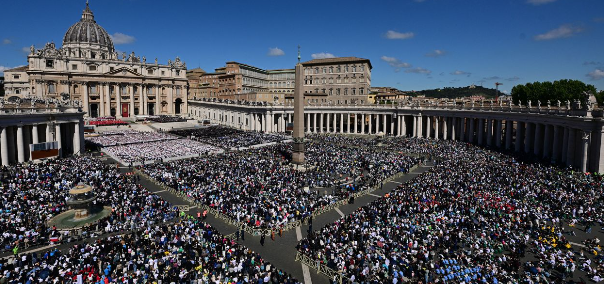
BENEATH A vivid spring sky, an immense gathering of red-robed cardinals, world leaders, and faithful Catholics filled St Peter’s Square to mourn Pope Francis, the first Latin American pontiff whose enduring call for a humbler, more inclusive Church reshaped the Catholic world.
Gregorian chants echoed solemnly through the air as mourners bowed their heads, standing shoulder to shoulder in silent tribute.
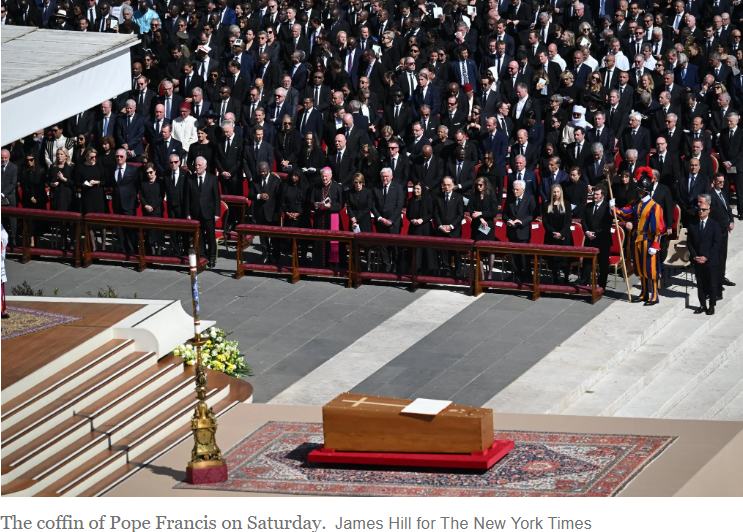
Over 250,000 people, according to Vatican estimates, converged at the heart of Rome, while thousands more thronged the city’s streets and historic bridges to catch a final glimpse of the pope’s simple wooden coffin.
Francis, who died at the age of 88 following a stroke at the Vatican’s Santa Marta guesthouse, had previously directed that his funeral rites remain subdued, favouring simplicity over grandeur.
Yet the funeral Mass, presided over by Cardinal Giovanni Battista Re, bore all the gravity and pageantry that centuries of Catholic tradition demand, set against the backdrop of global conflicts and pressing humanitarian crises.
The ceremony carried powerful symbolism. Prayers were offered in English, Spanish, and Italian, reflecting the international congregation Francis so often championed.
As the Mass unfolded, his coffin was placed before the mourners, the sobering melodies of Gregorian chants weaving through the dense crowds who had waited since dawn.
Among those paying respects were United States President Donald Trump, former President Joseph R. Biden Jr., Ukrainian President Volodymyr Zelensky, and Argentine President Javier Milei, the latter hailing from Francis’ native Argentina.
Refugees, youths, and pilgrims from across continents also formed part of the vast assembly, a testament to the pope’s enduring appeal beyond traditional Catholic circles.
The funeral concluded with the sealing of Francis’ coffin in a private rite inside St Peter’s Basilica, where, according to Vatican tradition, twelve commemorative coins — each representing a year of his papacy — and a metal tube containing a written account of his legacy were interred with him.
Following the ceremony, the late pontiff’s body embarked on a poignant journey across Rome.
Carried in a slow-moving procession, the coffin passed revered landmarks including the Roman Forum and the Colosseum.
Crowds lined the streets, hands clasped, and heads bowed, as the cortege made its way to the Basilica di Santa Maria Maggiore — a beloved site for Francis throughout his papacy.
It marked a historic return to ancient tradition. Not since 1903, with the funeral of Pope Leo XIII, had a deceased pope’s coffin been publicly processed through Rome.
The route, reminiscent of the medieval “Via Papalis,” retraced paths once taken by newly elected popes as they assumed the throne of St John Lateran.
Inside the Basilica di Santa Maria Maggiore, Francis’ body was welcomed by a gathering of Rome’s poor and needy, symbolic of his lifelong devotion to the marginalised.
A private burial, away from cameras and public gaze, would lay him to rest in a simple tomb bearing the inscription “Franciscus”.
Across St Peter’s Square and Rome, the crowds lingered, rosaries in hand, offering final prayers for a pope who, despite fierce internal resistance, strove to humanise the Church while safeguarding its sacred traditions.
With Francis laid to rest, the focus now shifts towards the College of Cardinals, tasked with choosing a successor to carry forward a legacy rooted in humility, reform, and an open heart to the world.