By Ajibola Olaide, JKNewsMedia Reporter
ECONOMIC GROWTH and national security must remain central to Nigeria’s 2027 elections as the country seeks to consolidate democratic gains, strengthen reforms and create greater opportunities for its growing young population, Lagos State Governor Babajide Sanwo-Olu has said.
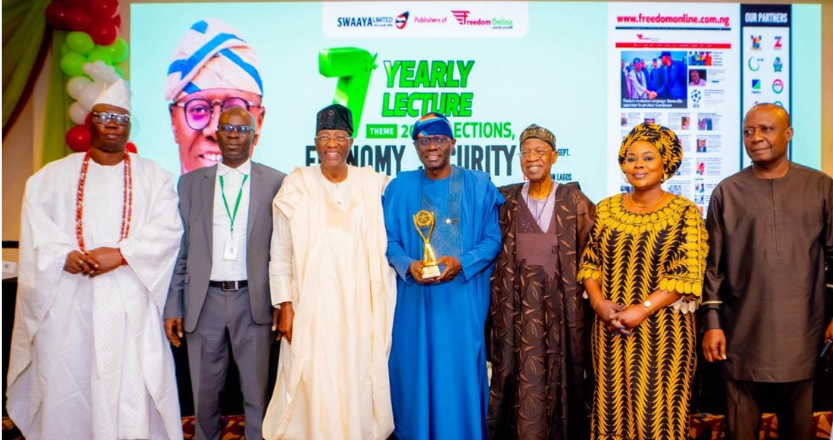
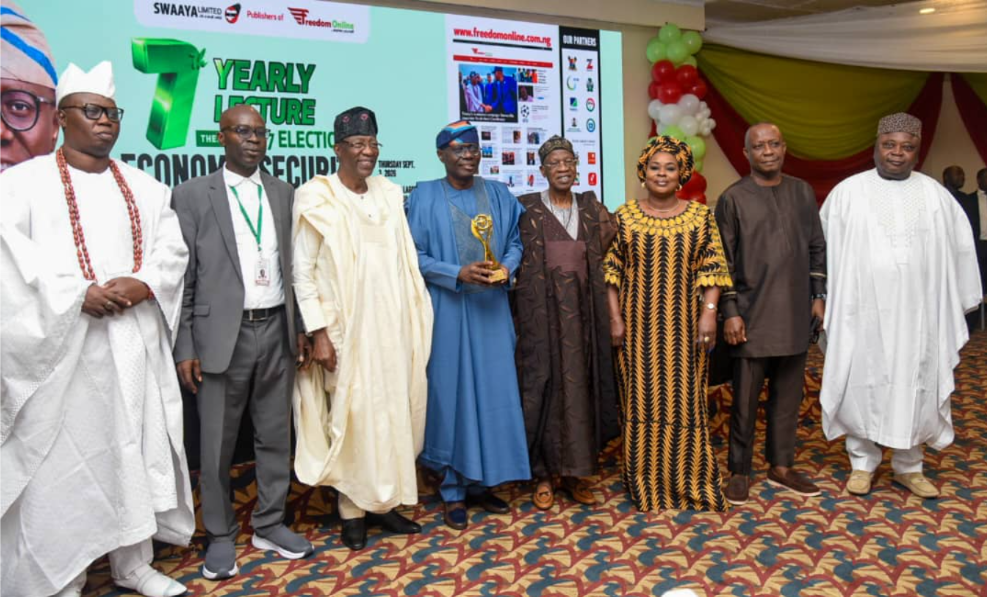
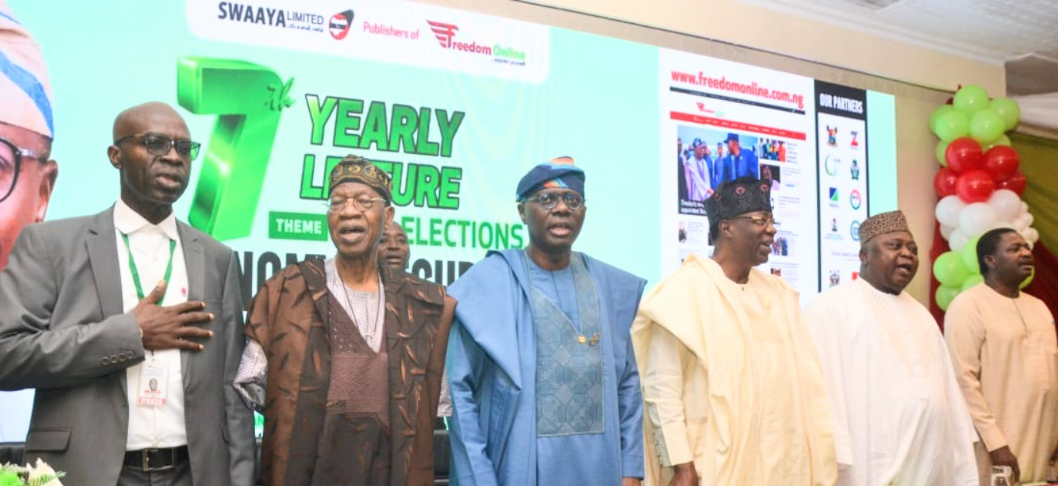
JKNewsMedia.com reports that, speaking at the Freedom Online 7th Yearly Lecture at the Sheraton Lagos Hotel, Ikeja, Sanwo-Olu said the 2027 election would be the eighth consecutive general election since 1999 and described Nigeria’s uninterrupted electoral process as an important achievement that should not be taken for granted.
The Lagos Governor said the country’s democratic journey had come at a significant cost, noting that people had been detained, exiled and killed in the struggle for democracy.
Sanwo-Olu, who spoke on the theme, “2027 Elections: Economy, Security and Nigeria’s Future”, said the election would be shaped largely by economic conditions and security.
He used the medium hosted by Freedom Online Chief Executive Officer and Publisher, Mr. Gabriel Akinadewo, to defend the removal of the fuel subsidy, saying it had become a drain on the national purse and that the money could instead support roads, schools and hospitals.
The governor acknowledged that the policy had imposed difficulties on Nigerians, including higher costs at the pump and in markets, but argued that the measure should be assessed by whether it ultimately produces improvement.
He pointed to economic figures published by the National Bureau of Statistics, saying Nigeria’s economy grew by 4.43 per cent in the second quarter of 2026, compared with 3.89 per cent in the first quarter and 4.23 per cent in the same quarter of the previous year.
Agriculture grew by 4.39 per cent, up from 2.82 per cent a year earlier, while services grew by 4.6 per cent. Sanwo-Olu also said the economy was more than 18 per cent larger in nominal terms than it was 12 months earlier.
He said Nigeria’s external reserves stood at $53 billion the previous week, the highest level since January 2009, while inflation had fallen from almost 35 per cent at the end of 2024 to 15.9 per cent in June.
Sanwo-Olu also cited Central Bank figures showing that Nigerians abroad sent $947 million through formal channels in July, describing it as the largest monthly figure in the country’s history.
“These are not my numbers. They belong to the National Bureau of Statistics and the Central Bank of Nigeria, and every journalist in this hall can check them,” he said.
On security, the governor said insecurity could affect the ability of candidates to campaign, the movement of electoral personnel and materials, and voter turnout in affected communities.
He said the administration had expanded the Nigerian Army from eight divisions to 12, with 28,000 additional personnel and new divisional headquarters in Makurdi, Ilorin, Jalingo and Benin City.
He also highlighted the Navy’s new Special Operations Command, decentralised police training, the deployment of Forest Guards and Mining Marshals, and the establishment of a presidential office coordinating homeland security.
Sanwo-Olu further backed State Policing, drawing from Lagos’ experience with the Lagos State Security Trust Fund (LSSTF) and the Neighborhood Safety Corps (NSC).
He said the experience showed that security worked best when communities could see and hold accountable those responsible for providing it.
The governor linked security directly to economic development, arguing that poverty and insecurity reinforce each other.
“When a farmer cannot go to his farm, the nation gets hungrier. When a school is not safe, the country gets another cohort of children who never learned to read,” he said.
He also highlighted government programmes targeted at young Nigerians, including the Nigerian Education Loan Fund, Consumer Credit Corporation, 3 Million Technical Talent programme and reforms to the National Youth Service Corps.
According to him, Nigeria’s large youth population could become either a major dividend or a major danger depending on decisions taken over the next decade.
Sanwo-Olu also urged stakeholders to protect the credibility of the 2027 elections, saying economic and security policies would have little significance if the electoral process itself was not credible.
He cited the August 15 Osun State governorship election, where the candidate of the All Progressives Congress lost to incumbent Governor Ademola Adeleke, as an example of a ruling party accepting an electoral defeat.
He said President Bola Ahmed Tinubu congratulated Adeleke the following day and thanked the Independent National Electoral Commission and security agencies for a peaceful and transparent election.
“A mandate is only as strong as the process that produced it,” Sanwo-Olu said. “No office in this land is worth the life of a single Nigerian, and no victory won by the wrong means is a victory at all.”
The governor also urged the media to maintain rigorous journalism ahead of the election, calling on journalists to check facts, challenge disinformation and cover candidates beyond traditional political narratives.
He said women and young people attempting to enter politics should receive greater media attention.
Sanwo-Olu expressed confidence in Nigeria’s future and said the Tinubu administration had set a target of building a $1 trillion economy by 2030.
He said he expected the All Progressives Congress (APC) to win the 2027 election and President Tinubu to secure a second term to consolidate the Renewed Hope agenda but added that he also expected the election to be peaceful and the loser to concede.
There Can’t Be Strong Economy Without Strong Security – Gbenga Daniel
Earlier, former Ogun State Governor Gbenga Daniel said Nigeria could not achieve a strong economy without security or lasting security without a strong economy.
Daniel, who was the Special Guest of Honour at the lecture, said economic progress should be measured beyond GDP figures by considering whether young people could find decent work, farmers could safely reach their farms, manufacturers could compete and businesses could survive rising costs.
He described security as an essential part of economic infrastructure, saying insecurity could reduce food production, raise transportation costs, discourage investment and weaken business competitiveness.
Daniel cited the reported abduction of more than 7,800 people between July 2025 and June 2026 as both a security statistic and an economic warning.
He also pointed to the non-oil sector’s contribution of approximately 95.8 per cent of real GDP in the second quarter of 2026, saying Nigeria’s future could not depend on oil alone.
According to him, the country needed to turn agriculture, manufacturing, technology, construction, financial services, tourism, entertainment and the digital economy into productive jobs, higher incomes and better living standards.
Daniel said Nigeria had the people, resources, market and entrepreneurial spirit needed to achieve prosperity, but required security, leadership, infrastructure and discipline to convert its potential into economic growth.
Robust Media Will Boost Credible Elections – Lai Mohammed
Chairman of the lecture, Lai Mohammed, also urged the media to remain robust, critical and responsible ahead of the 2027 elections, warning that irresponsible reporting could amplify fear and deepen political, ethnic, religious and regional divisions.
He said responsible journalism should elevate political discourse towards policy, competence and concrete solutions.
In closing, Akinadewo described the annual platform as one that has, since 2017, addressed major national issues including unemployment, leadership, Nigeria’s place in the world, politics, democracy and the social contract.
—