By John Ekeh, JKNewsMedia Reporter
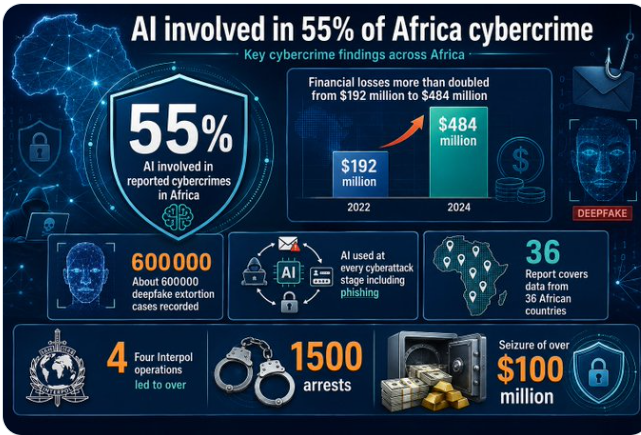
ARTIFICIAL INTELLIGENCE now enables 55 per cent of reported cybercrimes across Africa, allowing criminals to launch faster, wider and more convincing attacks, according to Interpol’s African Cyberthreat Assessment Report 2026.
JKNewsMedia.com reports that the report, released on Monday, said Nigeria had become both a major target and a source of cybercrime, recording 5,822 ransomware detections in 2025.
Cabo Verde recorded the continent’s second highest figure with 16,997 detections.
It said data breaches were particularly common in Nigeria, South Africa, South Sudan and Namibia between January 2024 and September 2025.
Ransomware attacks were prevalent in Nigeria, South Africa, Namibia, Senegal and Zambia.


The 40-page report, based on responses from 36 African countries, said cybercriminals were increasingly targeting hospitals, utility companies and government portals to cause maximum disruption and extract payments.
Business email compromise remained one of the most damaging forms of cybercrime, with criminals impersonating company executives or trusted partners to steal money or sensitive information.
West Africa emerged as a major centre for such attacks.
Nigeria accounted for 29 per cent of business email compromise detections in 2025, behind South Africa’s 70 per cent.
Interpol said criminals were using AI to reproduce executives’ writing styles, internal terminology and email signatures, making fraudulent messages increasingly difficult to distinguish from genuine correspondence.
The report also linked Nigeria based criminal networks to international money laundering operations involving cryptocurrency exchanges, shell companies, mobile payment platforms and networks of intermediaries.
Interpol warned that Africa’s expanding cryptocurrency market had become a magnet for fraud.

Nigeria accounted for $92 billion of the $205 billion in crypto transactions recorded across sub-Saharan Africa between July 2024 and July 2025.
It also said criminals were using AI generated identities to bypass verification systems, open bank accounts, obtain mobile loans and register SIM cards under false names despite stricter identity linking requirements.
Across Africa, reported cybercrime losses more than doubled from $192 million in 2024 to $484 million in 2025, while the number of identified victims rose from 35,000 to 87,000.
—