By Jemimah Wellington, JKNewsMedia Correspondent
PRESIDENT BOLA Tinubu has urged West African leaders to expedite the activation of the Economic Community Of West African States (ECOWAS) Standby Force, stressing that regional security must no longer remain a concept on paper.
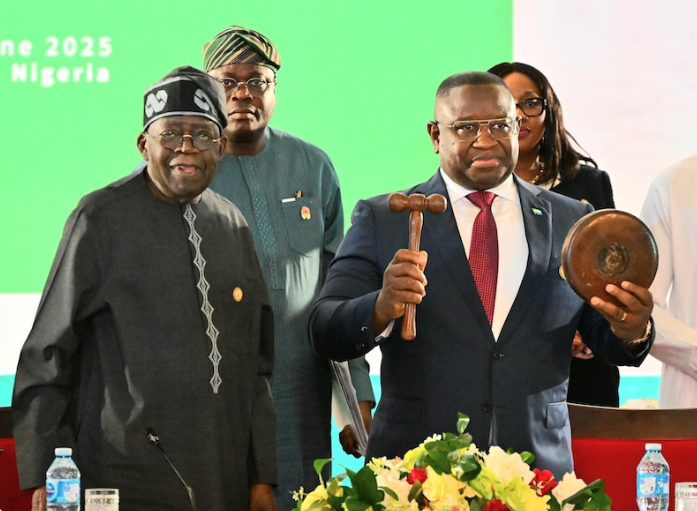
His remarks came as he handed over leadership of the bloc to Sierra Leone’s President Julius Maada Bio during the 67th Ordinary Session of the ECOWAS Authority of Heads of State and Government held in Abuja.
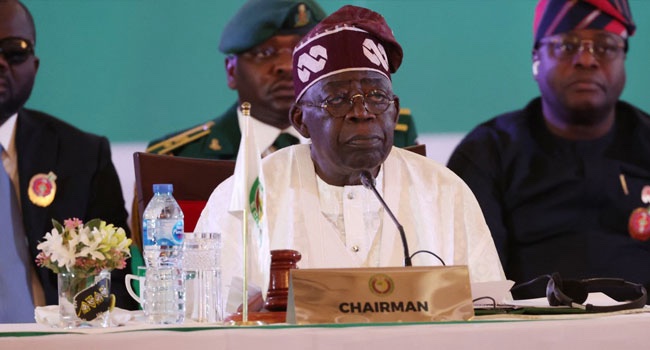
Addressing fellow leaders in what marked one of his final acts as ECOWAS Chair, President Tinubu voiced concern over the delayed operationalisation of the standby force, citing worsening insecurity and the urgent need for coordinated regional responses.
“The ECOWAS Standby Force must move from concept to operational reality. I am a little bit worried about the slow pace of its activation, which is taking longer than desired,” he said.
“Threats confronting the region are transnational, driven by agile and dangerous networks that respect nobody’s border.”
His tenure, first initiated in Guinea-Bissau on 9 July 2023 and extended a year later in Abuja, focused on stabilising regional security, rebuilding diplomatic bridges, and pushing forward economic development across the bloc’s 15 member states.
At the Abuja summit, Tinubu formally passed the baton of ECOWAS leadership to President Bio, ending months of speculation that Senegal’s President Bassirou Diomaye Faye would emerge as Chair following earlier consultations.
In his acceptance speech, President Bio pledged to steer the bloc towards constitutional governance, enhanced security cooperation, economic integration, and institutional reform.
He reaffirmed his commitment to collective decision-making and regional stability.
Reflecting on his achievements, Tinubu highlighted the completion of the ECOWAS Military Logistics Depot in Lungi, Sierra Leone, as a milestone for regional peacekeeping logistics.
“Nigeria is committing itself to sea-lift and air-lift arrangements with ECOWAS to support this effort,” he added.
He also pointed to Nigeria’s signing of the Sixth Agreement with the African Union in Addis Ababa as part of broader efforts to enhance security collaboration on the continent.
During his chairmanship, diplomatic efforts intensified to reconcile with Burkina Faso, Mali, and Niger, countries that have distanced themselves from ECOWAS amid political transitions.
Tinubu expressed cautious optimism about their eventual reintegration, saying, “I deployed all diplomatic means to engage and dialogue with our brothers… I am confident that before too long, they may return to the family.”
He called on ECOWAS member states to remove trade barriers and stimulate private sector growth. “Our intra-regional trade remains low, even as we possess the potential to be an economic powerhouse. We must create the enabling environment,” he said.
Tinubu urged faster implementation of strategic projects such as the West African Gas Pipeline, West African Power Pool, and the Abidjan–Lagos Corridor Highway to drive integration and economic growth.
In his farewell remarks, Tinubu thanked fellow leaders for their confidence during his two-term tenure and appealed for continued unity in the face of regional challenges.
“As we look forward to the future of West Africa, I remain positive that with the continued cooperation of all its members, ECOWAS will scale over greater heights in our collective pursuit of peace, security, stability and prosperity for our people and for our region.”
He stressed the importance of balancing economic ambitions with governance reforms, and reiterated the need to safeguard democracy, empower vulnerable populations, and strengthen institutional resilience.