By Joke Kujenya
CALLS FOR a legally binding global treaty to protect older persons from discrimination, social exclusion and barriers to healthcare have gained renewed attention following the establishment of a United Nations-intergovernmental working group tasked with drafting the instrument.
JKNewsMedia.com reports that the proposed treaty aims to strengthen accountability, address persistent gaps in existing human rights frameworks and ensure that older persons enjoy equal rights, dignity, security and access to essential services as the global population ages.
Also, their demands for dedicated legal protection dates back to 1948, when Argentina formally proposed a Declaration of Old Age Rights during the drafting of the Universal Declaration of Human Rights in Paris.
Nearly eight decades later, the UN Human Rights Council (UNHRC) has established an Intergovernmental Working Group (IWG) with a mandate to draft a legally binding treaty addressing ageism and the realities experienced by older persons across regions.
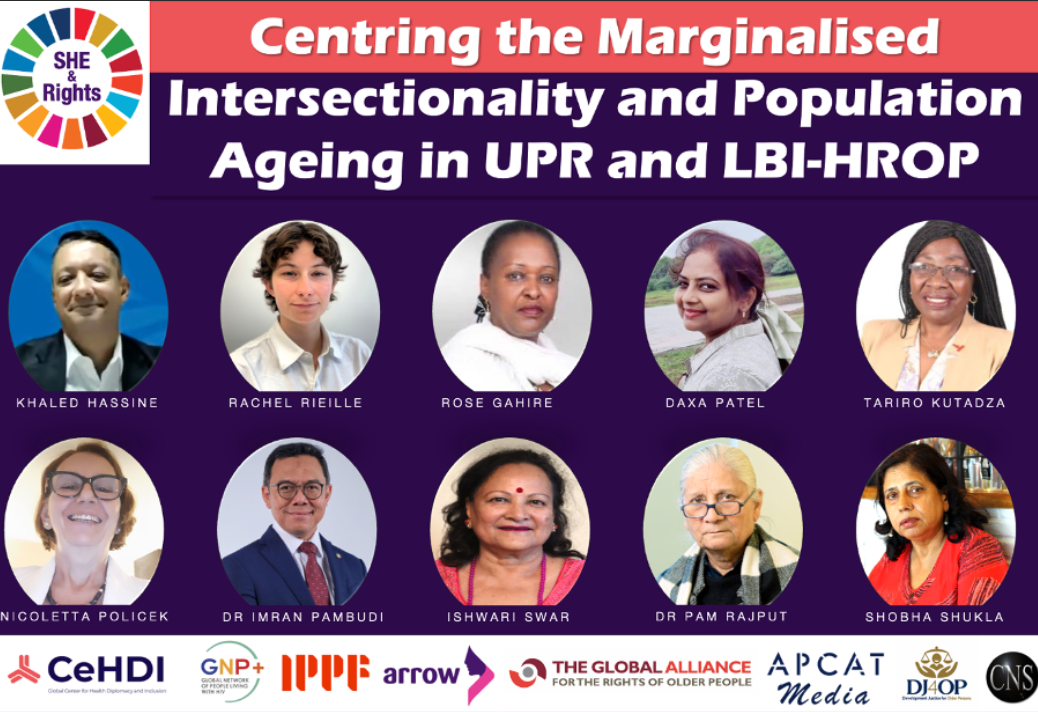
Khaled Hassine, Secretary, IWG at the Office of the United Nations High Commissioner for Human Rights (UNHCHR), said existing human rights structures fail to adequately recognise older persons in data, statistics and accountability mechanisms.
He explained that age discrimination and the broader problem of ageism, which encompasses stereotypes, prejudice and exclusionary practices, remain poorly recognised and weakly constrained.
Hassine also stressed that ageing cannot be understood through chronological age alone, as experiences are shaped by social, economic and personal circumstances throughout life.
He added that when older persons remain underrepresented in official statistics and human rights reporting, policymakers risk overlooking their needs when designing public services and protection measures.
He made the remarks during a SHE & Rights session held ahead of the IGWG discussions on the human rights of older persons.
Generally, the session was jointly organised by the Global Center for Health Diplomacy and Inclusion (CeHDI) and CNS, alongside the Global Alliance for the Rights of Older People (GAROP), Global Network of People Living with HIV (GNP+), International Planned Parenthood Federation (IPPF), Asian-Pacific Resource and Research Centre for Women (ARROW), Asia Pacific Media Alliance for Health, Gender and Development Justice (APCAT Media), and Development Justice for Older Persons (DJ4OP).
Also, Shobha Shukla, CNS Executive Director and SHE & Rights coordinator, highlighted the continued exclusion of older persons from human rights policies, data and international monitoring mechanisms despite the global commitment to leave no one behind.
She said this invisibility particularly affects older women, persons with disabilities, people living with HIV, indigenous peoples, gender-diverse people and other marginalised communities and argued that systemic barriers, prejudice and patriarchy can deliberately exclude some older persons from policy discussions and protection frameworks.
Figures from the United Nations Human Rights Council’s Universal Periodic Review (UPR), which examines the human rights records of member states, illustrate the scale of the gap.
Since the mechanism began in 2008, only 681 of more than 124,539 recommendations have addressed older persons, representing approximately 0.5 per cent of the total, Shukla said.
Rachel Rieille, Data Manager at CeHDI, reinforced the concern while presenting the Health and Rights Observatory, a free, public and interactive platform that connects UPR recommendations with health indicators.
She reported that only 144 of approximately 29,000 health-related UPR recommendations specifically addressed the health of older persons. Although governments supported approximately 92 per cent of those recommendations, the issue remains significantly underrepresented in international human rights monitoring.
The observatory allows civil society organisations and policymakers to track commitments, government responses and health outcomes, helping identify gaps that could inform monitoring mechanisms under a future convention.
Rose Gahire, Co-Chair of GAROP, said a dedicated legally binding treaty would provide an opportunity to address longstanding protection gaps, clarify government obligations and strengthen accountability while building on existing international and regional standards.
She argued that the treaty must address discrimination affecting older persons’ independence, employment, participation in policymaking and protection during conflicts and natural disasters.
Gahire also emphasised that older persons are not a homogeneous group, noting that their experiences differ according to gender, disability, poverty, race, ethnicity, migration, displacement and geographical location.
She cited the legally binding Protocol to the African Charter on Human and Peoples’ Rights on the Rights of Older Persons in Africa, which came into force in 2024, as an existing regional framework that a global convention could complement and reinforce.
The principle guiding the proposed treaty, she said, must be that nothing about older persons should be decided without older persons.
Dr Pam Rajput, a feminist with experience in international law and informal diplomacy, called on civil society organisations to participate actively in shaping the treaty and ensure that the final text reflects the different experiences of older persons.
She said the proposed instrument should build on existing standards, including the 2015 Inter-American Convention on Protecting the Human Rights of Older Persons, which recognises multiple and intersecting forms of discrimination.
Rajput also stressed the importance of recognising older persons as active holders of rights whose wisdom, experience and contributions deserve respect, rather than treating them solely as recipients of care and protection.
The experiences of older people living with HIV further illustrate the need for a rights-based approach that extends beyond clinical treatment.
Nicoletta Policek, co-founder and director of PRISMA, the European community-driven observatory on ageing and HIV, said her 42 years of living with HIV had reinforced the importance of rights, resources and power in discussions about ageing.
She described the ability of people living with HIV to grow older as a scientific and collective community achievement, but noted that many continue to face discrimination, breaches of confidentiality, barriers to social protection and fragmented healthcare.
JKNewsMedia.com further reports that Policek called for community-led evidence to shape public policy and accountability, arguing that people ageing with HIV should help define priorities, assess services and monitor government commitments. She also urged governments to prevent discrimination against older people living with HIV, particularly in long-term care.
“For me, this also means recognising our right to bodily autonomy, sexual health, freedom from violence and discrimination, and care that respects our dignity. Older women must have power in shaping these rights and holding institutions accountable,” Policek said.
She added: “Living longer must also mean living with rights, dignity and the power to shape our own lives.”
Tariro Kutadza, Advocacy Lead at the Zimbabwe National Network of People Living with HIV (ZNNP+) and founder-leader of TB People in Zimbabwe, alongside Daxa Patel, co-founder and former president of the National Coalition of People Living with HIV in India (NCPI+), highlighted the multiple health conditions, stigma, isolation and treatment challenges affecting older people living with HIV.
They called for stronger peer-support networks, integrated HIV care and healthy ageing services, improved community-led monitoring, better social protection and more person-centred, gender-responsive services.
Ishwari Swar, Founder-Chairperson of the Senior Citizens Welfare Association Nepal, described the challenges facing older people in remote Nepalese communities, where youth migration has left many rural areas populated largely by older residents.
She said many of these older persons lack family support, accessible healthcare and adequate social protection. Despite existing legal protections, weak implementation, insufficient budgets and limited access to essential services continue to undermine their rights.
Indonesia’s experience offered examples of practical responses. Dr Imran Pambudi, Director for Vulnerable Groups at the country’s Ministry of Health, outlined measures including integrated primary healthcare, free health checks, community-based long-term care and disability-inclusive services.
He stressed that older persons should be recognised not only as recipients of care but also as valued contributors to society. He also called for stronger health systems, sustainable financing, support for caregivers and improved international accountability.
“Ageing is a triumph of human development; our responsibility is to ensure that everyone can experience it with dignity, health and meaning,” Pambudi said.
The discussions highlighted the role of the Universal Periodic Review and tools such as CeHDI’s Health and Rights Observatory in identifying protection gaps, tracking commitments and encouraging governments to adopt targeted recommendations on older persons’ health rights.
The proposed treaty presents an opportunity to strengthen protections against ageism and ensure that older persons can participate meaningfully in decisions affecting their lives, while recognising the different forms of discrimination they may encounter.
Gahire summarised the principle underpinning the campaign for stronger legal protections, saying: “Human rights do not diminish with age. Dignity has no expiry date.”
—

Share Your Story with us!
Advertise with us!
Publicity for a product, service, or event!
Contact: WhatsApp Only: +2348039560647
Email: jkmediapress@gmail.com