By Ajibola Olaide, JKNewsMedia
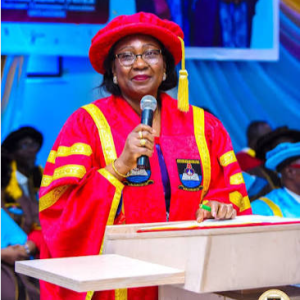
FOR FIVE years, Professor Ibiyemi Olatunji-Bello led Lagos State University (LASU) through a period of expansion, institutional reform and growing financial pressure, leaving office with a record shaped by new programmes, stronger revenue generation, infrastructure projects and a renewed push for research and innovation.
JKNewsMedia.com reports that her tenure as the university’s ninth Vice-Chancellor ended on September 19, 2026, but the questions surrounding the future of public university funding remain as significant as the achievements she recorded.
She stressed that public universities that want to achieve financial independence and sustain quality education may need to charge students at least N1m annually in tuition, adding that universities could not continue to depend heavily on government funding if they wanted to maintain academic excellence and meet their growing financial obligations.
“Universities that want to attain self-sustainability will have to increase school fees into millions,” she said.
“So, any public university that wants to sustain financial independence will have to charge school fees of not less than N1m per student. You can’t have academic excellence without paying for it.”
Her position came against the backdrop of the financial pressures she said LASU faced despite a significant increase in its internally generated revenue during her administration.
According to her, LASU’s Internally Generated Revenue (IGR) rose from about N3bn when she assumed office to N13bn by the end of her tenure. But she said the increase was still not enough to meet the university’s financial obligations, with the institution’s monthly payroll exceeding N1bn, electricity consuming about N140m monthly and salary augmentation requiring another N240m.
The immediate past VC said the university therefore had to explore other ways of strengthening its finances, including introducing relevant academic programmes, expanding postgraduate offerings, increasing digital services, undertaking consultancy and short courses, building partnerships and developing other legitimate revenue-generating ventures.
She recalled that in 2021, LASU’s dedicated revenue stood at about N3bn while her administration initially set a target of N7bn, then raised it to N10bn and eventually N12bn.
Eventually, the university ultimately recorded N13bn after generating N10bn from one area and receiving another N3bn in dedicated capital expenditure support.
During her five-year tenure, she disclosed that more than 75 new postgraduate programmes were introduced, while the university expanded its academic offerings and digital operations.
Olatunji-Bello also spoke about the scale of the university she inherited and the challenges of providing facilities for its growing population.
LASU now has about 85,000 students when postgraduate and part-time students are included, although only about 12,000 are on campus at any given time, she said, adding that, about 8,000 students are accommodated through the university’s own hostels and public-private partnership facilities.
Infrastructure was one of the major areas of focus during her tenure. She recalled that the university had faced flooding problems and inadequate toilet facilities, while some academic programmes were either unaccredited or awaiting accreditation when she assumed office.
She disclosed that her administration completed projects inherited from her predecessor, including hostel projects, despite increases in construction costs, while also pushing new infrastructure and drainage projects across the university.
Academic accreditation was another major part of the tenure.
In the first year, 37 programmes were presented for accreditation, with 31 securing full accreditation, representing a 96 per cent success rate.
Her administration also worked to ensure that professional programmes secured full accreditation.
She said the university’s research capacity also received attention. A N5mn competitive internal research grant was introduced, while seven members of staff secured more than N29m in grants from the Lagos State Research and Innovation Council (LSRIC) between 2022 and 2025.
Another major development was the establishment of a N3bn Tertiary Education Trust Fund (TETFund) Centre of Excellence.
Olatunji-Bello described the centre as the only one of its kind in the South-West.
She spoke on how her administration also approved an Artificial Intelligence (AI) policy through the Senate, requiring ethical use of AI and proper citation.
The policy, approved in July 2022, she said, complemented the university’s existing plagiarism policy.
There were difficult moments as well, she admitted.
One of the most significant came in 2024 when thousands of students protested over plans requiring them to pay for computer-based testing.
Olatunji-Bello said she quickly withdrew the proposed payment and directed that the affected examination should instead be conducted using pen and paper.
LASU Retains Most-Subscribed University Spot, Wins N25m JAMB Award
She described 2025 as one of the high points of her tenure after the Joint Admissions and Matriculation Board (JAMB) identified LASU as the most subscribed university by UTME candidates in Nigeria.
She said the institution retained the position in 2026 and received a N25m award for compliance with JAMB requirements.
Beyond revenue, infrastructure and academic programmes, LASU also recorded recognition for its sustainability efforts. The university maintained its position as the top university in West Africa under the UI GreenMetric World University Ranking from 2022 to 2026 and secured the vice-chairmanship of the ranking initiative, she said excitedly.
Olatunji-Bello said her administration’s work was guided by six strategic priorities covering accreditation, research, infrastructure, revenue generation, welfare and sports as the university also expanded its faculties, schools and centres while pursuing staff welfare initiatives and support for students through scholarships, foundation programmes and work-study opportunities.
She revealed that her tenure also saw LASU co-host the 11th All-Africa University Games (AAUG) with the University of Lagos (UNILAG) in 2024 as her institution emerged as the best Nigerian univrsity and second overall in Africa at the competition.
She Flags Key Projects For Lagos
As she prepared to leave office, Olatunji-Bello identified the Innovation Hub and some outstanding building projects as areas she wanted the Lagos State Government to prioritise.
Looking back on the five years, she admitted that the journey has been one marked by difficult decisions, institutional reforms and collective effort, stressing that the achievements could not be attributed to one person alone.
In addition, she said the university had distinctly undergone changes in its academic programmes, infrastructure, digital systems and financial capacity, while students and researchers also recorded achievements during the period; all of which can never be erased in its records.
On a final note, Olatunji-Bello, who became LASU’s ninth substantive VC in September 2021, formally handed over after completing her five-year tenure.
“Offices and titles are temporary, but the relationships built and the institutional impact achieved endure beyond tenure,” she said.
She noted that the next chapter will determine how much of that progress can be sustained and how the institution responds to its financial challenges.
—