By Jemimah Wellington, JKNewsMedia Correspondent
THE NATIONAL Drug Law Enforcement Agency (NDLEA) has reaffirmed its opposition to the local consumption of cannabis oil but expressed readiness to support its controlled and regulated export to countries where it is legally approved.
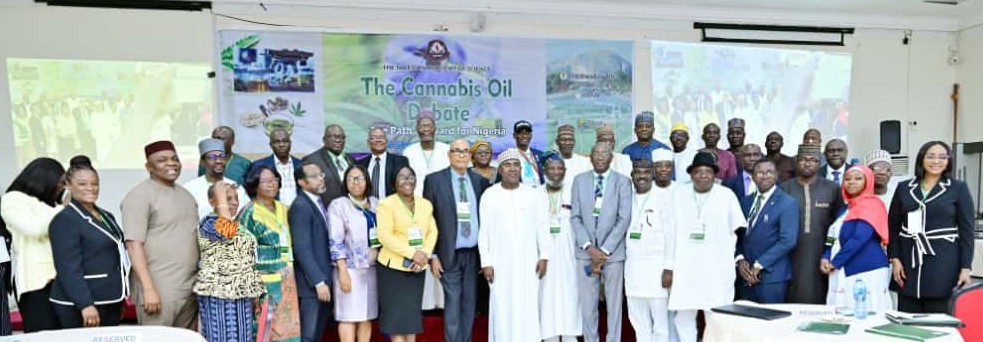
Chairman and Chief Executive Officer of the Agency, Brigadier General Mohamed Buba Marwa (Retd), made this known during a stakeholders’ workshop themed “Cannabis Oil Debate: The Path Forward for Nigeria,” organised by the Nigerian Academy of Science in Abuja on Wednesday, 8th October 2025.
Marwa described the national conversation on cannabis oil as a welcome development, stating that the NDLEA is committed to evidence-based dialogue and scientific engagement.
“At NDLEA, our position on cannabis oil is simple: we welcome dialogue. We believe Nigeria must make informed choices, not choices driven by half-truths, commercial interests, or global trends,” he said.
He noted that while cannabis oil may possess medicinal properties worthy of scientific investigation, it also carries significant health risks and potential for misuse.
“Policy must protect lives, safeguard public health, and strengthen—not weaken—our fight against drug abuse,” Marwa stated.
According to him, the Agency is not opposed to innovation or scientific exploration but insists on a cautious approach that prioritises safety and regulatory integrity.
“As such, the Agency will not be averse to the idea of controlled export of cannabis oil to foreign companies and countries who desire it, as part of our drive to enhance foreign earnings,” he added.
He explained that such exports must be strictly licensed, monitored, and conducted within export free zones under the direct supervision of the NDLEA.
“Our concern is about its consumption in Nigeria. We are not opposed to the idea of exporting the oil to those who desire it, but such must be strictly controlled and regulated,” he emphasised.
Marwa also emphasised that the conversation about cannabis oil must be grounded in science and public health.
“We are talking about cannabis, which is not just another plant. It is a substance with complex medical, social, and economic dimensions. For decades, the debate has been one-sided, often highlighting benefits while glossing over the risks,” he said.
He confirmed that the NDLEA had commissioned a study on cannabis oil through the Nigerian Academy of Science to generate credible, research-based insights that would guide national policy.
“In a country like Nigeria, which is already contending with a high burden of drug abuse, it is imperative that we approach this matter with sobriety, clarity, and balance,” he added.
The NDLEA chairman cited data showing that Nigeria faces a 14.4 percent substance abuse prevalence rate compared to a global average of 5.6 percent, with an estimated 10.6 million cannabis users based on the 2018 national drug use survey.
“Evidence shows that cannabis, including its oil extracts, can have adverse effects on mental health, especially among young people,” he stated, linking prolonged or uncontrolled use to anxiety, depression, psychosis, and cognitive impairment.
Marwa warned that lack of standardised production and regulation in several countries poses additional risks.
“Products sold as cannabis oil often vary in potency, contain contaminants, or are misused outside medical supervision,” he said, stressing that Nigeria must not overlook these realities”, he noted.
Highlighting NDLEA’s ongoing interventions, Marwa recalled that in 2023 the Agency introduced the Alternative Development Project, the first of its kind in Africa, to address the root causes of illicit drug cultivation.
He explained that the initiative aims to reduce vulnerabilities caused by poverty, unemployment, and underdevelopment that drive people into illicit economies.
“We intend to reduce these vulnerabilities through sensitisation, skills acquisition, empowerment, and positive engagements for sustainable livelihoods,” he said.
In his welcome remarks, President of the Nigerian Academy of Science, Professor Abubakar Sambo, represented by Vice President, Professor Friday Okonofua, said several studies have examined the potential benefits and side effects of cannabis.
He noted that the workshop aimed to develop an evidence-based consensus on the use of cannabis oil in Nigeria. “At the end of the day, we’ll have a properly documented consensus that will guide national decisions on the use of cannabis,” he stated.
Chairman of the Academy’s study committee, Professor Musbau Akanbi, commended NDLEA for commissioning a science-led approach to the issue.
“The Nigerian Academy of Science constituted a consensus study committee comprising experts across fields to collect and review global literature on cannabis oil.
This workshop brings together stakeholders to present evidence that will assist NDLEA in carrying out its responsibility,” he said.
Representing Governor Lucky Aiyedatiwa of Ondo State, Dr Samuel Adekola urged participants to contribute constructively. “This all-important workshop will offer our great country the opportunity to move from debate to design, from potential to policy,” he said.
Delivering the keynote address, Professor Oye Gureje, Director of the WHO Collaborating Centre for Research and Training in Mental Health, Neurosciences, and Substance Abuse, University of Ibadan (UI), stated that evidence suggests cannabis may have limited medical use but warned that widespread recreational use increases the risk of psychosis and public health challenges, including road accidents.
The NDLEA further reaffirmed its readiness to engage with scientific and policy stakeholders while maintaining a firm stance against domestic consumption of cannabis oil.