By JKNewsMedia
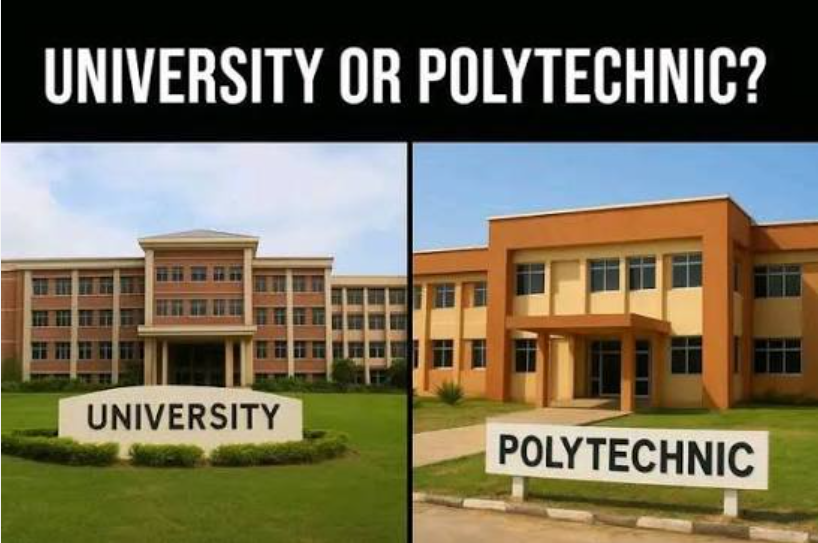
CHOOSING BETWEEN a polytechnic and a university remains one of the biggest decisions facing students after completing secondary school, with the right choice depending on career goals, preferred learning style, financial situation and long-term aspirations.
JKNewsMedia.com reports that universities focus on academic learning, research and professional education, awarding bachelor’s degrees as well as postgraduate qualifications including master’s degrees and doctorates.
But polytechnics emphasise practical, technical and vocational education through classroom instruction, laboratory work, workshops, field exercises and industrial attachments.
They award the National Diploma (ND) and Higher National Diploma (HND), while some also offer bachelor’s degree programmes through approved affiliations or legislative reforms.
Most university degree programmes in Nigeria last four years, although professional courses such as Engineering, Pharmacy, Law, Veterinary Medicine and Medicine may take five or six years.
On the other hand, polytechnic students typically complete a two-year ND, a one-year Industrial Training (IT) programme and a two-year HND, gaining workplace experience before graduation.
University graduates commonly pursue careers in law, medicine, academia, architecture, public administration, banking and scientific research.
Polytechnic graduates build careers in engineering technology, information technology, business administration, media production, agriculture, hospitality management, environmental technology and other technical occupations.
Another factor is that many public polytechnics are generally more affordable than universities, although students are advised to consider transportation, accommodation, learning materials, feeding and other personal expenses when assessing the total cost of education.
Recent years’ educational reforms have also expanded opportunities for HND holders, with many now able to progress to postgraduate diploma programmes, master’s degrees or professional certifications after meeting admission requirements.
Some institutions even offer top-up programmes leading to bachelor’s degrees, while university graduates continue to have access to postgraduate study.
Students are therefore advised to base their decision on personal ambitions rather than public opinion.
While universities may suit those pursuing research, academic careers or professions such as law, medicine, pharmacy and lecturing, polytechnics may be more suitable for students seeking practical learning, entrepreneurship or technical specialisation.
In reality however, education counsellors emphasise that employers increasingly value competence, integrity, communication skills, adaptability, leadership, digital literacy and problem-solving ability, adding that continuous learning and professional development remain important regardless of the institution attended.
—