By Sola Olaiya, JKNewsMedia Intern
NIGERIA HAS proposed a strategic deal to the United States of America (US): ease sweeping visa restrictions on government officials in exchange for access to the region’s critical and rare earth minerals.
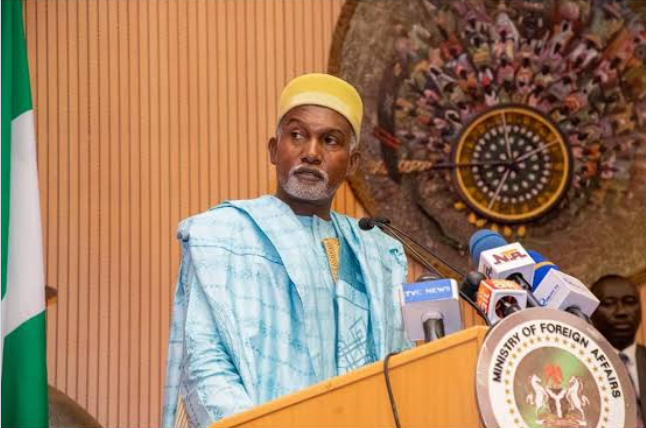
Addressing regional leaders at the Economic Community of West African States (ECOWAS) Mediation and Security Council meeting in Abuja, Minister of Foreign Affairs, Ambassador Yusuf Tuggar, warned that a proposed blanket U.S. visa restriction across all member states would undermine vital diplomatic and economic partnerships.
He argued the move constituted a “non-tariff barrier” to trade and regional prosperity.
He revealed that minerals such as Samarium, sourced from Monazite in Bauchi State, were vital to modern technology and defence industries and represented a serious incentive for global cooperation.
“We are a region of opportunities ready to do deals,” Tuggar said, urging Washington to review its approach.
“Visa restrictions are non-tariff barriers to trade, diplomacy, and regional prosperity,” he adds.
Tuggar positioned the ECOWAS bloc as a strategic alternative to distant and politically divergent energy partners, insisting that access and mobility were central to any sustainable collaboration.
“The United States and West Africa have a rare opportunity to create a partnership based on mutual need,” he said.
The minister stressed the region’s long-standing role in global trade and its readiness to expand commercial relations, provided that barriers were dismantled.
“We in this part of the world are students of the Art of the Deal and have been part of the international trading system even before the modern state system,” he added.
Tuggar questioned whether the U.S. would seize the opportunity.
“We will do deals for our prosperity; the only question is with whom? Who takes up the opportunities in our region by allowing government officials and technocrats, business executives and entrepreneurs to travel freely back and forth to close the deals?” he asked.
He said his was informed as concerns mounted across Africa over a leaked U.S. memo proposing travel restrictions on 36 countries, including Nigeria and several ECOWAS members.
The directive, signed by the current U.S President Donald Trump’s administration, cited terrorism threats, unreliable civil documentation, and alleged identity fraud.
The memo also set a 60-day deadline for listed nations to comply with new security benchmarks or face intensified visa bans.
U.S. authorities further claimed some countries had “no competent or cooperative central government authority to produce reliable identity documents,” while also criticising policies such as economic citizenship programmes.
Additional scrutiny, the memo stated, would fall on countries accused of antisemitic or anti-American activity.
The potential restrictions echo Trump’s earlier travel bans, which drew global backlash for disproportionately affecting Muslim-majority and African states.
Although no official timeline has been released for the new policy’s implementation, the directive signals a hardening stance.
Washington has however indicated that cooperation with U.S. immigration enforcement, such as accepting deportees or signing third-country agreements—may reduce the severity of sanctions.
Tuggar notes that as diplomatic tensions build, West African leaders are also urging the U.S. to recognise the region’s economic value and strategic minerals as the basis for mutual engagement, not exclusion.