By Faith Obams, JKNewsMedia Intern
LAGOS STATE Governor Babajide Sanwo-Olu has called for stronger access to agricultural financing, warning that Nigeria continues to lose substantial economic value by exporting raw commodities instead of processed goods.
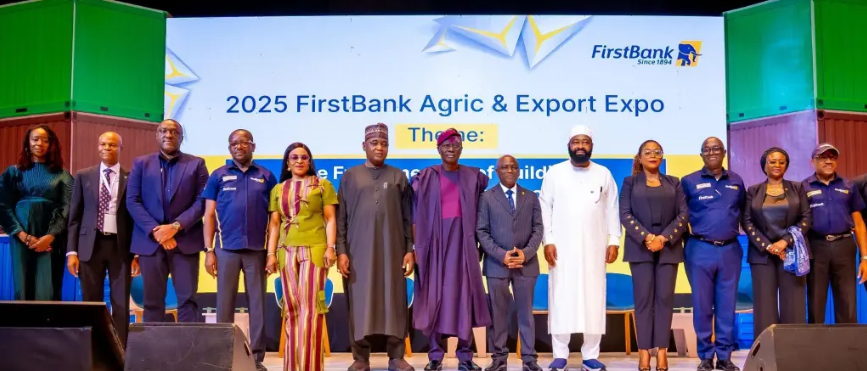
Addressing stakeholders at the First Bank 2025 Agric and Export Expo held at Eko Hotels and Suites, Victoria Island, Lagos, the Governor said that although crop production has improved in recent years, agricultural exports remain underwhelming due to the lack of value addition and weak financing structures available to farmers.
The event, themed The Fundamentals of Building an Export-Driven Economy, convened policymakers, investors, producers and entrepreneurs to deliberate on strategies for diversifying Nigeria’s economy through agriculture and non-oil exports.
Sanwo-Olu stressed the urgency of reducing dependence on crude oil, noting that global economic pressures — including volatile oil prices, foreign exchange challenges and high import costs – have heightened the need for a productivity-driven economy.
“Too often, we export raw commodities rather than finished products, thereby losing out on the real wealth and jobs that come from processing, packaging, and branding,” he stated.
He explained that while Lagos State continues to expand infrastructure through road construction, port development and digital trade platforms, these investments require complementary financial support systems that enable farmers and agribusinesses to meet global benchmarks in both volume and quality.
“The global marketplace is not waiting for Nigeria. Other African countries are aggressively positioning their agricultural products to secure market share.
We must be intentional, strategic, and relentless in pursuing non-oil export growth,” the Governor said.
He acknowledged federal initiatives under President Bola Tinubu’s administration, which he said had boosted agricultural output, but emphasised that higher economic gains would only be realised if Nigerian exports undergo processing before reaching international markets.
“Lagos is the nation’s gateway to the global economy. Most exports pass through our ports, placing a responsibility on us to support agribusiness and export competitiveness,” Sanwo-Olu added.
Niger State Governor Umar Bago, who also spoke at the forum, aligned with Sanwo-Olu’s position, stressing that countries which export only raw commodities are often disadvantaged in global trade.
“If we add value to our produce, we will dictate the prices — not the buyers,” Bago asserted.
He disclosed that Niger State would gradually phase out the shipment of live cattle to Lagos and Ogun States, replacing it with meat processing initiatives that would supply frozen products. According to him, this would reduce waste while generating higher earnings for local farmers.
“We’re terminating the movement of live cows at Mokwa. We’ll process meat in Niger and bring in only frozen products,” he said.
Bago also revealed an expansion of land allocation to Lagos for joint agricultural projects, increasing the available farmland from 20,000 hectares to 100,000 hectares to enhance production capacity and meet rising food demands across the country.