By Jemimah Wellington, JKNewsMedia Correspondent
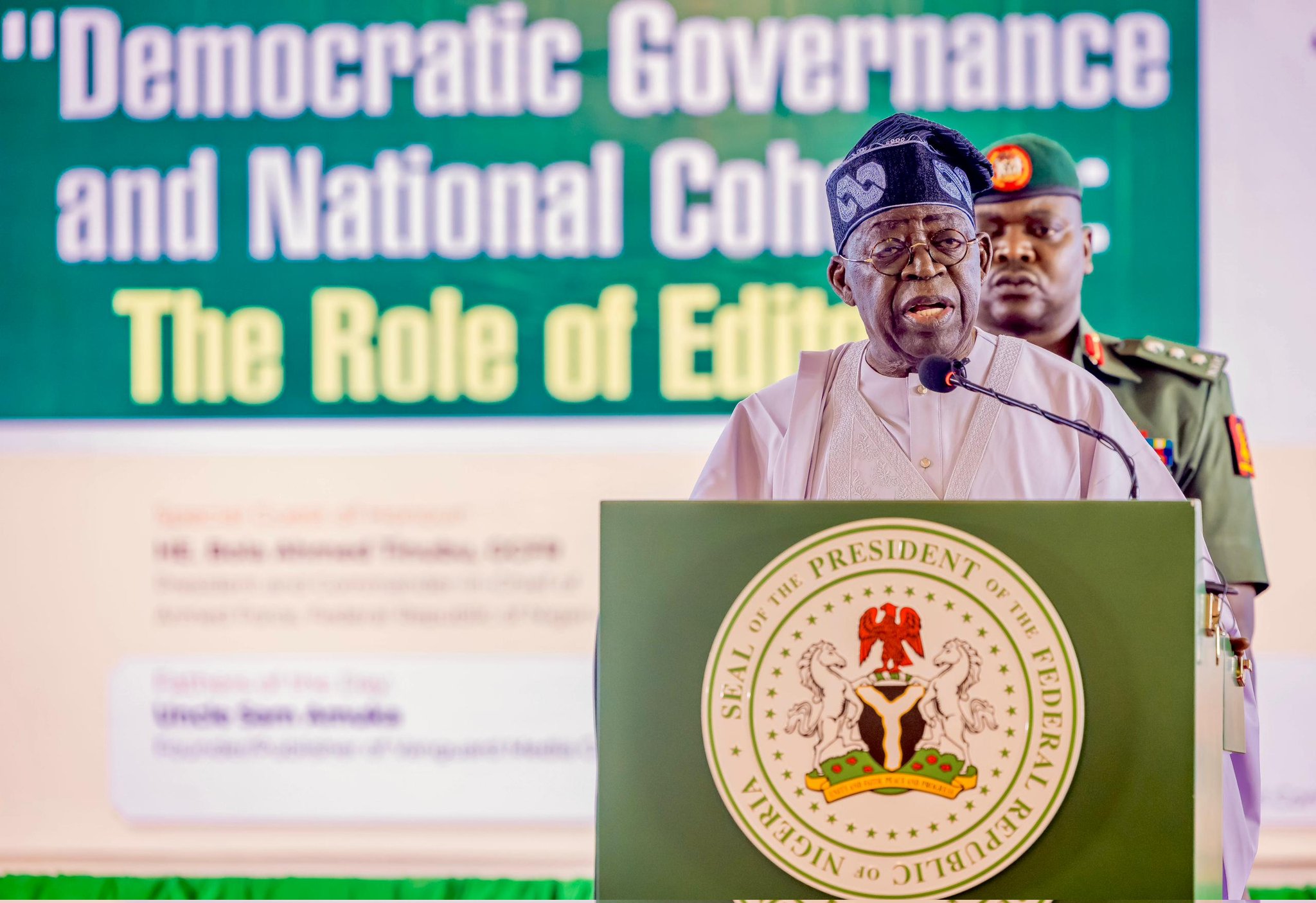
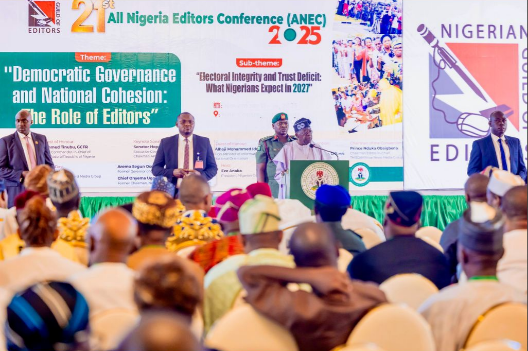
PRESIDENT BOLA Tinubu on Wednesday opened the 21st All Nigeria Editors Conference (ANEC 2025) at the State House Banquet Hall, Abuja, emphasising the central role of journalism in sustaining democracy and national cohesion.
The event, organised by the Nigerian Guild of Editors (NGE), drew over 500 editors, media executives, and policymakers to discuss the influence of media in shaping public understanding and national discourse.
Addressing participants, Tinubu hinged on the fact that freedom gained through struggle demands constant vigilance and responsible exercise.
“A democracy is sustained not only by elections and laws, but also by the integrity of public conversation.
This is where your role becomes central and indispensable,” he said.
The President also highlighted that editors, as managers of the national information space, shape narratives, influence public understanding, and determine the focus of national challenges.
He stressed that this responsibility must be exercised with wisdom, fairness, and a strong sense of national duty.
Noting Nigeria’s diversity, Tinubu acknowledged that debate and disagreement are part of national life, but warned that such differences must never erode cohesion.
“Criticism, when informed and constructive, is a service to the nation.
But cynicism that breeds mistrust and despair can weaken the very foundations of the society we all seek to improve. The national interest must always remain paramount,” he said.
Tinubu called on media practitioners to continue upholding high journalistic standards, advocating for bold but truthful reporting.
He encouraged critics of government policy to exercise knowledge and fairness in their assessments.
“Your aim must never be to tear down, but to help build a better society,” he stated.
The President also addressed the challenges posed by social media, recognising its role in enhancing citizen journalism while cautioning against the rapid spread of misinformation.
“We live in a time when information travels rapidly and widely. Social media has made every citizen a potential publisher.
“This has benefits, but it also increases the speed and scale of misinformation. Falsehood can take root before truth has time to speak,” he explained.
He emphasised that in such a fast-paced information environment, the editorial function is more critical than ever. Verification, balance, and professional judgment, Tinubu said, must guide journalists in their work.
“Verification must be your anchor; balance must be your principle, and professional judgement must be your guide,” the President added.
Media executives noted that the 21st ANEC provided them a platform to deliberate on contemporary challenges facing journalism, including ethics, information integrity, and the role of media in national development.
They also stated that stakeholders at the conference aimed to strengthen the capacity of media professionals to report responsibly and foster an informed citizenry.
Reflecting on President Tinubu’s address, the media executives said it reflects government’s recognition of the press as a partner in building a unified and democratic society, noting that he reiterated the importance of media independence while emphasising that public critique should serve the broader national interest rather than undermine progress.
President Tinubu concluded by reaffirming the government’s commitment to fostering an environment where the media can operate freely and responsibly, noting that the press remains indispensable in holding institutions accountable and advancing democratic ideals.
Full Text of The President’s Speech
OPENING ADDRESS BY HIS EXCELLENCY, PRESIDENT BOLA AHMED TINUBU GCFR AT THE NIGERIAN GUILD OF EDITORS’ ANNUAL CONFERENCE STATE HOUSE ON WEDNESDAY, 12TH NOVEMBER 2025.
PROTOCOL
It is my privilege to welcome you to the State House for this year’s Annual Conference of the Nigerian Guild of Editors. Your presence here reflects the enduring importance of the media in shaping national direction and strengthening democratic life. I commend the leadership of the Guild for sustaining this tradition of reflection and professional engagement.
2. The theme you have chosen, “Democratic Governance and National Cohesion: The Role of Editors”, invites us to reflect on the state of our democracy and the ways in which public discourse can either strengthen or weaken the bonds that hold our nation together. This conversation is necessary as we continue to build institutions that are transparent, resilient, and trusted by our citizens.
3. Throughout our history, journalism in Nigeria has been more than a profession. It has been an instrument of national awakening. From the early newspapers that challenged colonial injustice to the principled voices that kept hope alive during the dark days of military dictatorship, the Nigerian press has stood at critical points in our nationhood to defend reason, dignity and progress. Many journalists endured intimidation, detention, and personal hardship in defence of the public good. Their sacrifices are part of the foundation upon which our democracy rests today. We honour them not only in memory but also by remaining committed to the values they upheld.
4. Yet, freedom secured through struggle is not self-sustaining. It requires constant vigilance and responsible exercise. A democracy is sustained not only by elections and laws, but also by the integrity of public conversation. This is where your role becomes central and indispensable.
5. As editors and managers of the national information space, you shape narratives. You influence public understanding. You decide what becomes national focus and how our collective challenges are interpreted. The weight of that responsibility is significant. It must be exercised with wisdom, fairness and a strong sense of national duty.
6. Nigeria is a large and diverse country. Debate and differences are part of our reality. However, disagreement must never translate into the erosion of national cohesion. Criticism, when informed and constructive, is a service to the nation. But cynicism that breeds mistrust and despair can weaken the very foundations of the society we all seek to improve. The national interest must always remain paramount.
7. We live in a time when information travels rapidly and widely. Social media has made every citizen a potential publisher. This has benefits, but it also increases the speed and scale of misinformation. Falsehood can take root before truth has time to speak. In such an environment, the editorial function is more important than ever. Verification must be your anchor; balance must be your principle and professional judgement must be your guide.
8. I urge you, therefore, to continue upholding the highest standards of journalism. Report boldly, but do so truthfully. Critique government policy but do so with knowledge and fairness. Your aim must never be to tear down, but to help build a better society.
9. On our part, this administration remains committed to securing our nation, sustaining economic stability and widening the circle of opportunity for all citizens. The reforms we have undertaken have been challenging, but they are designed to place our economy on a strong and enduring footing. We have taken steps to restore macroeconomic balance, encourage investment and rebuild confidence. The signs of progress are visible in several sectors of the economy. Still, we know there is more work to do, and we remain focused on ensuring that growth translates into real improvements in the daily lives of Nigerians.
10. However, economic reforms and institutional improvements alone cannot build the Nigeria we seek. Nation-building requires cooperation. It requires trust. It requires a shared understanding that our future is tied together. Government has its role. The private sector has its role. Civil society has its role. And the media has a distinct responsibility to help shape a climate of reason and unity.
11. I ask that you continue to exercise that responsibility with seriousness and honour. Let us choose clarity over confusion, responsibility over recklessness, and hope over despair. Let us remember that the stories we tell ourselves as a nation and as a people, influence the country we become.
12. Distinguished Editors, your work matters. The tone you set in your newsrooms, the standards you enforce, and the courage with which you defend the truth will all help shape the direction of our national journey. Let us carry this responsibility with purpose.
13. I wish you constructive, thoughtful and fruitful deliberations, and I look forward to the outcomes of your discussions.
14. Thank you, and God bless the Federal Republic of Nigeria.
Bola Ahmed Tinubu, GCFR
President, Commander-in-Chief of The Armed Forces,
Federal Republic of Nigeria