By Jemimah Wellington, JKNewsMedia Correspondent
THE UNITED States has redesignated Nigeria as a “Country of Particular Concern” over alleged killings of Christians, a move announced by President Donald Trump on Friday that immediately drew a strong rebuttal from the Nigerian government.
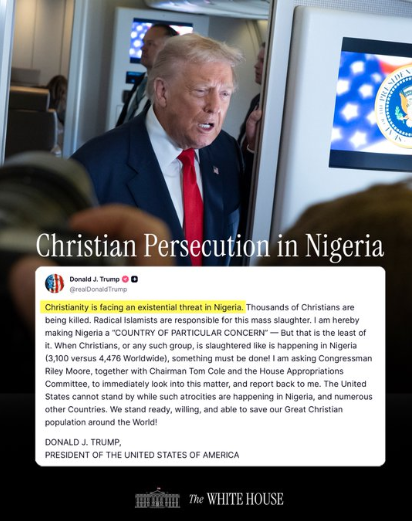
Trump, in a statement posted on his social media platform, Truth Social, said Christianity faced an existential threat in Nigeria, describing the situation as a “mass slaughter” blamed on radical Islamist groups.
“Christianity is facing an existential threat in Nigeria. Thousands of Christians are being killed. Radical Islamists are responsible for this mass slaughter,” the U.S. president wrote.
He declared that Nigeria had officially been placed on the list of Countries of Particular Concern (CPC), adding that the United States “cannot stand by while such atrocities are happening.” Trump stated,
“When Christians, or any such group, are slaughtered like is happening in Nigeria (3,100 versus 4,476 worldwide), something must be done.”
The U.S. president said he had directed Congressman Riley Moore and House Appropriations Committee Chairman Tom Cole to investigate the alleged attacks and report their findings.
“I am hereby making Nigeria a ‘Country of Particular Concern.’ I am asking Congressman Riley Moore, together with Chairman Tom Cole and the House Appropriations Committee, to immediately look into this matter and report back to me,” Trump added.
Trump’s designation reactivates a policy tool under the International Religious Freedom Act, allowing the U.S. government to impose sanctions or take diplomatic action against countries accused of severe violations of religious freedom.
Nigeria was previously placed on the CPC list in 2020 during Trump’s first term but was removed by President Joe Biden’s administration.
The move followed months of lobbying in Washington by conservative lawmakers. Senator Ted Cruz had introduced a bill in September calling for targeted sanctions against Nigerian officials accused of enforcing Sharia and blasphemy laws, while Congressman Moore had urged the U.S. State Department to reinstate Nigeria’s designation.
In the Truth Social post, Trump said the United States “stands ready, willing, and able to save our great Christian population around the world.” He did not, however, cite the sources of the figures referenced in his statement.
The decision has reignited international debate over religious freedom in Nigeria, prompting immediate reaction from Abuja. The Federal Government strongly rejected Trump’s claim, insisting that Nigeria’s conflict with terrorism is not religiously motivated.
Nigeria’s Government Dismisses Claims
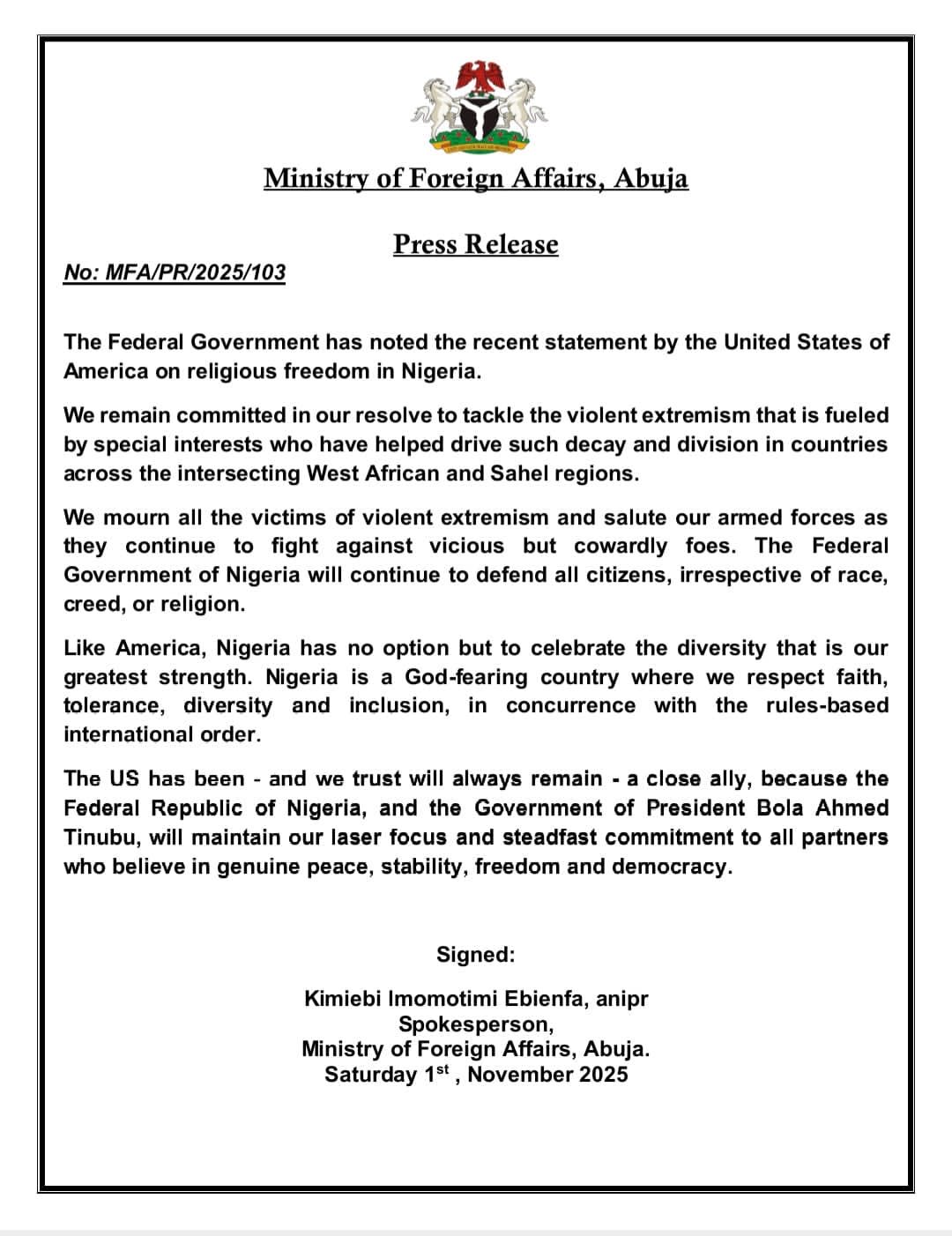
In an official statement signed by Kimiebi Imomotimi Ebienfa, spokesperson for the Ministry of Foreign Affairs, the Nigerian government described Trump’s declaration as “inaccurate and not reflective of the country’s realities.”
The statement read, “While Nigeria appreciates global concern for human rights and religious freedom, these claims do not reflect the situation on the ground. Nigerians of all faiths have long lived, worked, and worshipped together peacefully.
“Under the leadership of President Bola Ahmed Tinubu, Nigeria remains committed to fighting terrorism, strengthening interfaith harmony, and protecting the lives and rights of all its people.”
The ministry said Nigeria would continue to engage with the U.S. government to deepen mutual understanding of regional dynamics and security efforts. “Nigeria will continue to engage constructively with the Government of the United States (US) to deepen mutual understanding of regional dynamics and the country’s ongoing peace and security efforts,” it added.
The Minister of Information and National Orientation, Mohammed Idris, also dismissed the U.S. president’s assertion as “false, baseless, despicable, and divisive.” Idris said portraying Nigeria’s security challenges as a religious conflict was a “gross misrepresentation of reality.”
He stated, “Portraying Nigeria’s security challenges as a targeted campaign against a single religious group is inaccurate and harmful. The federal government strongly condemns and categorically refutes recent allegations by certain international platforms and online influencers suggesting that terrorists operating in Nigeria are engaged in a systematic genocide against Christians.”
According to the minister, extremists in Nigeria have attacked citizens of all faiths without discrimination. “Muslims, Christians, and even non-religious Nigerians have suffered alike,” he said. Idris noted that between May 2023 and February 2025, security forces had killed more than 13,500 terrorists and rescued nearly 10,000 hostages across the country.
He added that the capture of top Ansaru leaders and over 700 convictions of Boko Haram suspects demonstrated Nigeria’s progress in counterterrorism. “These criminals target all who reject their murderous ideology, regardless of faith,” Idris said.
The Nigerian government reiterated that freedom of religion is guaranteed under the Constitution and reaffirmed its commitment to democracy and human rights. “It is doubtful that foreign interlopers are aware that the current heads of both the armed forces and the police are Christians,” Idris noted.
Religious leaders in Nigeria also reacted to Trump’s statement. The Christian Association of Nigeria (CAN) acknowledged that Christian communities had suffered attacks in parts of the country but urged the government to strengthen security responses.
CAN President, Archbishop Daniel Okoh, said, “Our concern remains that these cries for justice and protection are too often met with delay or denial.” He added that the association had consistently documented religiously motivated attacks and appealed to international bodies, including the International Criminal Court, for intervention.
Meanwhile, Trump’s senior adviser on Arab and African affairs, Massad Boulos, who visited President Tinubu in Abuja on October 17, dismissed the notion of a targeted religious genocide in Nigeria. “Those who know the terrain well know that terrorism has no colour, no religion, and no tribe,” Boulos said. He emphasised that extremist groups such as Boko Haram and ISIS have killed people of all faiths, often attacking Muslims more than Christians.
On October 14, the Nigerian Senate also established a 12-member ad-hoc committee to review international claims of Christian persecution. Senate President Godswill Akpabio directed the committee to present a fact-based position paper to guide Nigeria’s diplomatic engagement. “Our findings must be backed with verifiable facts and statistics,” Akpabio said, stressing that the Senate would work with the U.S. Congress to address what it described as misleading narratives about Nigeria’s security situation.
The controversy marks a new chapter in the debate over religious freedom and security policy between Abuja and Washington. While Trump’s announcement reignites international scrutiny, Nigerian authorities insist that terrorism in the country is a complex issue driven by socio-economic and ideological factors, not religion.