
By Joke Kujenya
APPLUCANTS SEEKING asylum, Temporary Protected Status (TPS), or parole in the United States (US) will now face a revised fee structure as the United States Citizenship and Immigration Services (USCIS) rolls out sweeping changes to immigration-related charges effective July 22, 2025.
Announced through a Federal Register notice dated July 18, the new fees form part of immigration reforms under the U.S. law H.R. 1 and will apply worldwide, including to applicants from Nigeria.
USCIS has confirmed that all requests submitted on or after July 22 must include the new fees, which are strictly non-waivable.
Any application postmarked from August 21 onwards without the correct payment will be automatically rejected.
A major shift is the mandatory $100 application fee for Form I-589, which is used to apply for asylum and withholding of removal.
This marks the first time a fee has been attached to the asylum request process.
Additionally, an Annual Asylum Fee (AAF) of $100 will now be charged each year a Form I-589 remains pending.
This recurring charge must be paid online, with individual payment notices issued to each affected applicant.
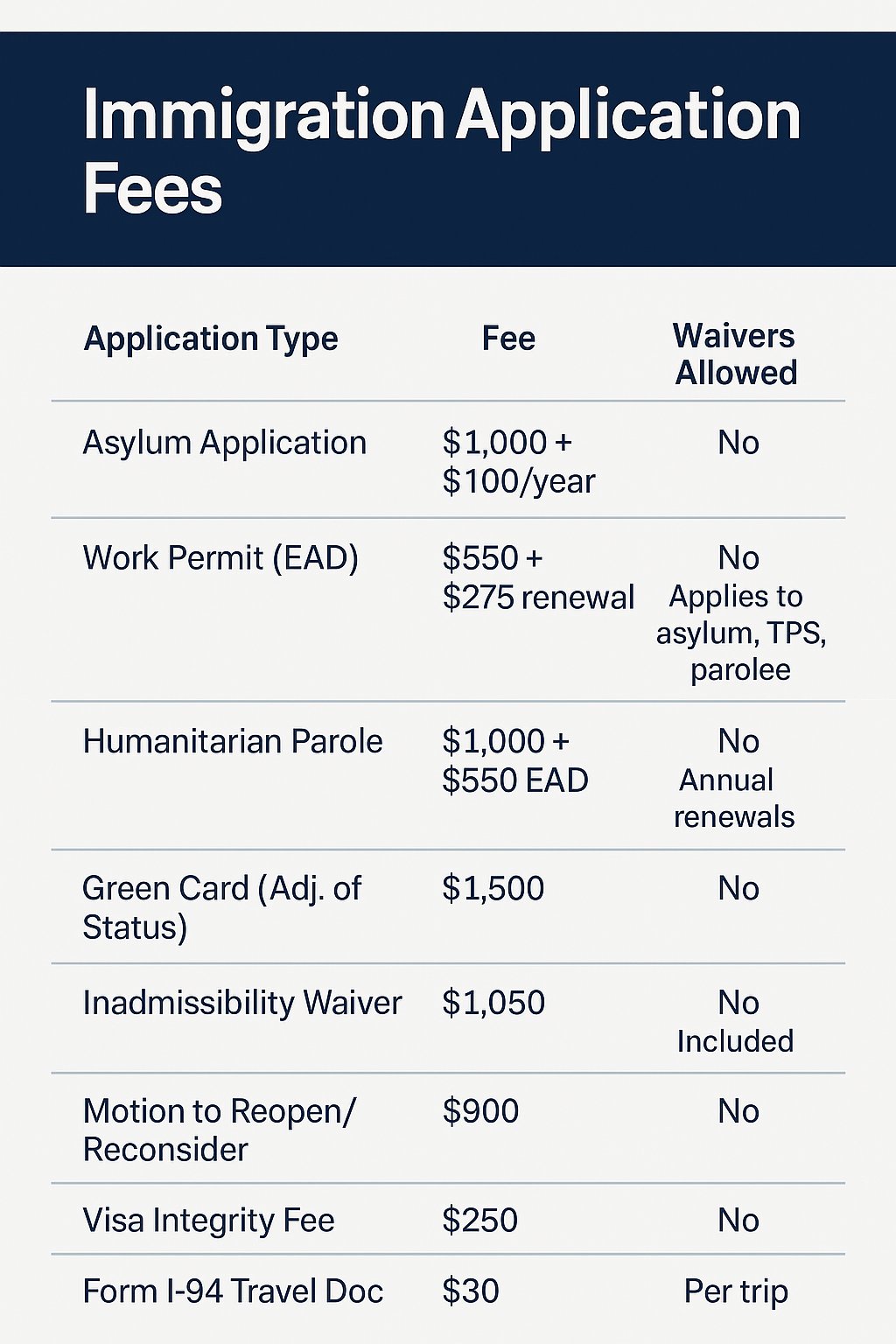
Employment Authorisation Documents (EADs) have also been adjusted under the new schedule.
The fee for an initial EAD application is set at $550, while renewals or extensions will cost $275 for applicants under specific categories—including asylum seekers, parolees, and TPS holders.
Parolees applying through Form I-131 will pay a reduced EAD fee of $275.
Special Immigrant Juvenile (SIJ) applicants filing Form I-360 will now be charged $250, and the TPS registration fee for Form I-821 has surged tenfold from $50 to $500.
All these changes are in addition to the existing fees listed under 8 CFR part 106 and are not eligible for waiver or reduction, even through Form I-912 or other written requests.
Fee adjustments for other USCIS forms, including Form I-102 and further changes to Form I-131, will be announced in future updates to the Federal Register.
Work permit validity will now vary by category. Parolees will receive EADs valid for up to one year or until the end of their parole term—whichever is shorter.
TPS beneficiaries will similarly have EADs capped at one year or the length of their TPS designation.
The updated charges are part of a broader enforcement and cost-recovery framework instituted under H.R. 1, with USCIS stressing that compliance with the new structure is mandatory for all global applicants, effective July 22.