By Esther Olaifa, JKNewsMedia Reporter
MILLIONS OF households risk being priced out of access to an essential resource if water services become increasingly dependent on prepaid meters, commercial tariffs and private operators, the Our Water, Our Right Africa Coalition (OWORAC) has warned, calling for stronger public investment and democratic control of water systems.
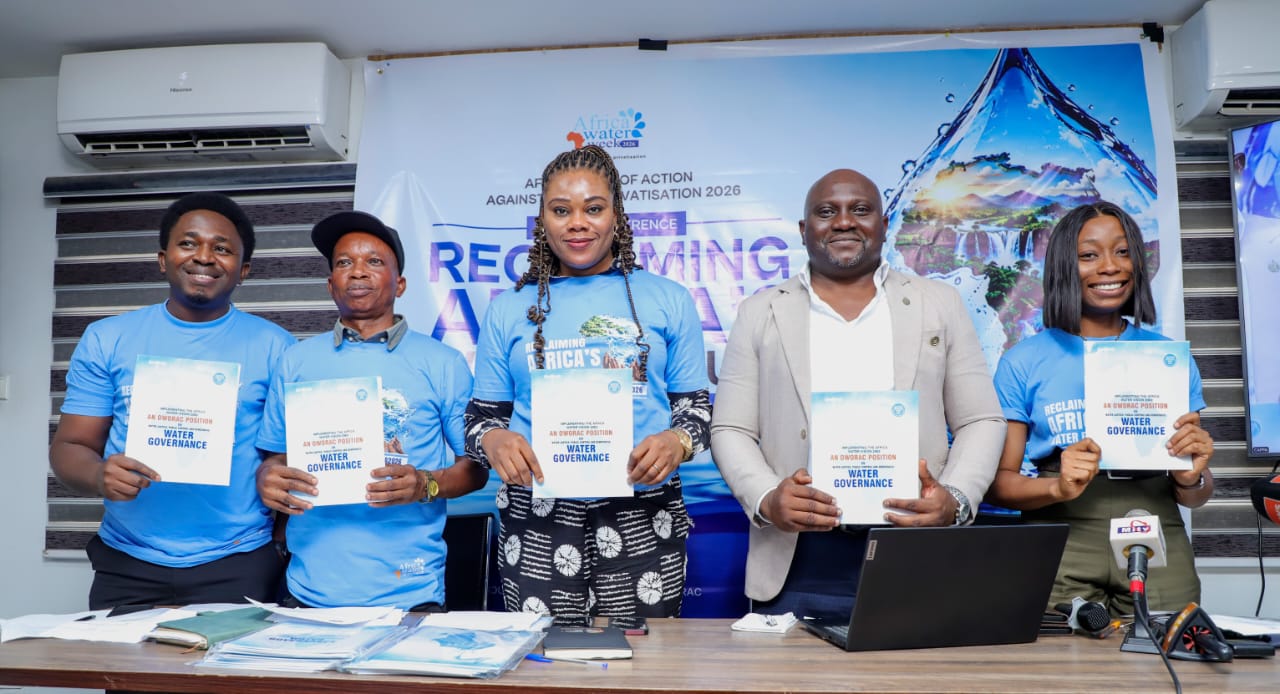
JKNewsMedia.com reports that the coalition made its position clear at a press conference in Ogba, Lagos, on Monday, October 12, 2026, where it demanded a continental financing benchmark to measure governments’ commitments to water and sanitation, while rejecting arrangements that transfer public water services to commercial interests.
OWORAC also demanded that African governments must commit to measurable public investment in water and sanitation, strengthen state-run utilities and reject commercial arrangements that could make access to safe drinking water dependent on household incomes.
They asserted that water must remain a publicly accountable service and a fundamental human right, warning that privatisation, commercial tariffs and prepaid water systems could deepen existing inequalities by denying affordable access to households unable to pay commercial prices.
OWORAC noted that it demands forms part of the Africa Week of Action Against Water Privatisation, which runs from October 12 to 18 under the theme, “Reclaiming Africa’s Water Future: Public Water for All”.
The gathering brought together civil society organisations, community representatives, workers, women, young people, water justice campaigners and journalists to discuss public control of water resources, funding gaps and the need for stronger accountability in the management of water services across the continent.
The coalition also presented its position paper, titled “Implementing the Africa Water Vision 2063: An OWORAC Coalition Position on Water Justice, Public Control and Democratic Water Governance”.
The presented document outlines recommendations for improving water security and sanitation through stronger public institutions, adequate financing, transparent decision-making and meaningful community participation.
Presenting the paper, Holiness Segun Olufemi, Programme Officer, Water Campaign at Corporate Accountability and Public Participation Africa (CAPPA), said the success of the Africa Water Vision 2063 would depend on whether governments translated their commitments into sustained public investment and tangible improvements in access to water.
Olufemi said OWORAC wanted the African Union and national governments to establish a Continental Water and Sanitation Financing Benchmark that would provide a common standard for assessing public spending and progress towards universal access.
She explained that the proposed benchmark must extend beyond budget announcements to examine how much governments allocate to water and sanitation, how much they actually release and spend, the infrastructure they deliver and whether those investments improve affordability, access and service quality.
“Public financing must translate into real outcomes for communities,” she said.
Olufemi stressed that governments must protect water as a human right and public good, adequately fund public water institutions and ensure communities have a meaningful voice in decisions affecting their access to the resource.
“We want an Africa where water is protected as a human right and public good, where public institutions are adequately supported, and where no community is left behind,” she added.
The coalition’s position paper examines opportunities and gaps in implementing the Africa Water Vision 2063, calling for measurable national and regional financing commitments, transparent reporting and an African Water Accountability and Monitoring Mechanism to track progress and hold institutions responsible for their performance.
It also recommends stronger public utilities, inclusive water resources management and safeguards against undue external interference and commercial capture saying it wants communities, workers, women and other affected groups to participate meaningfully in water governance and decisions about water infrastructure, tariffs, financing and service delivery.
OWORAC said governments should reject privatisation, commercialisation, concessions, public-private partnerships, management and lease contracts, outsourcing, prepaid water-meter systems and other arrangements that transfer the control or delivery of public water services to commercial interests.
Executive Director, CAPPA, Akinbode Oluwafemi, urged the African Union (AU) to formulate policies that protect citizens’ rights rather than expose the continent’s resources to corporate control.
He criticised water-metering arrangements that make access conditional on payment, arguing that people without sufficient money could lose access to an essential resource.
Oluwafemi also questioned the treatment of people affected by water-metering systems, urging governments to stop criminalising citizens for seeking their rights and instead fulfil their responsibility to provide clean, accessible water for domestic use.
He maintained that public authorities should put people’s needs ahead of the interests of corporations that seek to profit from water distribution.
The coalition’s position received strong support from labour representatives, who argued that water privatisation had failed to resolve access challenges and that governments could not transfer their public responsibilities to private operators.
National President of the Precision, Electrical and Related Equipment Senior Staff Association (PERESSA), Rufus Olusesan, described public-private participation in the water sector as a ruse, insisting that privatisation would not resolve the crisis facing communities without reliable supplies.
Olusesan drew attention to communities hosting major water infrastructure in Lagos, arguing that residents should not continue to lack adequate supplies while water from their areas serves more privileged neighbourhoods.
“Water should not be purchased. Iju, Adinyan and Ishasi communities that host water works don’t have water, but water from their areas is pumped to Ikoyi and Lekki to serve the privileged few,” he said.
He called for democratic public control of water systems and urged governments to redirect public spending towards water infrastructure rather than concentrating on flyovers and other projects.
Olusesan proposed using recovered looted funds and pension funds for public infrastructure, while calling for an end to repeated contract awards that, he said, had failed to deliver adequate water supplies.
He urged the authorities to repair and rehabilitate the Iju, Adiyan and Ishasi waterworks, complete Adiyan II and construct new mini waterworks to expand access.
The labour leader also highlighted the importance of protecting workers and developing the skills needed to operate and maintain public water systems. He called for the reinstatement of dismissed workers, training for young engineers and an end to casualisation.
He argued that water infrastructure could not function effectively without adequately trained personnel, stressing that a water system without skilled workers was like a hospital without doctors.
JKNewsMedia.com also reports that OWORAC’s concerns also drew on experiences from other African countries, particularly Senegal, where water management has involved private operators for decades.
Oumar Ba, General Secretary of the Autonomous Union of Water Workers of Senegal, said Senegal transferred water management to private operators in 1996 following structural adjustment policies, and stressed that under the arrangement, the government retained responsibility for financing infrastructure while private companies operated water systems.
Ba said Sen’Eau handled urban water distribution and was majority-owned by French multinational Suez, while several multinational companies operated in rural areas.
Despite the arrangements, he said communities continued to complain about inadequate water supplies, poor service quality and high bills. He also raised concerns about workers’ conditions, citing excessive workloads, low wages and poor working environments.
Ba, who previously headed the trade union at Sen’Eau, said his employer dismissed him in December after he stood up for workers’ rights in his capacity as a unionist.
“My employer unfairly dismissed me last December simply because in my capacity as a trade unionist, I stood up with workers’ rights. We are still engaged in legal proceedings to fight this injustice,” he said.
He further alleged that Sen’Eau was testing smart water meters in customers’ homes as a possible precursor to introducing prepaid water services similar to prepaid electricity systems.
Under the proposed arrangement, customers would pay in advance for a specified quantity of water. Once they exhausted the amount purchased, the system would automatically shut off their taps.
Ba warned that such a model would treat water as a commercial commodity rather than a common good essential to life. He argued that water privatisation was not a viable option for communities and called for publicly accountable systems that provide reliable, affordable supplies.
He also cited the recognition of access to water as a universal human right by the United Nations in 2010 and its inclusion in Sustainable Development Goal 6, adopted by the United Nations General Assembly in 2015, which seeks universal access to water and the protection of water resources.
“Water is life, water is a human right, water must remain a common good accessible to all and not a commodity reserved for those who can afford it,” Ba said.
He added that water should be publicly available, affordable, clean and effective for everyone, rather than restricted to people able to pay for prepaid meters.
Anne Maina, National Coordinator of the Biodiversity and Biosafety Association of Kenya, also raised concerns about the introduction of smart water meters in Kenya, particularly their implications for borehole users.
Maina said borehole owners and communities installing the meters faced additional taxes linked to water consumption, while remaining responsible for maintenance and energy costs associated with their boreholes.
She questioned the implications for data privacy, warning that consumers could lose control over information generated by their water use.
Maina said water justice remained a major challenge in Kenya, where communities continued to struggle with access, affordability, quality and governance. She cautioned that technologies introduced in the name of improving water management could influence how people accessed, monitored and paid for the resource.
She called for equitable access, public participation and a strong, publicly accountable water system, while urging greater solidarity among African water justice movements.
Research and Water Campaign Director at Corporate Accountability, Neil Gupta, said the threat of privatisation persisted across Africa despite what he described as well-documented failures involving unaffordable bills, labour abuses and environmental damage.
Gupta criticised multinational water companies, including Veolia and Suez, arguing that corporate interests continued to threaten communities’ access to essential services.
He said public mobilisation remained a crucial counterweight to commercial control and described the campaign to defend the human right to water as a long-term struggle requiring sustained commitment from communities and civil society organisations.
Assistant Executive Director of CAPPA, Zikora Ibeh, also defended the coalition’s continued advocacy, dismissing suggestions that its recurring campaigns had failed to produce results.
“No matter how long governments pretend to be asleep, we will keep waking them. You may say we do this yearly without results; if we stop, they will up their game,” she said.
Geoffrey Occansey of Water Citizens Network and Revenue Mobilisation Africa, Ghana, presented the coalition’s statement and highlighted the tension between the urgent need for investment and the financing models governments choose to pursue.
Occansey said inadequate infrastructure and financing pressures had encouraged approaches such as public-private partnerships, concessions, commercial tariffs, prepaid water systems and increased private-sector participation.
He argued that investment remained essential but warned that arrangements making access dependent on people’s ability to pay before receiving water could worsen existing inequalities.
Occansey said Africa’s water future should not depend on attracting more private investment but on building functioning public water systems that communities could rely on.
He called for stronger public institutions, increased investment in infrastructure and workers, better data and planning systems, protection of public water resources and greater community participation in decisions affecting people’s lives.
He also said OWORAC’s campaign had helped challenge corporate influence in water governance, warning that international financial institutions promoting privatisation continued to pursue their interests even when communities resisted such policies.
Executive Director of Green Scenery in Sierra Leone, Joseph Rahall, said communities across Africa continued to lack access to safely managed water despite the continent’s freshwater resources.
Rahall argued that water should not become a commodity bought and sold for corporate profit, stressing that governments had a responsibility to provide safe and accessible supplies to communities that remained underserved.
He urged journalists to raise public awareness, scrutinise government decisions and hold decision-makers accountable for water access and service delivery.
Associate Director of CAPPA, Olamide Martins, also warned of a looming problem if governments failed to resolve persistent water access challenges. He alleged that some corporate entities were taking pipe-borne water from public systems in his country, depriving thousands of households of access.
The coalition said the scale of the crisis extended beyond individual communities, pointing to global figures showing that 2.1 billion people lacked safely managed drinking water in 2024, while 3.4 billion lacked safely managed sanitation.
In sub-Saharan Africa, 167 million people relied on limited drinking-water services during the same year, accounting for more than half of the global population using services at that level.
OWORAC said low-income households, rural communities and underserved urban and peri-urban settlements faced particularly severe challenges. Where reliable public supplies were unavailable, households often had to depend on unsafe open water sources or purchase supplies from vendors, public standpipes, private boreholes, tankers and packaged-water sellers.
Such alternatives did not always provide reliable assurances of water quality or safety, the coalition said.
It cited research on urban water access in sub-Saharan Africa indicating that low-income households dependent on vendors could pay between 10 and 20 times more per unit of water than wealthier households connected to public networks.
The coalition described the disparity as a poverty penalty, in which people with the lowest incomes could end up paying the highest prices for an essential service.
JKNewsMedia.com also reports that OWORAC attributed the difficulties to a combination of inadequate public investment, rapid urbanisation, population growth and climate pressures, including droughts, flooding and pollution. It argued that governments needed to address these challenges through reliable public infrastructure and accountable financing rather than relying on commercial arrangements that could exclude vulnerable households.
The coalition also called for stronger cross-border cooperation among African water justice movements, workers and civil society organisations to defend public interests and promote more equitable water governance.
It said governments must ensure that water-related contracts, financing agreements, tariffs, allocations and expenditures remained transparent and subject to public scrutiny.
The demands come as the AU has designated 2026 as the Year of “Assuring Sustainable Water Availability and Safe Sanitation Systems to Achieve the Goals of Agenda 2063”, alongside the launch of the Africa Water Vision 2063 and Policy.
The coalition also pointed to the 2026 United Nations Water Conference as an opportunity to advance commitments on water and sanitation, insisting that continental and international declarations must lead to measurable improvements in people’s access to services.
OWORAC said the AU and national governments should establish clear financing targets, report publicly on expenditure and outcomes, strengthen water utilities and create effective mechanisms for communities to monitor progress.
The position statement was signed by the Senegalese Water Justice Network, CAPPA, Amaka Nweke Foundation, Water Citizens Network and Revenue Mobilisation Africa, Disability Not a Barrier Initiative, Cheriehomes Global Initiatives, Christian Initiative For Nation Building, Green Scenery, Voices for Water, the Biodiversity and Biosafety Association of Kenya, and Corporate Accountability (BAKCA).
In its concluding remarks, the coalition maintained that Africa’s water future must be shaped by the needs, rights and voices of the people who depend on water every day, calling for publicly financed, democratically controlled and accountable systems that put human needs ahead of commercial profit.
—

Share Your Story with us!
Advertise with us!
Publicity for a product, service, or event!
Contact: WhatsApp Only: +2348039560647
Email: jkmediapress@gmail.com