By Joke Kujenya
SAFE USE of Artificial Intelligence (AI) requires stronger global cooperation among world leaders, technology companies and other stakeholders, United Nations Secretary General, António Guterres, has said.
JKNewsMedia.com reports that the Secretary General warned that without greater international cooperation, the technology could widen global inequality instead of advancing sustainable development.
He said the unregulated use of AI has direct impacts on the environment, children and weapons systems that are developing at a rapid pace without close human oversight.
He said nations must come together to increase the safety of AI while mitigating its detrimental impacts in four critical areas.
On the environment, Guterres said AI is hungry for land, water and power, while the data centres behind it already consume more electricity than most nations.
“By 2030, they could use more power than all but five countries and enough water to meet the basic needs of all 1.3 billion residents of sub-Saharan Africa for an entire year.”
He said communities are often uninformed about the environmental impact of the infrastructure rising around them.
In response, the Secretary General proposed the AI Environmental Transparency Initiative (AIETI), calling on every major AI company to measure and publicly disclose the full environmental impact of its systems, including carbon, water and land footprints, and to commit to powering every data centre with renewable energy by 2030.
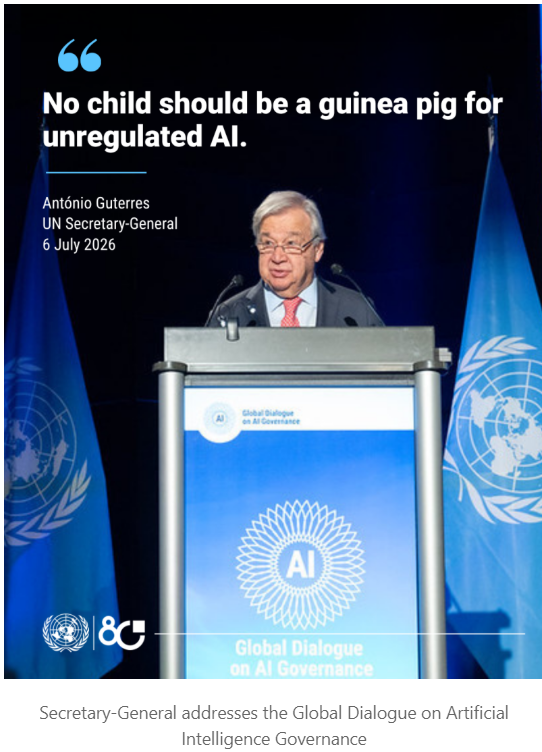
On child safety, Guterres said AI has reached children through their learning, friendships and most private questions before anyone asked what it would do to them.
He called for an AI Child Safety Pledge (ACSP) with three rules for any system a child can reach.
He said no company should deploy an AI system accessible to children without child specific safety testing and independent oversight.
He also said no company should allow its AI to generate sexual images of children and that companies must detect, report and remove them.
He added that when a child shows signs of distress, the system must stop and connect them to real human support.
“When a child is harmed, the answer must never be ‘the algorithm did it’,” he said.
Expressing concern over AI enabled weapons systems, the Secretary General described the taking of human life by AI weapons as “morally repugnant.”
“Some decisions must remain forever human, none more than taking a human life.”
He said machines selecting and engaging their target and taking a life without human control and judgment must be banned by international law.
On human oversight, Guterres said responsible and ethical use of AI requires close cooperation among governments, companies and scientists.
“We may be the last generation able to set the terms on which humanity and machines coexist.”
He said humanity is tasked to help build a future of AI “by humanity, with humanity and for all humanity,” adding that AI governance cannot be governed by a handful of countries or companies because every nation needs a seat at the table.
The Secretary General insisted that any future agreement must be “worthy of global trust” and put safety first.
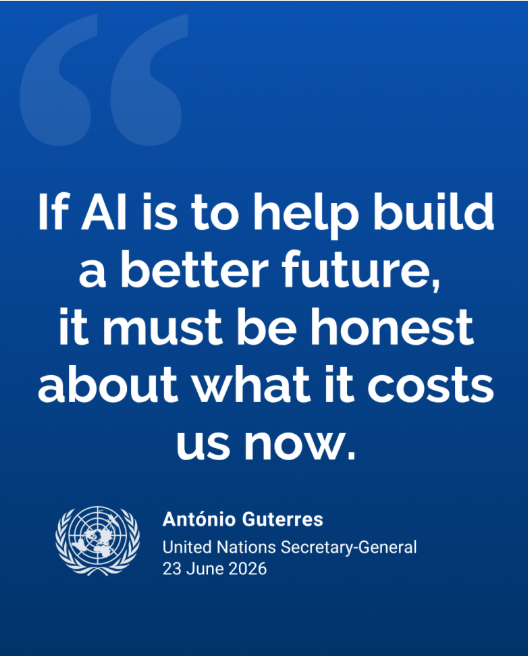
“It is time to come clean. If AI is to help build a better future, it must be honest about what it costs us now. It’s time to come clean,” Guterres said.
—