By Joke Kujenya
MORNING ROUTINES rarely travel beyond the kitchen. A banana is peeled, eaten, and the day moves on. Yet on farms thousands of miles away, the plant that produced that fruit leaves behind a thick, water-heavy trunk, the pseudostem, that may soon reappear as part of a T-shirt, a notebook or even a moulded fruit tray in a supermarket.
JKNewsMedia.com reports across major banana-producing regions, that once-ignored trunk is becoming the centre of a new industrial story.
Mountains Of Residue In The Field
Only a small share of the banana plant becomes food. The rest remains in the field as biomass. Circular agriculture studies show that in some systems, residue can reach about 220 tonnes per hectare after harvest.
Researchers also estimate that banana pseudostems generate tens of millions of tonnes of waste each year in producer countries such as Brazil.
For decades, most of that mass was left to decompose, ploughed back into the soil or treated as waste to be removed. Today, companies and research institutes see something else in it, cellulose.
The stems contain strong cellulosic fibres. Laboratory analyses show that mechanically extracted banana pseudostem fibres can reach tensile strengths of around 570 megapascals, surpassing classic natural fibres such as jute and sisal.
That performance has shifted the material from craft curiosity to industrial candidate.
From Artisan Craft To Factory Floor
Banana fibre has appeared for years in small artisan weaving projects. The shift now is scale and standardisation.
In Brazil, the change became more visible when the Federação das Indústrias do Estado de Santa Catarina (FIESC) highlighted projects developed at the SENAI Institute of Textile Technology, Apparel and Design.
There, researchers have been working to transform banana stem fibre into fabrics suitable for large-scale textile production.
One initiative, Banana Têxtil, advanced to the finals of the BRICS Solutions Awards, demonstrating that cloth made from banana stalks could meet industrial weaving standards rather than remain confined to niche craft markets.
Engineers involved in these projects describe the biggest breakthrough not as the fibre itself, but the organisation of a supply chain.
Farms, transporters and factories are beginning to treat pseudostems as a raw material with quality parameters, traceability and safety routines comparable to other natural fibres.
The Race Against Water And Distance
The process begins close to the farms. Fresh pseudostems are bulky and saturated with water. Transporting them over long distances is costly and increases truck traffic on rural roads, eroding both margins and environmental benefits.
At the plant gate, loads are sorted by size, moisture and condition. Degraded stems produce shorter fibres with more impurities, affecting final strength and texture. That first inspection already shapes the quality of the finished yarn or pulp.
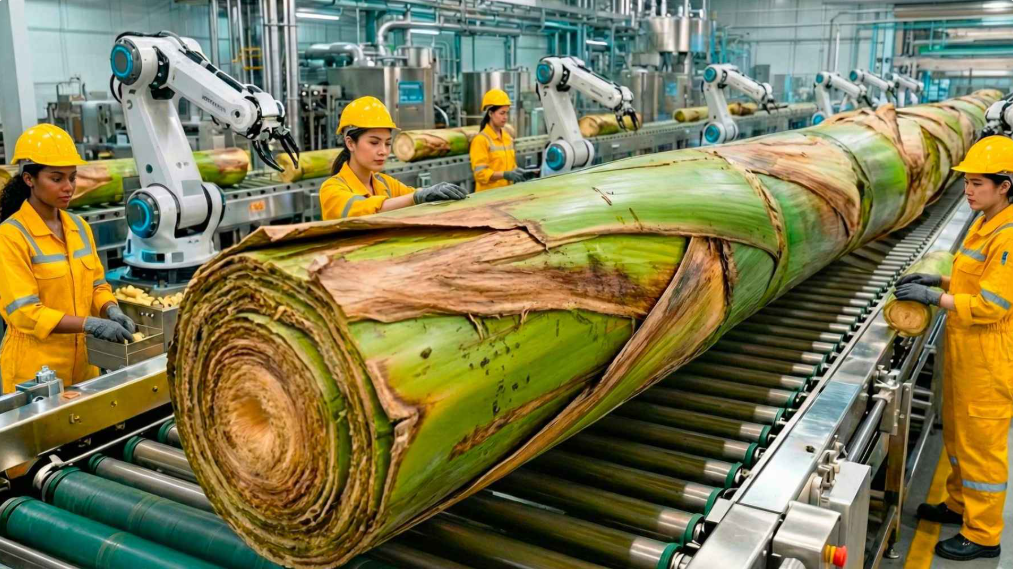
The core of production is mechanical extraction, known as decortication. Rollers and blades scrape and press the pseudostem, separating fibrous strands from the softer pulp.
Technical studies identify this mechanical route as the most viable for industrial scale because it avoids harsh chemicals and delivers fibres that can be aligned and spun.
After extraction comes intensive washing. Removing residual pulp reduces odour and improves the feel of the fibre, but it also consumes significant water.
Plants aiming for long-term viability invest in recirculation systems and wastewater treatment to limit environmental impact and keep costs predictable.
Drying follows under controlled conditions. Researchers have found that temperature during drying influences physical and mechanical properties, meaning factories treat it as a calibrated process rather than simply leaving fibres in the sun.
Quality teams monitor average length, moisture content, impurity levels and, in more advanced operations, strength parameters.
For textile mills and paper plants, consistency is critical. Buyers want banana fibre that behaves the same way in every batch.
Beyond clothing: Paper and Packaging
Textiles attract the most attention. Blended yarns combining banana fibre with cotton and other materials are already being woven into fabrics for clothing and home textiles in Brazil and other producer countries.
But the value chain extends further. Trials in alternative pulp and paper are moving from laboratory sheets to pilot lines.
A recent open-access study tested thermomechanically extracted pseudostem fibre mixed with gum Arabic to mould fruit packaging boards.
In several mechanical tests, the boards performed as well as or better than recycled paper pulp trays, although they showed higher water absorption.
The pulp and sap left behind after decortication are not automatically waste. They can be converted into compost, solid fertiliser, biogas or liquid fertilisers.
Experiments combining banana pseudostem residue with microbial mixes suggest it can provide nutrients while helping farmers reduce reliance on synthetic inputs.
Managers involved in these operations are blunt: the environmental and financial case only works if most fractions of the biomass find a use.
Otherwise, factories risk replacing one waste problem with another – soggy residue, odours and runoff that nearby communities must contend with.
A circular ambition with limits
JKNewsMedia.com reports that industry experts caution that banana pseudostem fibre will not replace synthetic fibres across the textile sector.
Logistics, farmer training and wastewater management remain weak points in many projects. Scaling up without undermining environmental gains is an ongoing challenge.
Still, the direction is clear. Instead of burning or abandoning banana trunks after harvest, producers are testing ways to channel that biomass into textiles, paper and packaging all products that can eventually biodegrade or return to the soil.
For consumers, the change may go unnoticed. The label on a shirt or the feel of a fruit tray will not always tell the full story.
Yet, behind those everyday objects, a quiet rethinking of agricultural “waste” is unfolding one banana stem at a time.

Original study was published in Packaging Technology and Science.