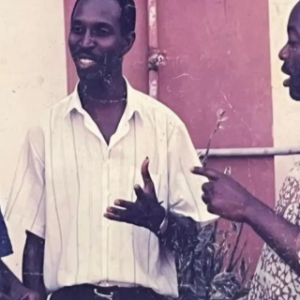
By Olukorede Yishau
AROLAKE LUNGES at Saro and, in one swift motion, bares her breasts, igniting an almost uncontrollable reaction in him. Their desire flares quickly, hands tracing the contours of femininity and masculinity.
This scene in Kunle Afolayan’s ‘Anikulapo’, particularly the exposure of breasts, sparked conversation among viewers, with some arguing that there was no need for Bimbo Ademoye, who played Arolake, to reveal so much.
What many did not realise, or what many found out later, is that what appears on screen is not real. The effect is the work of visual artistry created by Hakeem Effect, whose real name is Hakeem Onilogbo.
You do not watch a film and say, “Ah, that is Hakeem Effect’s work.” Instead, you flinch at a wound, believe a transformation, accept a character as real. His success lies in disappearing into the story.
I have watched two interviews where Hakeem spoke about himself, his work, his family, his philosophy. The latest, and the most detailed, is available on Dele Adeyanju’s Agbaletu YouTube channel.
Some of the things he said in the interview, especially the part about hearing from some celestial forces, tug at the belief that our world is deeply spiritual and the more we look the less we see. There are so many parts of this universe we will never decipher.
Based on his works and the Agbaletu interview, I came to the conclusion that Hakeem is one of those artists whose genius is measured not by how often they are seen, but by how convincingly they make others believable. His brilliance has brought him out of the shadows.
He is a quiet conjurer in an industry addicted to spectacle. To speak of Nollywood’s evolution without mentioning him is to tell a story with missing bones.
He was not born into glamour. Born in Ibadan in 1978 to an Abeokuta indigene working as a salesman to a pharmaceutical giant, Onilogbo’s journey into special effects makeup did not begin with a formal classroom or a polished studio. It began, as many Nigerian success stories do, with hunger—literal and metaphorical. Hunger to survive. Hunger to create. Hunger to be more than the circumstances that hemmed him in.
After his father lost his job with the pharmaceutical company, the family moved to Abeokuta. With no job, there was a limit to the luxury available, and Hakeem had to learn the hard way. A diviner told his father he had no glory and it looked like he was right when he found himself either as a houseboy, or on the streets of Lagos, or in a brothel’s bar, or in cellars where he inhaled second-hand smoke and perhaps ended up consuming more smoke than the individual smokers around him.
He ‘stumbled’ on sign-writing and in a matter of time became a pro and was renowned within the Akowonjo-Egbeda suburbs of Lagos. A government policy killed his sign-writing career and to movie making, a vocation he had fallen in love with as a kid in Ibadan and Abeokuta, he turned to.
Without the privilege of structured training in special effects, he turned to instinct. Faces became his canvases. Imagination, his curriculum. And to sit in his chair is to surrender your face, your identity, to another person’s vision. It requires trust, it requires vulnerability and when it works, it creates magic, magic that makes audiences forget they are watching a performance.
By 2008, he had found his way into Yoruba-language movie, those often underfunded productions that nonetheless pulse with raw storytelling energy. It was here, in the trenches of Yoruba Nollywood, that he began to sharpen his craft—learning not just how to apply makeup, but how to deceive the eye, how to create illusion, how to elevate deception into art.
He set about changing the conversation in an industry mocked for its technical limitations. He did not merely apply makeup; he engineered transformations. We see blood that looked disturbingly real, wounds that made audiences wince and faces that could age, morph, or even cross racial lines under his careful manipulation.
He knows that audiences forgive many things, but they rarely forgive bad illusion. If the blood looks fake, the story collapses. If the scars are unconvincing, the pain feels hollow. And so, he insisted on raising standards.
Half in awe, half in disbelief, it is said that he could turn “a black person white” for a movie.
In time, his name has become synonymous with excellence in special effects makeup across the industry. Through his company, Tricks International, he created not just a business but a pipeline of possibility. Here was a space dedicated to prosthetics, special effects, and the kind of technical artistry that Nollywood had long outsourced or ignored. It was a statement that Nigerian stories deserved Nigerian craftsmanship of global quality.
He has been honoured with the Africa Movie Academy Awards and the Africa Magic Viewers Awards. Not once, but repeatedly. From 2016 till date, he has been crowned Africa’s Best Makeup Artist, a recognition that spoke not just to his talent but to his consistency.
His imprints are all over films like ‘King of Boys’, ‘Omo Ghetto: The Saga’, and ‘The Milkmaid’. He also put his magic on Kunle Afolayan’s ‘Anikulapo’, Femi Adebayo’s ‘Jagun Jagun’, Funke Akindele’s ‘Behind The Scene’, ‘Shanty Town’ and ‘Black Book’. These are projects that signal Nollywood’s growing confidence on the global stage.
I celebrate this raw talent for his defiance of the traditional narrative. There is no prestigious film school in the background, no apprenticeship under a Hollywood master, but just experimentation, failure, iteration and the stubborn refusal to accept that excellence must be imported. He is the definition of improvisation as innovation.
My final take: Hakeem Onilogbo’s story, in the long run, is not just about makeup. It is about possibility, about what happens when talent meets tenacity, about what happens when imagination refuses to be constrained, about what happens when a young man decides that the limits of his environment will not define the scope of his vision.
Quote
Hakeem Onilogbo’s story, in the long run, is not just about makeup. It is about possibility, about what happens when talent meets tenacity, about what happens when imagination refuses to be constrained, about what happens when a young man decides that the limits of his environment will not define the scope of his vision.
Box
What ‘ina kwana’ started
For Obafemi Kadri Hamzat, the path now being cleared with quiet deliberateness began with a greeting, simple, misplaced, almost comic.
The story: Over two decades ago, Bola Tinubu, then Lagos State governor, met a young Kadri Hamzat in America, leaned on the easy crutch of assumption and said, “ina kwana.”
It was a cultural misfire, but also in retrospect, an introduction of consequence. For beneath that brief exchange was the first flicker of a relationship that would stretch into the long corridors of influence.
Today, Hamzat stands at the threshold of something larger.
Around him, the heavyweights are gathering in that careful choreography Lagos politics has perfected. Governor Babajide Sanwo-Olu, whose own journey rode on the currents of endorsements, has offered more than passing nods. Ex-Governor Babatunde Raji Fashola, the technocrat of measured words, has lent his voice in ways that matter. And in Abuja, ex-House of Representatives Speaker, who is President Tinubu’s Chief of Staff, Femi Gbajabiamila, stands as both ally and amplifier.
The members of the Governance Advisory Council, which kicked off the process, signed, sealed and delivered it on Tuesday with the declaration of Hamzat as the consensus candidate. These are not casual names. They are pillars in a structure where succession is rarely accidental. Their convergence around Hamzat speaks loud.
True to form, Hamzat remains the quiet centre of it all. No flamboyance, no desperate reach for the microphone. Just the studied calm of a man who understands that, in Lagos, power often arrives not with a bang, but with a series of soft, decisive footsteps.
And so, the “ina kwana” greeting lingers, echoing from a past that seemed trivial.
—
Do you have a news tip for JKNewsMedia.com? Please copy and email us at jkmediapress@gmail.com.