By Olukorede Yishau
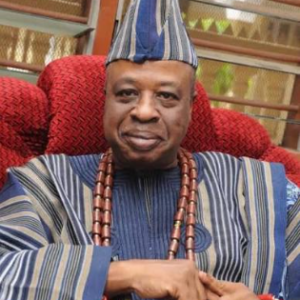
In life, fortune romanced Adebayo Alao-Akala like a loyal consort. Politics, not the badge of his police years, adorned him with gold and laughter. It was in the corridors of Oyo State’s power, first by robbing Rasidi Ladoja, and later by the ‘will’ of the people, that his cup ran over. His days as governor dripped with bounty; the kind of opulence that lets a man rinse his fingers in rare wine and banish want with a finger’s snap.
But when death knocked, as it does for kings and commoners alike, it asked no permission and made no exemptions. The once-bustling lion of Ogbomoso was lowered into the earth, wrapped not in silks or accolades, but in the humility of white shrouds. The ground, unhurried and ancient, went to work, first stealing the raiment, then the flesh, until all that remained were the bare, whispering relics of what once lived: bones and teeth.
It is these bones, those mute witnesses of his passage, that Oluwatoyin Alao-Aderinto, his first child, now seek to summon, not in memory, but in litigation. She is urging the law to exhume what remains of her father for a paternity test on herself and six others who bear his name: Olamijuwonlo, now a lawmaker; Olamide, Adebukola, Olamipo, Tabitha, and Olamikunle. Seven children supposedly bound by blood and now by a contested legacy.
At the heart of this unfolding soap opera are properties, many amassed during his reign as governor. Some erroneously blame the brouhaha on the fact that when he died on January 12, 2022, he left this world with no written instruction, no map to guide his children through the forest of his estate.
By October of that year, the first seeds of discord bloomed. His widow, Kemi, and her daughter, Olamide, secured a Letter of Administration from the Oyo State Probate Registry. They did so quietly, without Oluwatoyin’s knowledge or consent. And since then, the drums of war have been beating.
As we await the court’s judgment on whether the bones will speak and clear or cloud the names etched on the family tree, my thoughts drift to two other families turned apart when wealth defeats wisdom.
The first family is that of the legendary legal mind, Timi the Law, FRA Williams, one that proves that will is no guarantee of peace after a patriarch’s demise. He knew the cost of silence so he left a will. He had only one wife, and with her four sons: Ladi (of blessed memory), Kayode, Folarin, and Tokunbo.
Yet even with the clarity of paperwork, his death cracked open a chasm. Love faltered and brotherhood frayed. The house that had once held the promise of legal brilliance became a haunted echo of quarrels unresolved. When Ladi died in 2021 of COVID-19 complications, the wounds had not healed and, to this day, the air in that lineage is thick with the ashes of unspoken things.
The second family is that of Olorogun Michael Ibru, another instance where a child sought a paternity test to determine who should get inheritance.
I particularly remember an incident a year after the passing of the visionary who built the Ibru Organisation from the dust of humble beginnings into a formidable empire. That Wednesday, family members gathered at St. Andrew’s Anglican Church, Agbarha-Otor in Ughelli North, Delta State, for a memorial service in his honour.
Among those present were his only surviving brother, Chief Goodie Ibru; his sons, Oscar and Gabriel; daughters-in-law, and other relatives. But while hymns echoed through the ancient arches of the church and prayers were offered in remembrance, a quieter tension hung in the air, one that not even the most solemn liturgy could mask.
It was no accident that the Bishop of the Ughelli Diocese, Rt. Rev. Dr. Cyril Odutemu, used the occasion to preach about unity. His voice rose, almost pleading: “Allow Olorogun Michael Ibru to live on. Conquer self and let the life of this man be your mirror. In the history of Urhobo, who else shared their wealth so generously with brothers, sisters, even those only related by path? Everything he had, he gave freely. But be warned: this wealth can be sustained if you are sustained, or vanish like mist if you fall apart.”
The priest obviously was speaking against the backdrop of the fact that six months after the patriarch’s passing, fault lines erupted into full-blown fractures.
The father of these feuding children was not born into comfort. His father, Peter Ibru, was a missionary and nursing superintendent at Igbobi Orthopedic Hospital. His mother, Janet, sold fish in the creeks to keep the family afloat. Michael’s path to greatness was paved not with privilege, but grit.
He only began formal secondary education at age 18, but quickly distinguished himself, leaping from elementary school straight into Secondary Class Two at Igbobi College, and graduating with distinction in the Cambridge School Certificate.
In 1951, he joined the United African Company (UAC) as a trainee manager, but by 1956, he struck out on his own. At 24, he co-founded Laibru with expatriate partner Jimmy Large.
One year later, he entered a then-overlooked market: frozen fish. It was a bold and ridiculed move. Competitors scoffed, calling his imports “mortuary fish.” But Ibru had vision, and more importantly, perseverance. He built cold storage facilities, secured import channels, and slowly won the trust of a growing customer base.
By the mid-1960s, he was a millionaire. By the 1970s, he controlled 60 per cent of the frozen fish market with turnover exceeding N90 million. He scaled beyond fish diving into transportation, palm oil, breweries, banking (Oceanic Bank), aviation (Aero Contractors), and insurance (Minet Nigeria).
His company, Ibafon Oil, was another testament to his reach. His trawlers fished the Atlantic, while his footprints dotted Apapa, Victoria Island, London, and beyond.
Ibru, who in 1983, tried to govern Bendel State but lost to Samuel Ogbemudia, kept family at the centre of his world, elevating his siblings, sponsoring their education, and giving them stakes in his ventures.
During his 80th birthday celebration, Oskar proudly declared, “We grew up as a team… like a bunch of broomsticks.” That was despite Ibru having children from five women. So how did these tightly bound broomsticks fall apart?
The trigger? A legal war. At the centre was Oboden Ibru, a former Oceanic Bank executive, who approached the Igbosere High Court in Lagos seeking recognition that all 16 children, regardless of maternal lineage, were entitled to equal shares of their father’s estate. Oboden also wanted an order that he, Oskar, Christiana, and Jero be appointed administrators.
But not all siblings agreed. Janet Ibru, through her affidavit, urged the court to restrict inheritance to only those who could scientifically prove their paternity via U.S.-based diagnostic testing. She also sought reimbursement of $48,000 in legal fees spent defending their father during his final years.
My final take: Estates don’t keep families together, hearts do. What balm can soothe when wealth outlives wisdom because fathers, who built empires in stone, failed in chiselling peace into the hearts of their children? Let every man, every patriarch, teach their children that unity is not born of shared blood alone; it is nurtured by shared love, mutual respect, and the humility to put the whole above the self.
Quote
Estates don’t keep families together, hearts do. What balm can soothe when wealth outlives wisdom because fathers, who built empires in stone, failed in chiselling peace into the hearts of their children? Let every man, every patriarch, teach their children that unity is not born of shared blood alone; it is nurtured by shared love, mutual respect, and the humility to put the whole above the self.