By JKNewsMedia
CROSS-BORDR trade is expanding across Africa, but businesses still face payment challenges that can affect cash flow, supply schedules and regional growth.
JKNewsMedia.com reports that the Nigerian businesses sourcing fabrics from Ghana, pharmaceutical products from Kenya, or serving customers in countries such as Rwanda and Zambia increasingly need payment systems that can support commercial relationships across the continent.
The African Continental Free Trade Area (ACFTA) is supporting this momentum by creating a framework for deeper economic integration, wider market access and increased trade among African countries.
Farmers, traders, cooperatives, commodity aggregators and small businesses are also using digital platforms and structured networks to connect with regional opportunities.
Yet. identifying an opportunity is only part of the process. Businesses also need to pay suppliers, settle invoices and receive proceeds efficiently.
Traditional cross-border payment routes can require foreign currency, intermediary banks, multiple currency conversions, additional costs and longer processing periods.
The Pan-African Payment and Settlement System, commonly known as PAPSS, is designed to address some of these challenges by facilitating secure, efficient and near-instant transactions between participating African countries.
Under the system, a Nigerian customer can initiate an eligible payment in Naira while the beneficiary receives the equivalent value in the applicable local currency.
This reduces the need to source United States dollars or euros for eligible transactions within Africa, while also reducing avoidable currency conversions and reliance on correspondent banks outside the continent.
For Nigerian businesses, the model can simplify payments, support faster settlement and provide greater visibility over transaction costs.
Through Fidelity Bank Plc, PAPSS transfers can be completed in 120 seconds, subject to applicable requirements and the receiving market. The speed can help businesses respond to supplier payment requests, protect agreed delivery timelines and move from negotiation to execution more efficiently.
A release issued on the development noted that the service covers a range of legitimate personal and commercial payment needs. Business owners can make eligible payments to suppliers, distributors, service providers and other commercial partners, while parents and guardians can make eligible school-related payments.
Individuals can also use PAPSS for approved family support and other permitted transactions across supported African corridors.
For businesses involved in regional trade, faster cross-border payments can support more predictable cash flow, stronger supplier relationships and improved operational planning.
Manufacturers can settle eligible invoices more efficiently when awaiting raw materials, while retailers importing products from other African countries can reduce the inconvenience associated with sourcing foreign currency.
Exporters can also receive eligible payments in Naira for goods sold across Africa, subject to applicable regulatory and export procedures.
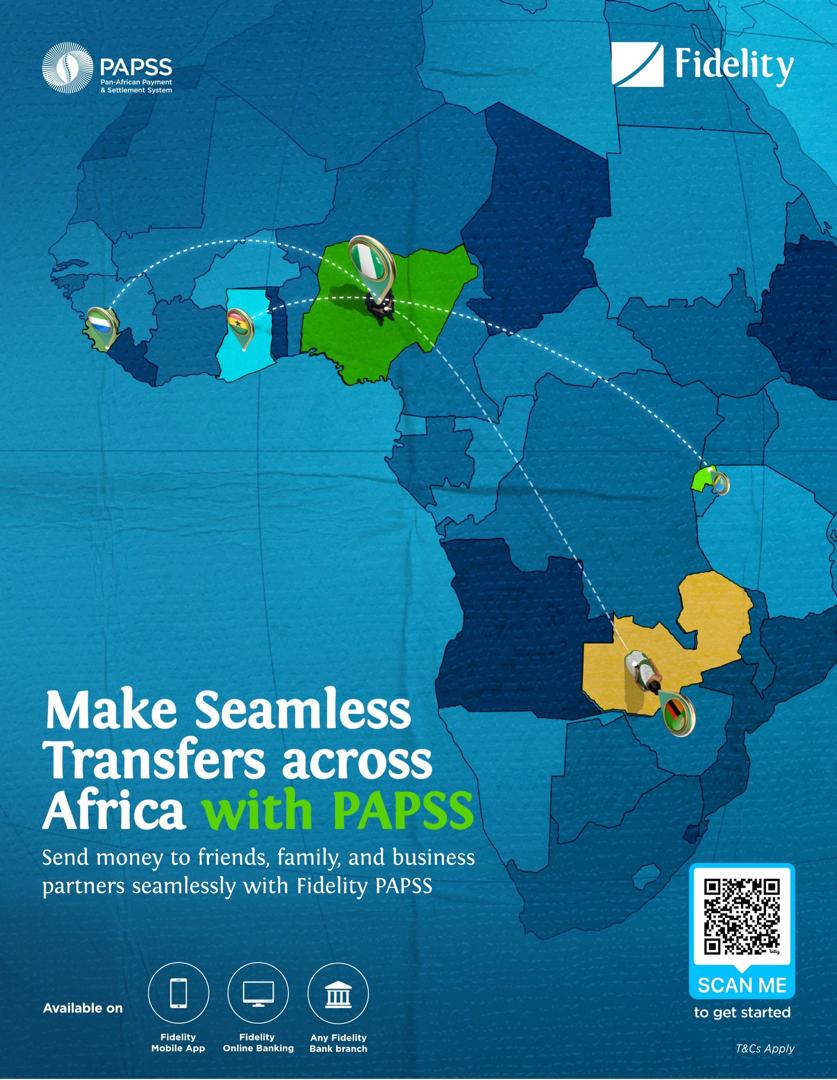
Fidelity Bank offers access to PAPSS through its Fidelity Mobile App, Fidelity Online Banking and its branch network. Customers can also seek assistance from Relationship Managers or visit a branch for guidance on applicable documentation and transaction requirements.
The bank onboarded PAPSS in September 2024 and recorded more than N46 billion in transactions during the early adoption phase before its official launch in August 2025. PAPSS also identified Fidelity Bank as one of the first Nigerian banks to meet the relevant integration requirements.
The bank has since extended PAPSS access across its digital channels and branches, allowing customers to initiate transactions through Fidelity Mobile App and Fidelity Online Banking, while customers seeking assisted service can visit a branch.
Security remains a central part of the payment process, with transactions authenticated and processed through a formal banking channel. Applicable validation, compliance and regulatory checks form part of the process, while customers are required to ensure that beneficiary information, transaction purposes and supporting documents are complete and accurate before initiating a transfer.
The growing use of PAPSS reflects the increasing digital connectivity of African commerce. Businesses using digital tools to discover suppliers, coordinate transactions and reach customers need payment infrastructure capable of supporting that connectivity.
PAPSS is currently live in 19 countries and connects more than 160 commercial banks and over 15 national switches, according to TechCabal.
For Nigerian businesses seeking to participate in regional trade, Fidelity Bank’s PAPSS service provides access to eligible cross-border payments through digital banking channels and its nationwide branch network.
Customers can send money in Naira to selected African countries, with beneficiaries receiving the applicable value in their local currencies. Transactions remain subject to supported corridors, applicable requirements, limits, charges, regulations, terms and conditions.
—