By Jemimah Wellington, JKNewsMedia Correspondent
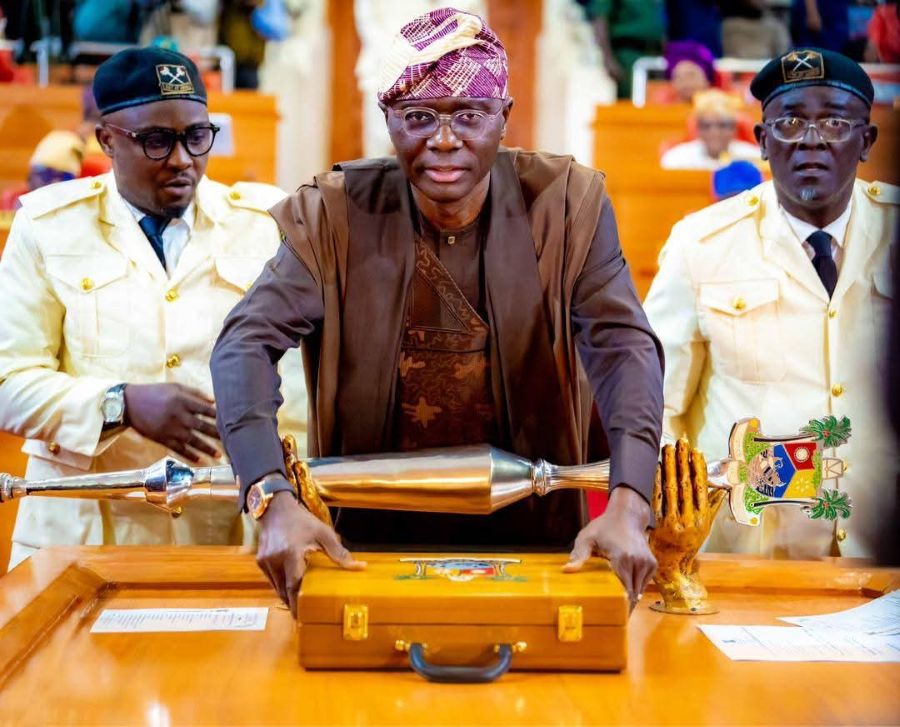
THE 2026 FISCAL year will see a major expansion as the Lagos State government presented its N4.237trillion ‘Budget of Shared Prosperity’ proposal to the House of Assembly.
Marking an increase of over N1 trillion compared with the 2025 budget of N3.005trillion, Governor Babajide Sanwo-Olu outlines the state’s revenue, expenditure, and sectoral priorities for the coming year.
He stated that the proposed budget comprises total revenue of N3.993 trillion and deficit financing of N243.332 billion.
The revenue streams include internally generated revenue (IGR) of N3.119 trillion and federal transfers of N874 billion, according to the governor.
The budget allocates N2.185 trillion to capital expenditure and N2.055 trillion to recurrent expenditure.
Recurrent expenditure, covering overheads, personnel costs, and debt servicing, includes N698.891 billion for overheads, N201.216 billion for subventions, and N184.139 billion for dedicated expenditures, bringing total overhead costs to N1.084 trillion.
Personnel costs total N440.449 billion, while debt servicing comprises N143.876 billion for recurring debt charges and N383.404 billion for debt repayment.
Sectoral allocations reflect state priorities, with N847.472 billion for general public services, N147.040 billion for public order and safety, and N1.372 trillion for economic affairs.
The environment is assigned N235.957 billion, housing N123.760 billion, health N338.449 billion, and education N249.132 billion.
Recreation and culture receive N54.682 billion, and social protection is allocated N70.024 billion.
Governor Sanwo-Olu described these allocations as aligning with the administration’s focus on infrastructure, human capital development, and social welfare.
The governor’s address before the 40-member legislature, presided over by Speaker Mudashiru Obasa, began at 1:25pm and unveiled the proposal under the title “Budget of Shared Prosperity.”
He emphasised that the 2026 budget aims to deepen inclusive growth and ensure that development benefits all residents.
“Our mission remains clear: to eradicate poverty and build a Lagos that works for all,” Sanwo-Olu said.
He outlined four strategic pillars underpinning the proposal: a human-centred approach, modern infrastructure, a thriving economy, and good governance.
The presentation highlighted the performance of the 2025 budget, with the governor noting that by the third quarter of 2025, the state had implemented N2.056 trillion of the N2.525 trillion prorated estimate.
Capital expenditure reached N1.238 trillion, representing 90 per cent of the prorated estimate, while actual recurrent expenditure stood at N818.577 billion, or 84 per cent of the projected estimate.
Security measures were heightened at the Assembly complex during the presentation. Officers from the police, Nigeria Security and Civil Defence Corps, and Lagos State Neighbourhood Safety Corps were stationed at major entry points.
Members of the state executive council, local government chairmen, traditional rulers, and invited guests attended the session.
Speaker Obasa highlighted the budget’s sectoral priorities, including healthcare, education, transportation, security, and governance.
He commended the 2025 budget’s implementation, noting its positive outcomes in these areas, and pledged meticulous scrutiny of the proposed N4.237 trillion plan.
“We have all listened with rapt attention to how the wealth of our state will be utilised for our common good in 2026. The responsibility now lies with this Honourable House to meticulously perform our constitutional duty,” Obasa said.
The governor outlined the budget as a continuation of Lagos’ growth trajectory, highlighting that annual appropriations have risen from N1.1 trillion in 2021 to N4.237 trillion in 2026, including N1.75 trillion in 2022, N1.76 trillion in 2023, N2.26 trillion in 2024, and N3.366 trillion in 2025.
He stated that the 2026 proposal reaffirms Lagos’ development foundations and seeks to complete ongoing projects.
Governor Sanwo-Olu emphasised that the budget is designed to expand access to quality education, strengthen healthcare delivery, widen social protection, and accelerate affordable housing.
Urban renewal, waste management, and flood resilience will also be prioritised, with specific attention to women, youth, older persons, and persons with disabilities.
On infrastructure, the governor said the state would focus on integrating existing roads, rail lines, waterways, energy systems, and digital networks.
He noted that major projects would be pushed to completion, drainage systems expanded, and smart city solutions advanced to improve connectivity, traffic management, housing, and public service delivery.
The proposal includes measures to accelerate economic growth, strengthen micro, small, and medium enterprises (MSMEs), promote circular economy initiatives, support startups, and foster innovation across sectors.
Investments in agribusiness, manufacturing, technology, creative industries, and tourism aim to create jobs and boost competitiveness, according to the governor.
Governor Sanwo-Olu stated that good governance is central to development, with plans to deepen fiscal reforms, expand e-governance, automate fiscal systems, and enhance transparency across ministries, departments, and agencies.
Security and emergency readiness remain priorities, with continued investment in citizen engagement and coordination.
The governor acknowledged the House of Assembly as a dependable partner, praising the legislature’s oversight and cooperation.
He also commended the Lagos State Civil Service for executing government policies across ministries, departments, and agencies, translating objectives into results.
Appreciation was extended to the Lagos State chapter of the All Progressives Congress for providing the political platform for governance.
The budget presentation is the last full-year plan of Governor Sanwo-Olu’s administration, marking a pivotal period for consolidating achievements.
He described the investments in people, infrastructure, social systems, and governance as deliberate, inclusive, and future-focused.
Speaker Obasa highlighted legislative contributions to governance and citizen engagement.
He referenced the recently passed University of Medicine and Health Sciences Law, 2025, establishing the Lagos State School of Health Science and Medicine.
The law aims to retain healthcare professionals in the state, reducing the brain drain of skilled workers.
Obasa reaffirmed the need for the proposed budget to match the aspirations of Lagosians, enhance economic resilience, improve welfare, strengthen security, and deliver enduring infrastructure.
He stated that the state’s strength relies on unity, careful planning, and inclusive policies, emphasising that governance works best when citizens are actively engaged.
The proposed N4.237 trillion budget will undergo legislative scrutiny before approval, with both the executive and legislative branches affirming their commitment to inclusive and accountable governance.